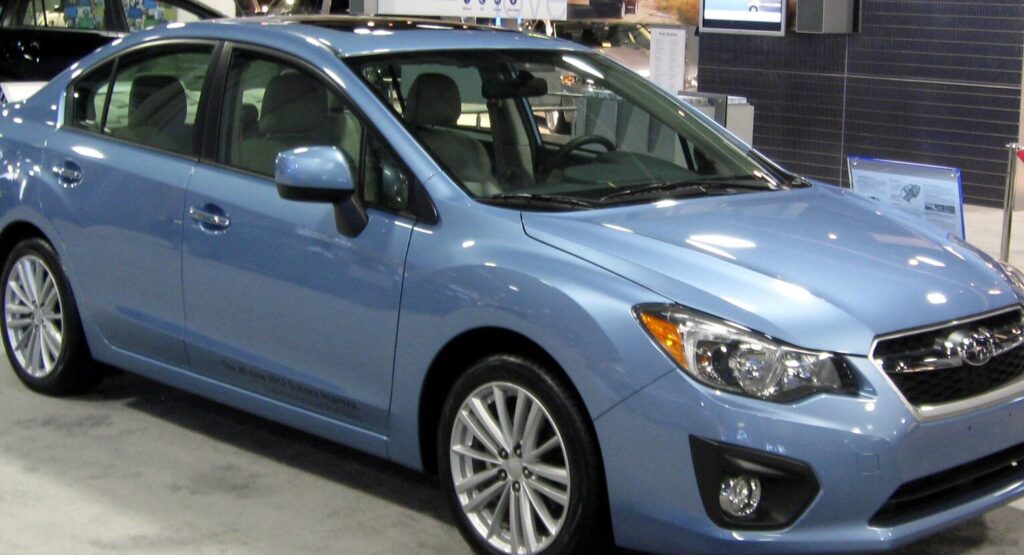
The Subaru Impreza IV Sedan 2.0i Sport, produced between 2011 and 2015, represented a significant evolution in Subaru’s compact car lineup. Positioned as a mid-range offering within the fourth generation (GE/GH/GR/GV) Impreza series, this variant combined Subaru’s renowned symmetrical all-wheel drive system with a 2.0-liter boxer engine and a continuously variable transmission (CVT), marketed as Lineartronic. This model aimed to balance fuel efficiency with the all-weather capability expected of a Subaru, appealing to a broad customer base seeking a practical and reliable sedan. It was a key model for Subaru in markets where sedans were preferred over hatchbacks, and it served as a stepping stone towards the more modern Impreza that followed.
Technical Specifications
| Brand | Subaru |
| Model | Impreza |
| Generation | Impreza IV Sedan |
| Type | 2.0i sport (150 Hp) AWD Lineartronic |
| Start of production | 2011 |
| End of production | 2015 |
| Powertrain Architecture | Internal Combustion engine |
| Body type | Sedan |
| Seats | 5 |
| Doors | 4 |
| Fuel consumption (urban) | 10.6 l/100 km (22.2 US mpg) |
| Fuel consumption (extra urban) | 6 l/100 km (39.2 US mpg) |
| Fuel consumption (combined) | 7.6 l/100 km (30.9 US mpg) |
| Fuel Type | Petrol (Gasoline) |
| Acceleration 0 – 100 km/h | 11.1 sec |
| Acceleration 0 – 62 mph | 11.1 sec |
| Acceleration 0 – 60 mph | 10.5 sec |
| Maximum speed | 197 km/h (122.41 mph) |
| Weight-to-power ratio | 9.3 kg/Hp |
| Weight-to-torque ratio | 7.1 kg/Nm |
| Power | 150 Hp @ 6200 rpm |
| Torque | 196 Nm @ 4200 rpm (144.56 lb.-ft. @ 4200 rpm) |
| Engine layout | Front, Longitudinal |
| Engine Model/Code | FB20 |
| Engine displacement | 1995 cm3 (121.74 cu. in.) |
| Number of cylinders | 4 |
| Engine configuration | Boxer |
| Cylinder Bore | 84 mm (3.31 in.) |
| Piston Stroke | 90 mm (3.54 in.) |
| Compression ratio | 10.5:1 |
| Number of valves per cylinder | 4 |
| Fuel injection system | Multi-port manifold injection |
| Engine aspiration | Naturally aspirated engine |
| Valvetrain | DOHC |
| Engine oil capacity | 4.8 l (5.07 US qt | 4.22 UK qt) |
| Coolant capacity | 7.7 l (8.14 US qt | 6.78 UK qt) |
| Kerb Weight | 1400 kg (3086.47 lbs.) |
| Trunk (boot) space | 460 l (16.24 cu. ft.) |
| Fuel tank capacity | 55 l (14.53 US gal | 12.1 UK gal) |
| Length | 4580 mm (180.31 in.) |
| Width | 1740 mm (68.5 in.) |
| Height | 1465 mm (57.68 in.) |
| Wheelbase | 2645 mm (104.13 in.) |
| Front track | 1510 mm (59.45 in.) |
| Rear track | 1515 mm (59.65 in.) |
| Minimum turning circle | 10.6 m (34.78 ft.) |
| Drive wheel | All wheel drive (4×4) |
| Front suspension | Independent type McPherson |
| Rear suspension | Double wishbone |
| Front brakes | Ventilated discs |
| Rear brakes | Disc |
| Tires size | 205/50 R17 |
| Wheel rims size | 7J x 17 |
Powertrain & Engine Architecture
The heart of the Impreza 2.0i Sport was the FB20 2.0-liter horizontally-opposed (boxer) four-cylinder engine. This engine was a key component of Subaru’s efforts to improve fuel efficiency and reduce emissions. The FB series engines, replacing the older EJ series, featured a square bore and stroke (84mm x 90mm) and a higher compression ratio of 10.5:1. The FB20 utilized multi-point fuel injection and a double overhead camshaft (DOHC) valvetrain with four valves per cylinder. This configuration contributed to a relatively smooth power delivery and decent responsiveness. Paired with this engine was Subaru’s Lineartronic CVT, a continuously variable transmission designed to maximize fuel economy by keeping the engine operating in its most efficient range. The Lineartronic featured simulated “shift points” to provide a more familiar driving experience for those accustomed to traditional automatic transmissions.
Driving Characteristics
The 150 horsepower and 144.56 lb-ft of torque produced by the FB20 engine, when coupled with the Lineartronic CVT, resulted in a driving experience focused on smoothness and efficiency rather than outright performance. Acceleration from 0-60 mph took around 10.5 seconds, which was adequate for everyday driving but noticeably slower than Impreza models equipped with a manual transmission or the more powerful 2.5-liter engine. The CVT’s programming prioritized fuel economy, sometimes resulting in a slight delay in response when accelerating quickly. However, the symmetrical all-wheel drive system provided excellent traction and stability in various weather conditions, a hallmark of the Subaru brand. The CVT’s continuously variable ratios allowed the engine to stay within its optimal power band, making highway cruising comfortable and relatively quiet.
Equipment & Trim Levels
The 2.0i Sport trim level offered a good balance of features and value. Standard equipment typically included alloy wheels, a rear spoiler, keyless entry, power windows and locks, and a basic audio system with auxiliary input. Interior upholstery was usually cloth, with a functional and straightforward dashboard layout. Optional extras often included a sunroof, upgraded audio system with Bluetooth connectivity, and heated front seats. The Sport trim was positioned above the base Impreza 2.0i but below the more premium 2.5i models, offering a step up in features without the higher price tag.
Chassis & Braking
The Impreza IV Sedan utilized a MacPherson strut front suspension and a double-wishbone rear suspension, providing a comfortable ride and predictable handling. The all-wheel drive system distributed power to all four wheels, enhancing traction and stability. Braking duties were handled by ventilated discs at the front and solid discs at the rear. Anti-lock braking system (ABS) was standard, providing enhanced stopping power and control during emergency braking situations. The suspension tuning was geared towards comfort and everyday usability, rather than aggressive cornering.
Market Reception & Comparison
The Impreza 2.0i Sport with the Lineartronic CVT received mixed reviews. Critics generally praised the car’s fuel efficiency, all-wheel drive capability, and comfortable ride. However, the CVT was often criticized for its lack of responsiveness and the engine’s relatively modest power output. Compared to the 2.5i models, the 2.0i Sport offered lower running costs but sacrificed performance. Compared to manual transmission versions of the 2.0i, the CVT provided greater convenience but reduced driver engagement. Fuel economy figures of around 30.9 US mpg combined were competitive for the segment at the time.
Legacy
The FB20 engine and Lineartronic CVT proved to be generally reliable powertrains, although some owners reported minor issues with the CVT over time, such as occasional shuddering or hesitation. The Impreza IV Sedan 2.0i Sport remains a relatively affordable and practical used car option today. Its all-wheel drive system and reputation for reliability continue to appeal to buyers seeking a dependable and capable compact sedan. While not a performance standout, this variant offered a compelling combination of fuel efficiency, practicality, and all-weather capability, solidifying the Impreza’s position as a popular choice in the compact car market.