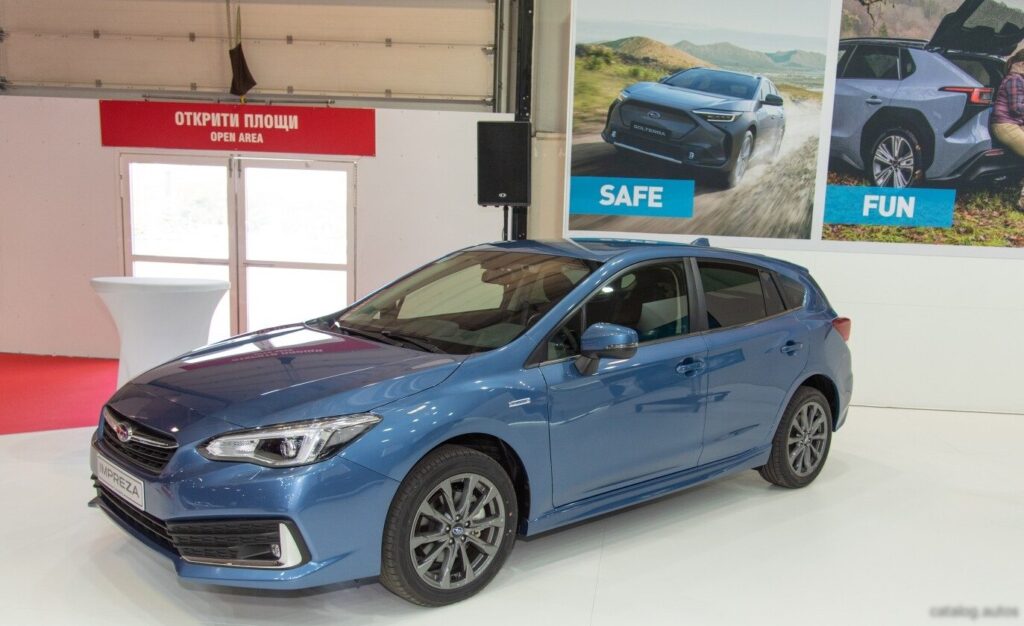
The Subaru Impreza V Hatchback, specifically the 2.0ie e-Boxer variant with the Lineartronic continuously variable transmission (CVT) and all-wheel drive, was produced from 2020 to 2023. This model represents a significant evolution of the Impreza line, incorporating Subaru’s EyeSight driver-assist technology and a mild-hybrid powertrain to enhance fuel efficiency and reduce emissions. Positioned as a mid-range offering within the fifth-generation Impreza (introduced in 2016 and facelifted in 2020), it aimed to provide a balance between affordability, practicality, and Subaru’s signature all-weather capability. The “e-Boxer” designation signifies Subaru’s first foray into electrified powertrains for the Impreza, marking a shift towards greater environmental consciousness.
Technical Specifications
| Brand | Subaru |
| Model | Impreza |
| Generation | Impreza V Hatchback (facelift 2020) |
| Type (Engine) | 2.0ie e-Boxer (150 Hp) AWD Lineartronic |
| Start of production | 2020 |
| End of production | 2023 |
| Powertrain Architecture | MHEV (Mild Hybrid Electric Vehicle) |
| Body type | Hatchback |
| Seats | 5 |
| Doors | 5 |
| Fuel consumption (urban) | 7.2 l/100 km (32.7 US mpg) |
| Fuel consumption (extra urban) | 5.8 l/100 km (40.6 US mpg) |
| Fuel consumption (combined) | 6.3 l/100 km (37.3 US mpg) |
| CO2 emissions | 143 g/km |
| Fuel Type | Petrol (Gasoline) |
| Acceleration 0 – 100 km/h | 10.0 sec |
| Acceleration 0 – 62 mph | 10.0 sec |
| Acceleration 0 – 60 mph | 9.5 sec |
| Maximum speed | 192 km/h (119.3 mph) |
| Emission standard | Euro 6d-ISC-FCM |
| Weight-to-power ratio | 10.1 kg/Hp |
| Weight-to-torque ratio | 7.8 kg/Nm |
| Electric motor power | 17 Hp |
| Electric motor Torque | 66 Nm (48.68 lb.-ft.) |
| Engine Power | 150 Hp @ 5600-6000 rpm |
| Engine Torque | 194 Nm @ 4000 rpm (143.09 lb.-ft. @ 4000 rpm) |
| Engine layout | Front, Longitudinal |
| Engine Model/Code | FB20 |
| Engine displacement | 1995 cm3 (121.74 cu. in.) |
| Number of cylinders | 4 |
| Engine configuration | Boxer |
| Cylinder Bore | 84 mm (3.31 in.) |
| Piston Stroke | 90 mm (3.54 in.) |
| Compression ratio | 12.5:1 |
| Number of valves per cylinder | 4 |
| Fuel injection system | Direct injection |
| Engine oil capacity | 4.2 l (4.44 US qt | 3.7 UK qt) |
| Coolant capacity | 7.8 l (8.24 US qt | 6.86 UK qt) |
| Kerb Weight | 1515-1536 kg (3340 – 3386.3 lbs.) |
| Max. weight | 2050 kg (4519.48 lbs.) |
| Max load | 514-535 kg (1133.18 – 1179.47 lbs.) |
| Trunk (boot) space (minimum) | 340 l (12.01 cu. ft.) |
| Fuel tank capacity | 48 l (12.68 US gal | 10.56 UK gal) |
| Max. roof load | 80 kg (176.37 lbs.) |
| Permitted trailer load (braked) | 1070 kg (2358.95 lbs.) |
| Permitted trailer load (unbraked) | 750 kg (1653.47 lbs.) |
| Permitted towbar download | 80 kg (176.37 lbs.) |
| Length | 4475 mm (176.18 in.) |
| Width | 1775 mm (69.88 in.) |
| Width (including mirrors) | 2019 mm (79.49 in.) |
| Height | 1515 mm (59.65 in.) |
| Wheelbase | 2670 mm (105.12 in.) |
| Front track | 1540 mm (60.63 in.) |
| Rear track | 1545 mm (60.83 in.) |
| Ride height (ground clearance) | 135 mm (5.31 in.) |
| Minimum turning circle | 11.6 m (38.06 ft.) |
| Front brakes | Ventilated discs |
| Rear brakes | Ventilated discs |
| Gearbox | automatic transmission Lineartronic |
Powertrain & Engine Architecture
The heart of the 2.0ie e-Boxer Impreza is the FB20 2.0-liter horizontally-opposed (Boxer) four-cylinder engine. This engine benefits from direct fuel injection, optimizing combustion efficiency and power delivery. The “e-Boxer” system integrates a small electric motor directly into the Lineartronic CVT. This motor doesn’t directly power the wheels but provides assistance during acceleration and smooths out engine restarts after the Start & Stop system engages. The electric motor draws power from a compact lithium-ion battery located under the rear seats. The Lineartronic CVT itself is programmed to simulate stepped gear changes, offering a more engaging driving experience than traditional CVTs. The engine produces 150 horsepower at 5600-6000 rpm and 194 Nm (143 lb-ft) of torque at 4000 rpm.
Driving Characteristics
The 2.0ie e-Boxer with the Lineartronic transmission delivers a comfortable and refined driving experience. While not particularly sporty, the powertrain provides adequate acceleration for everyday driving situations. The CVT effectively manages engine speed to maximize fuel efficiency, and the electric motor assist provides a noticeable boost during initial acceleration. Compared to the manual transmission versions of the Impreza, the Lineartronic offers smoother gear changes but sacrifices some driver engagement. The all-wheel-drive system provides excellent traction in various weather conditions, a hallmark of Subaru vehicles. The CVT’s programming prioritizes fuel economy, meaning the engine can sometimes feel strained during aggressive acceleration.
Equipment & Trim Levels
The 2.0ie e-Boxer typically came well-equipped, often including standard features such as Subaru’s EyeSight driver-assist system (including adaptive cruise control, lane departure warning, and automatic emergency braking), a touchscreen infotainment system with Apple CarPlay and Android Auto compatibility, automatic climate control, and power windows and locks. Interior upholstery was typically cloth, with options for leather upgrades. Higher trim levels added features like a premium audio system, heated front seats, and a power-adjustable driver’s seat. Exterior features included alloy wheels, automatic headlights, and a rear spoiler.
Chassis & Braking
The Impreza V Hatchback utilizes a MacPherson strut front suspension and a double-wishbone rear suspension, providing a comfortable ride and predictable handling. The chassis is reinforced for improved rigidity, enhancing stability and responsiveness. Braking duties are handled by ventilated disc brakes on all four wheels, providing ample stopping power. Anti-lock braking system (ABS) and electronic brakeforce distribution (EBD) are standard features. The suspension tuning is geared towards comfort rather than outright sportiness, prioritizing a smooth ride over aggressive cornering.
Market Reception & Comparison
The 2.0ie e-Boxer Impreza was generally well-received by critics, who praised its fuel efficiency, standard safety features, and all-weather capability. However, some reviewers noted that the powertrain lacked the excitement of more powerful Impreza variants, such as those equipped with the 2.5-liter engine. Compared to the standard 2.0-liter Impreza, the e-Boxer offered improved fuel economy thanks to the mild-hybrid system. Reliability reports have been generally positive, with the FB20 engine proving to be a durable and dependable unit. The Lineartronic CVT, while generally reliable, requires regular fluid changes to ensure optimal performance.
Legacy
The 2.0ie e-Boxer Impreza represents an important step in Subaru’s electrification strategy. While a mild-hybrid system, it paved the way for more advanced hybrid and electric vehicles in the Subaru lineup. On the used car market, these Imprezas are often sought after for their fuel efficiency and standard safety features. The FB20 engine’s reputation for reliability makes these models a relatively safe bet for buyers seeking a dependable and practical compact hatchback. Proper maintenance, including regular CVT fluid changes, is crucial to ensure the long-term health of the powertrain.