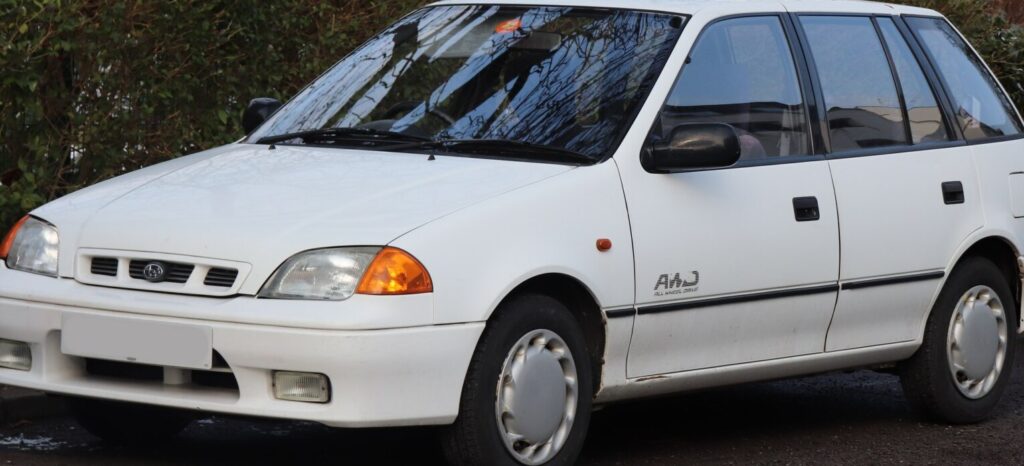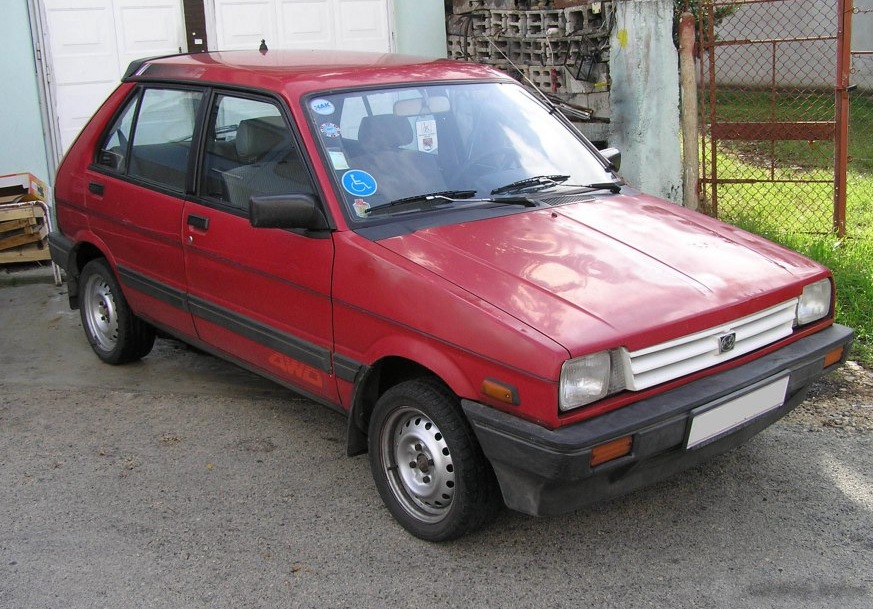
The Subaru Justy I, specifically the 1000 4WD (KAD-A) 3-door variant, was produced between 1990 and 1994. This model represented Subaru’s entry into the burgeoning European microcar market, and offered all-wheel drive – a Subaru hallmark – in a very compact and affordable package. Positioned as the base model within the Justy range, the KAD-A offered a practical and economical transportation solution, particularly appealing to first-time buyers or those seeking a nimble city car. It was built on the KAD platform, a front-engine, front-wheel-drive (with available all-wheel drive) layout designed for maximizing interior space within a small footprint.
Technical Specifications
| Brand | Subaru |
| Model | Justy |
| Generation | Justy I (KAD) |
| Type | 1000 4WD (KAD-A) (3 dr) (50 Hp) |
| Start of production | 1990 |
| End of production | 1994 |
| Powertrain Architecture | Internal Combustion engine |
| Body type | Hatchback |
| Seats | 5 |
| Doors | 3 |
| Fuel consumption (urban) | 7.5 l/100 km (31.4 US mpg, 37.7 UK mpg, 13.3 km/l) |
| Fuel consumption (extra urban) | 5.5 l/100 km (42.8 US mpg, 51.4 UK mpg, 18.2 km/l) |
| Fuel consumption (combined) | 7.5 l/100 km (31.4 US mpg, 37.7 UK mpg, 13.3 km/l) |
| Fuel Type | Petrol (Gasoline) |
| Acceleration 0 – 100 km/h | 17.3 sec |
| Acceleration 0 – 62 mph | 17.3 sec |
| Acceleration 0 – 60 mph | 16.4 sec |
| Maximum speed | 140 km/h (86.99 mph) |
| Weight-to-power ratio | 16.5 kg/Hp, 60.6 Hp/tonne |
| Weight-to-torque ratio | 10.9 kg/Nm, 92.1 Nm/tonne |
| Power | 50 Hp @ 6000 rpm |
| Power per litre | 50.2 Hp/l |
| Torque | 76 Nm @ 3600 rpm (56.05 lb.-ft. @ 3600 rpm) |
| Engine layout | Front, Transverse |
| Engine Model/Code | J10 |
| Engine displacement | 997 cm3 (60.84 cu. in.) |
| Number of cylinders | 3 |
| Engine configuration | Inline |
| Cylinder Bore | 78 mm (3.07 in.) |
| Piston Stroke | 69.6 mm (2.74 in.) |
| Compression ratio | 9.5:1 |
| Number of valves per cylinder | 2 |
| Fuel injection system | Carburettor |
| Engine aspiration | Naturally aspirated |
| Valvetrain | OHC |
| Engine oil capacity | 2.8 l (2.96 US qt | 2.46 UK qt) |
| Coolant capacity | 4.6 l (4.86 US qt | 4.05 UK qt) |
| Kerb Weight | 825 kg (1818.81 lbs.) |
| Max. weight | 1250 kg (2755.78 lbs.) |
| Max load | 425 kg (936.96 lbs.) |
| Trunk (boot) space – minimum | 158 l (5.58 cu. ft.) |
| Trunk (boot) space – maximum | 1000 l (35.31 cu. ft.) |
| Fuel tank capacity | 35 l (9.25 US gal | 7.7 UK gal) |
| Length | 3695 mm (145.47 in.) |
| Width | 1535 mm (60.43 in.) |
| Height | 1420 mm (55.91 in.) |
| Wheelbase | 2285 mm (89.96 in.) |
| Front track | 1330 mm (52.36 in.) |
| Rear track | 1290 mm (50.79 in.) |
| Minimum turning circle | 9.8 m (32.15 ft.) |
| Drive wheel | All wheel drive (4×4) |
| Number of gears | 5 gears, manual transmission |
| Front suspension | Spring Strut |
| Rear suspension | Wishbone |
| Front brakes | Ventilated discs |
| Rear brakes | Drum |
| Assisting systems | ABS (Anti-lock braking system) |
| Steering type | Steering rack and pinion |
| Tires size | 145/80 R12 S |
Powertrain & Engine Architecture
The heart of the Justy KAD-A was the Subaru J10 engine, a 997cc inline three-cylinder petrol engine. This engine utilized a single overhead camshaft (OHC) valvetrain with two valves per cylinder. Notably, it employed a carburetor for fuel delivery, a relatively archaic system by the early 1990s, but one that contributed to its affordability. The J10 produced 50 horsepower at 6000 rpm and 76 Nm (56 lb-ft) of torque at 3600 rpm. The engine was transversely mounted in the front of the vehicle. The transmission was a five-speed manual, providing reasonable control over the limited power output. The all-wheel-drive system was a part-time system, engaging the rear wheels when traction was needed, enhancing stability in slippery conditions.
Driving Characteristics
The 1.0L engine and 5-speed manual combination resulted in leisurely, rather than exhilarating, performance. Acceleration to 60 mph took around 16.4 seconds, and top speed was limited to 140 km/h (87 mph). The gear ratios were tuned for economy, meaning the engine needed to be revved to extract the most performance. Compared to potential upgrades like a larger 1.3L engine available in other Justy models, the KAD-A felt noticeably slower. However, the all-wheel-drive system provided a surefooted feel, particularly on loose surfaces, making it a surprisingly capable vehicle in inclement weather. The light weight of the car (825 kg) helped to mitigate the lack of outright power.
Equipment & Trim Levels
The KAD-A was the entry-level Justy, and as such, it featured a fairly basic level of equipment. Standard features included cloth upholstery, a simple dashboard layout, and manual windows and door locks. Power steering was not standard, contributing to a direct, if somewhat heavy, steering feel. Optional extras included a sunroof, upgraded stereo, and different wheel covers. The interior was designed for practicality, with durable materials and a focus on maximizing space within the small cabin.
Chassis & Braking
The Justy KAD-A utilized a relatively simple chassis design. Front suspension consisted of MacPherson strut springs, while the rear employed a wishbone setup. The front brakes were ventilated discs, providing adequate stopping power, while the rear brakes were drums. ABS (Anti-lock Braking System) was available as an option, enhancing safety. The relatively narrow tires (145/80 R12) contributed to fuel efficiency but limited grip in dry conditions.
Market Reception & Comparison
The Justy KAD-A was generally well-received as an affordable and practical city car. Critics praised its all-wheel-drive system and compact size, but noted its lack of power and basic interior. Compared to other small cars of the era, such as the Fiat Cinquecento or the Renault Twingo, the Justy offered the advantage of all-wheel drive, but at the cost of performance and refinement. Fuel economy was respectable for the time, averaging around 31.4 US mpg in combined driving. Reliability was generally good, although the carburetor required periodic maintenance.
Legacy
The Subaru Justy I, including the KAD-A variant, holds a niche position in automotive history as a pioneering example of a small, affordable all-wheel-drive car. While not known for blistering performance, its practicality, reliability, and unique drivetrain made it a popular choice for those seeking a capable and economical vehicle. Today, the Justy KAD-A is becoming increasingly sought after by collectors and enthusiasts, particularly those interested in Japanese domestic market (JDM) cars and the early days of all-wheel-drive technology. The J10 engine, while simple, is relatively robust, and parts availability remains reasonable, making it a viable classic car for those willing to undertake some maintenance.