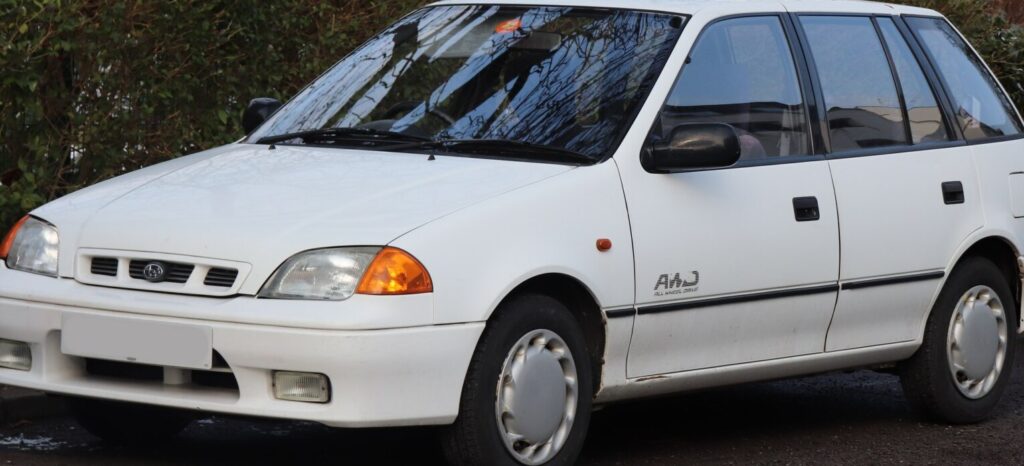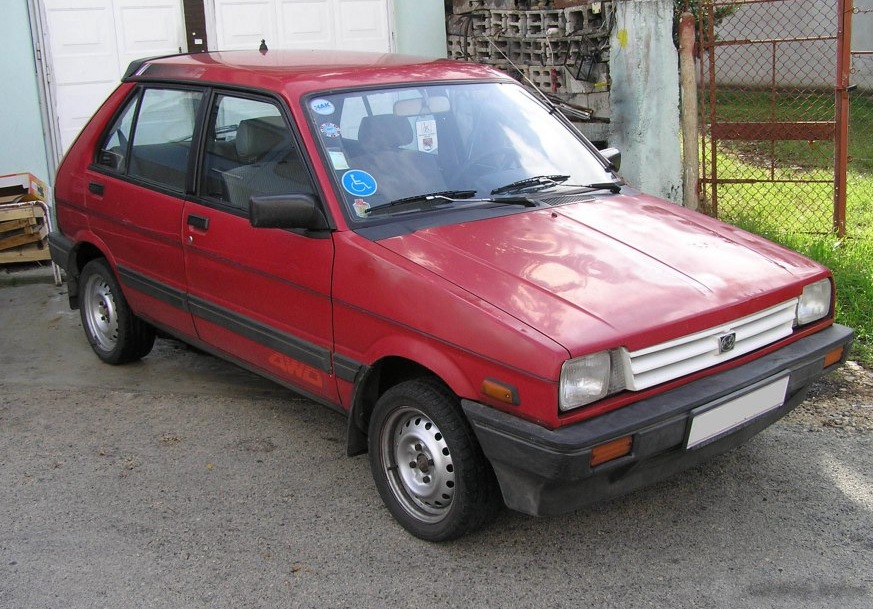
The Subaru Justy I, internally designated the KAD series, was a small, economical hatchback produced by Subaru from 1983 to 1989. The 1000 4WD (KAD-A) 3-door variant, powered by a 55 horsepower engine, represented an entry-level offering within the Justy range. Positioned as a practical and affordable vehicle, the Justy aimed to provide all-wheel-drive capability in a compact package, a hallmark of Subaru’s engineering philosophy. This first generation Justy was significant for being one of the first Kei car-sized vehicles to be offered with standard four-wheel drive, broadening its appeal beyond the Japanese domestic market.
Technical Specifications
| Brand | Subaru |
| Model | Justy |
| Generation | Justy I (KAD) |
| Type | 1000 4WD (KAD-A) (3 dr) (55 Hp) |
| Start of production | 1983 |
| End of production | 1989 |
| Powertrain Architecture | Internal Combustion engine |
| Body type | Hatchback |
| Seats | 5 |
| Doors | 3 |
| Fuel consumption (urban) | 7.2 l/100 km (32.7 US mpg, 39.2 UK mpg, 13.9 km/l) |
| Fuel consumption (extra urban) | 6.8 l/100 km (34.6 US mpg, 41.5 UK mpg, 14.7 km/l) |
| Fuel consumption (combined) | 7.2 l/100 km (32.7 US mpg, 39.2 UK mpg, 13.9 km/l) |
| Fuel Type | Petrol (Gasoline) |
| Acceleration 0 – 100 km/h | 15.5 sec |
| Acceleration 0 – 62 mph | 15.5 sec |
| Acceleration 0 – 60 mph | 14.7 sec |
| Maximum speed | 140 km/h (86.99 mph) |
| Weight-to-power ratio | 13.6 kg/Hp, 73.3 Hp/tonne |
| Weight-to-torque ratio | 9.5 kg/Nm, 105.3 Nm/tonne |
| Power | 55 Hp @ 6000 rpm |
| Power per litre | 55.1 Hp/l |
| Torque | 79 Nm @ 3600 rpm (58.27 lb.-ft. @ 3600 rpm) |
| Engine layout | Front, Transverse |
| Engine Model/Code | J10 |
| Engine displacement | 998 cm3 (60.9 cu. in.) |
| Number of cylinders | 3 |
| Engine configuration | Inline |
| Cylinder Bore | 78 mm (3.07 in.) |
| Piston Stroke | 69.6 mm (2.74 in.) |
| Compression ratio | 9.5:1 |
| Number of valves per cylinder | 3 |
| Fuel injection system | Carburettor |
| Engine aspiration | Naturally aspirated |
| Engine oil capacity | 3 l (3.17 US qt | 2.64 UK qt) |
| Coolant capacity | 4 l (4.23 US qt | 3.52 UK qt) |
| Kerb Weight | 750 kg (1653.47 lbs.) |
| Trunk (boot) space – minimum | 160 l (5.65 cu. ft.) |
| Trunk (boot) space – maximum | 980 l (34.61 cu. ft.) |
| Fuel tank capacity | 35 l (9.25 US gal | 7.7 UK gal) |
| Length | 3695 mm (145.47 in.) |
| Width | 1535 mm (60.43 in.) |
| Height | 1420 mm (55.91 in.) |
| Wheelbase | 2285 mm (89.96 in.) |
| Front track | 1330 mm (52.36 in.) |
| Rear track | 1290 mm (50.79 in.) |
| Minimum turning circle | 9.8 m (32.15 ft.) |
| Drive wheel | All wheel drive (4×4) |
| Number of gears | 5 gears, manual transmission |
| Front suspension | Spring Strut |
| Rear suspension | Wishbone |
| Front brakes | Disc |
| Rear brakes | Drum |
| Assisting systems | ABS (Anti-lock braking system) |
| Steering type | Steering rack and pinion |
Powertrain & Engine Architecture
The heart of the KAD-A was the Subaru J10 engine, a 998cc inline three-cylinder unit. This engine utilized a single carburetor for fuel delivery, a common practice for vehicles of this era aiming for affordability. The J10 featured three valves per cylinder, contributing to improved breathing and efficiency for its displacement. The engine’s modest 55 horsepower output at 6000 rpm and 58.27 lb-ft of torque at 3600 rpm were typical for a small displacement engine of the 1980s. The engine was transversely mounted, a space-saving configuration common in front-wheel-drive and all-wheel-drive vehicles. The five-speed manual transmission was the standard offering, providing a reasonable spread of gears to manage the engine’s limited power band. The all-wheel-drive system was a part-time system, engaging the rear wheels when traction was needed, enhancing stability in slippery conditions.
Driving Characteristics
The 1000 4WD Justy was not designed for outright speed. Acceleration from 0-60 mph took around 14.7 seconds, and its top speed was approximately 87 mph. The engine felt strained at higher speeds, and overtaking required careful planning. However, the all-wheel-drive system provided a noticeable improvement in traction, particularly on loose surfaces. The five-speed manual transmission allowed drivers to keep the engine in its optimal power range, but the gear ratios were spaced to prioritize fuel economy over performance. Compared to potential higher-spec Justy variants (which were not widely available in the US market), the 1.0L engine felt significantly underpowered, but it offered a more economical and accessible entry point into Subaru ownership.
Equipment & Trim Levels
The KAD-A trim level was fairly basic, reflecting its position as the entry-level model. Standard features typically included cloth upholstery, a simple dashboard layout, and manual windows and door locks. Optional extras were limited but could include a radio, upgraded seat fabric, and occasionally, a sunroof. The interior was functional and durable, prioritizing practicality over luxury. The 3-door configuration meant limited rear passenger access, further emphasizing the car’s focus on individual or small family transportation.
Chassis & Braking
The Justy I utilized a relatively simple chassis design. Front suspension consisted of MacPherson struts, while the rear employed a wishbone setup. This configuration provided a reasonable balance between ride comfort and handling. Braking was accomplished via front disc brakes and rear drum brakes. The inclusion of ABS (Anti-lock Braking System) was a notable feature for a vehicle in this price range, enhancing safety by preventing wheel lockup during hard braking. The car’s relatively light weight (750 kg or 1653 lbs) helped to mitigate the limitations of the braking system.
Market Reception & Comparison
The Subaru Justy I was generally well-received as an affordable and practical city car. Critics praised its all-wheel-drive capability and fuel efficiency, but noted its limited performance. Compared to other small hatchbacks of the era, the Justy stood out due to its standard four-wheel drive, a feature typically reserved for more expensive vehicles. However, its carbureted engine and basic interior placed it behind some competitors in terms of refinement and performance. Fuel economy was a strong point, averaging around 33 mpg in combined driving, making it an attractive option for budget-conscious buyers.
Legacy
The Subaru Justy I, particularly the 1000 4WD (KAD-A) variant, has become a sought-after vehicle among enthusiasts and collectors. Its simplicity, reliability, and unique all-wheel-drive system have contributed to its enduring appeal. While not known for blistering performance, the J10 engine is generally considered durable and relatively easy to maintain. Rust can be a concern on older examples, particularly in regions with harsh winters. Today, well-maintained Justys command a modest but growing following in the used car market, appreciated for their quirky charm and the pioneering all-wheel-drive system that set them apart from their contemporaries.