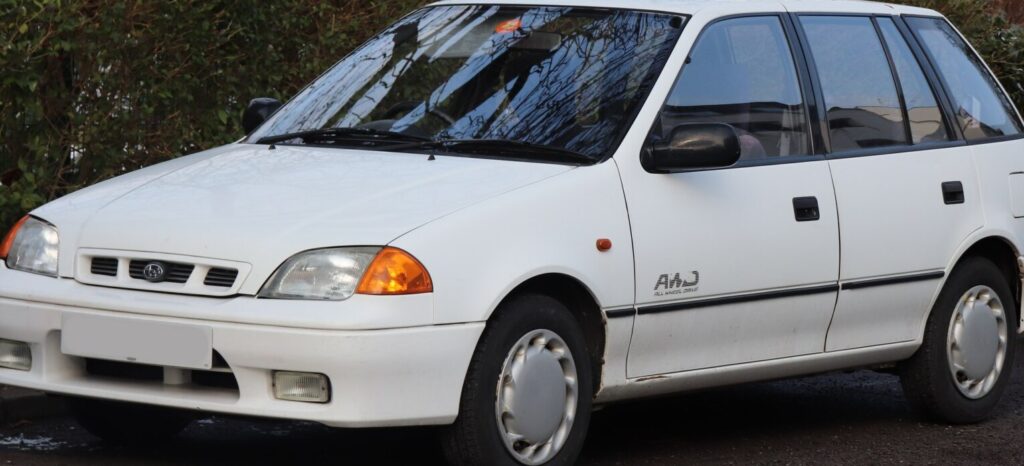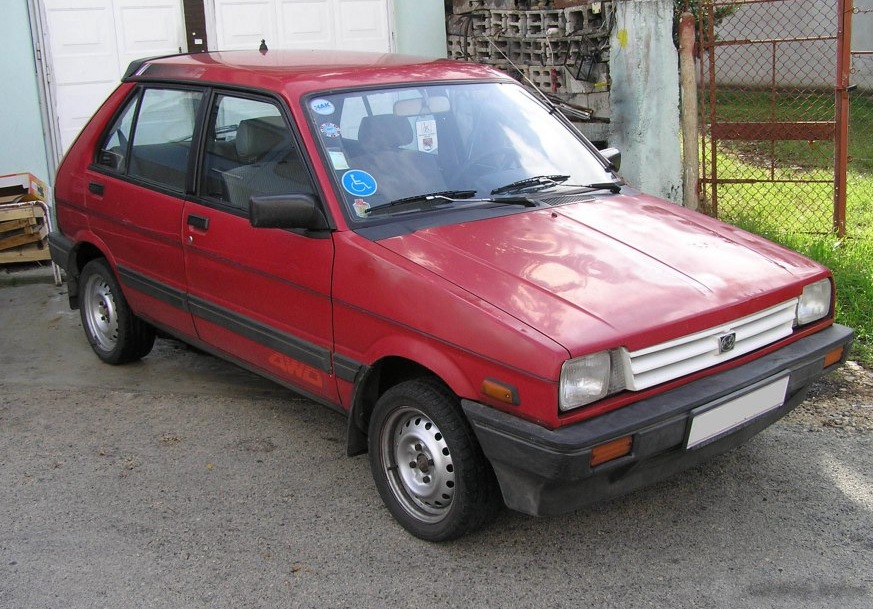
The Subaru Justy I, produced between 1990 and 1994, represented Subaru’s entry into the burgeoning supermini market, particularly in Europe and Japan. The 1000 4WD (KAD-A) variant, a five-door hatchback, was a notable offering within the Justy range, distinguished by its all-wheel drive system and modest 50 horsepower engine. This model, built on the KAD platform, aimed to provide affordable and practical transportation with the added security of Subaru’s renowned symmetrical all-wheel drive. It occupied the entry-level position within the Justy lineup, appealing to buyers seeking economy and all-weather capability over outright performance.
Technical Specifications
| Brand | Subaru |
| Model | Justy |
| Generation | Justy I (KAD) |
| Type | 1000 4WD (KAD-A) (5 dr) (50 Hp) |
| Start of production | 1990 |
| End of production | 1994 |
| Powertrain Architecture | Internal Combustion engine |
| Body type | Hatchback |
| Seats | 5 |
| Doors | 5 |
| Fuel consumption (urban) | 7.5 l/100 km (31.4 US mpg, 37.7 UK mpg, 13.3 km/l) |
| Fuel consumption (extra urban) | 5.5 l/100 km (42.8 US mpg, 51.4 UK mpg, 18.2 km/l) |
| Fuel consumption (combined) | 7.5 l/100 km (31.4 US mpg, 37.7 UK mpg, 13.3 km/l) |
| Fuel Type | Petrol (Gasoline) |
| Acceleration 0 – 100 km/h | 17.3 sec |
| Acceleration 0 – 62 mph | 17.3 sec |
| Acceleration 0 – 60 mph | 16.4 sec |
| Maximum speed | 140 km/h (86.99 mph) |
| Weight-to-power ratio | 16.5 kg/Hp, 60.6 Hp/tonne |
| Weight-to-torque ratio | 10.9 kg/Nm, 92.1 Nm/tonne |
| Power | 50 Hp @ 6000 rpm |
| Power per litre | 50.2 Hp/l |
| Torque | 76 Nm @ 3600 rpm (56.05 lb.-ft. @ 3600 rpm) |
| Engine layout | Front, Transverse |
| Engine Model/Code | J10 |
| Engine displacement | 997 cm3 (60.84 cu. in.) |
| Number of cylinders | 3 |
| Engine configuration | Inline |
| Cylinder Bore | 78 mm (3.07 in.) |
| Piston Stroke | 69.6 mm (2.74 in.) |
| Compression ratio | 9.5:1 |
| Number of valves per cylinder | 2 |
| Fuel injection system | Carburettor |
| Engine aspiration | Naturally aspirated |
| Valvetrain | OHC |
| Engine oil capacity | 2.8 l (2.96 US qt | 2.46 UK qt) |
| Coolant capacity | 4.6 l (4.86 US qt | 4.05 UK qt) |
| Kerb Weight | 825 kg (1818.81 lbs.) |
| Max. weight | 1250 kg (2755.78 lbs.) |
| Max load | 425 kg (936.96 lbs.) |
| Trunk (boot) space – minimum | 158 l (5.58 cu. ft.) |
| Trunk (boot) space – maximum | 1000 l (35.31 cu. ft.) |
| Fuel tank capacity | 35 l (9.25 US gal | 7.7 UK gal) |
| Length | 3695 mm (145.47 in.) |
| Width | 1535 mm (60.43 in.) |
| Height | 1420 mm (55.91 in.) |
| Wheelbase | 2285 mm (89.96 in.) |
| Front track | 1330 mm (52.36 in.) |
| Rear track | 1290 mm (50.79 in.) |
| Minimum turning circle | 9.8 m (32.15 ft.) |
| Drive wheel | All wheel drive (4×4) |
| Number of gears | 5 gears, manual transmission |
| Front suspension | Spring Strut |
| Rear suspension | Wishbone |
| Front brakes | Ventilated discs |
| Rear brakes | Drum |
| Assisting systems | ABS (Anti-lock braking system) |
| Steering type | Steering rack and pinion |
| Tires size | 145/80 R12 S |
Powertrain & Engine Architecture
The heart of the Justy 1000 4WD was the Subaru J10 engine, a 997cc inline three-cylinder petrol engine. This engine utilized a single overhead camshaft (OHC) valvetrain with two valves per cylinder. Fuel delivery was managed by a carburetor, a relatively simple system for the time, prioritizing cost-effectiveness over advanced fuel efficiency. The J10 produced a modest 50 horsepower at 6000 rpm and 76 Nm (56 lb-ft) of torque at 3600 rpm. The engine’s compact size and lightweight construction contributed to the Justy’s overall nimble handling. The transmission was a five-speed manual gearbox, chosen to maximize fuel economy and provide reasonable control given the engine’s limited power output. The engine’s transverse mounting further aided in packaging within the small chassis.
Driving Characteristics
The 1.0-liter engine and five-speed manual transmission combination in the Justy 4WD resulted in a driving experience focused on practicality rather than performance. Acceleration was slow, with a 0-60 mph time of around 16.4 seconds. The car’s top speed was approximately 87 mph. The gear ratios were tuned for economy, meaning the engine needed to be revved to extract the most performance. Compared to potential upgrades like a larger engine, the 1.0L offered a smoother, more predictable power delivery, ideal for urban driving. The all-wheel drive system provided enhanced traction, particularly on slippery surfaces, making it a capable vehicle in inclement weather. However, the all-wheel drive also added weight, slightly impacting fuel economy and acceleration compared to front-wheel drive variants.
Equipment & Trim Levels
The Justy 1000 4WD was generally equipped with basic, functional features. Standard equipment typically included cloth upholstery, a simple dashboard layout, and manual windows and door locks. Power steering was not standard on all models, and air conditioning was often an optional extra. The interior was designed for practicality and durability, rather than luxury. Optional extras could include upgraded audio systems and different wheel covers. The trim level was fairly basic, reflecting its position as the entry point to the Justy range.
Chassis & Braking
The Justy I featured a relatively simple chassis design. Front suspension utilized a MacPherson strut setup, while the rear employed a wishbone suspension. This configuration aimed to balance ride comfort with handling stability. Braking was accomplished via ventilated discs on the front wheels and drum brakes on the rear. An anti-lock braking system (ABS) was available, but not standard on all models. The car’s relatively light weight helped to compensate for the limited braking power. The steering system was a rack and pinion setup, providing reasonably precise steering feel.
Market Reception & Comparison
The Subaru Justy 1000 4WD was generally well-received as an affordable and practical supermini, particularly in markets where all-wheel drive was valued. Critics praised its all-weather capability and fuel efficiency. However, the engine’s lack of power was a common criticism. Compared to other superminis of the era, such as the Fiat Uno or the Peugeot 205, the Justy offered the advantage of all-wheel drive, but at the expense of performance. Fuel economy was comparable to other small cars of the time, averaging around 31-38 mpg. Reliability was generally good, although the carburetor required periodic maintenance.
Legacy
The Subaru Justy I, particularly the 1000 4WD variant, holds a modest but enduring place in automotive history. While not a performance icon, it demonstrated Subaru’s commitment to all-wheel drive technology in a smaller, more affordable package. Today, these cars are relatively rare and are sought after by enthusiasts and collectors. The J10 engine, while simple, proved to be reasonably durable. Finding well-maintained examples can be challenging, and parts availability can be limited. However, the Justy 1000 4WD remains a charming and practical example of 1990s automotive engineering, offering a unique blend of affordability, all-weather capability, and Subaru’s signature symmetrical all-wheel drive system.