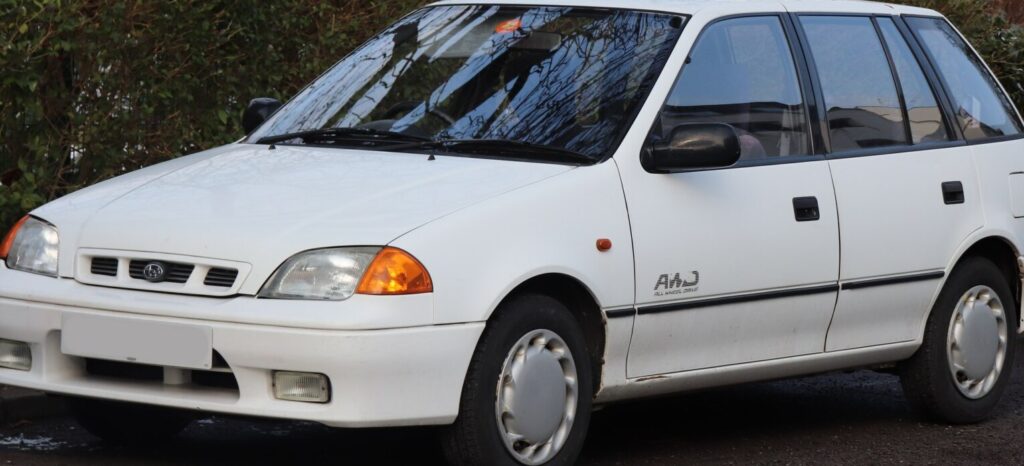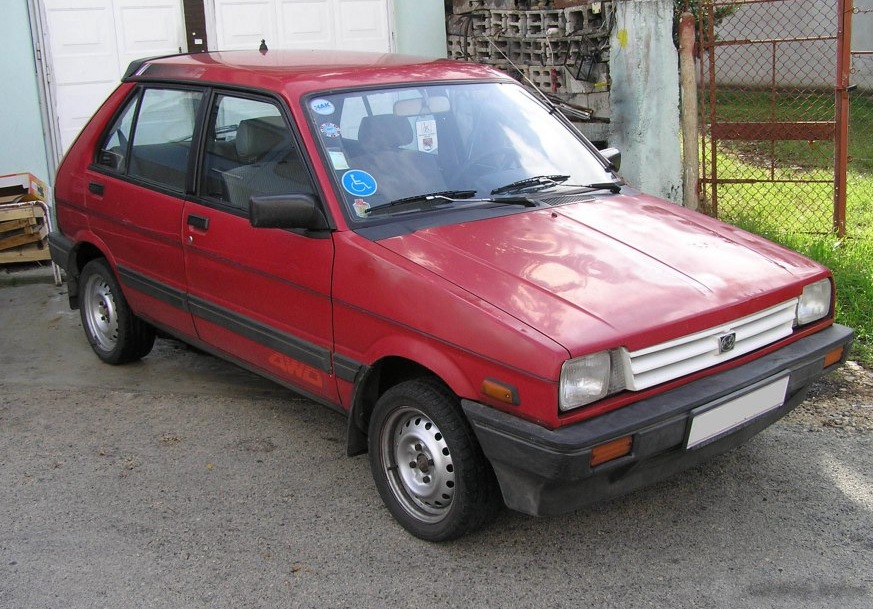
The Subaru Justy I, internally designated the KAD series, was a supermini car produced by Subaru from 1983 to 1989. The 1000 4WD (KAD-A) 5-door hatchback, powered by a 55 horsepower engine, represented a unique offering in the early 1980s, particularly for an American market increasingly focused on larger vehicles. It was built on Subaru’s expertise in all-wheel drive, offering a compact and relatively affordable entry point into the brand’s signature technology. This model occupied the entry-level position within the Justy range, appealing to buyers seeking fuel efficiency and all-weather capability in a small package. The KAD series was notable for its use of a three-cylinder engine and its relatively spacious interior for its size.
Technical Specifications
| Brand | Subaru |
| Model | Justy |
| Generation | Justy I (KAD) |
| Type | 1000 4WD (KAD-A) (5 dr) (55 Hp) |
| Start of production | 1983 |
| End of production | 1989 |
| Powertrain Architecture | Internal Combustion engine |
| Body type | Hatchback |
| Seats | 5 |
| Doors | 5 |
| Fuel consumption (urban) | 7.2 l/100 km (32.7 US mpg, 39.2 UK mpg, 13.9 km/l) |
| Fuel consumption (extra urban) | 6.8 l/100 km (34.6 US mpg, 41.5 UK mpg, 14.7 km/l) |
| Fuel consumption (combined) | 7.2 l/100 km (32.7 US mpg, 39.2 UK mpg, 13.9 km/l) |
| Fuel Type | Petrol (Gasoline) |
| Acceleration 0 – 100 km/h | 15.5 sec |
| Acceleration 0 – 62 mph | 15.5 sec |
| Acceleration 0 – 60 mph | 14.7 sec |
| Maximum speed | 150 km/h (93.21 mph) |
| Weight-to-power ratio | 13.9 kg/Hp, 71.9 Hp/tonne |
| Weight-to-torque ratio | 9.7 kg/Nm, 103.3 Nm/tonne |
| Power | 55 Hp @ 6000 rpm |
| Power per litre | 55.1 Hp/l |
| Torque | 79 Nm @ 3600 rpm (58.27 lb.-ft. @ 3600 rpm) |
| Engine layout | Front, Transverse |
| Engine Model/Code | J10 |
| Engine displacement | 998 cm3 (60.9 cu. in.) |
| Number of cylinders | 3 |
| Engine configuration | Inline |
| Cylinder Bore | 78 mm (3.07 in.) |
| Piston Stroke | 69.6 mm (2.74 in.) |
| Compression ratio | 9.5:1 |
| Number of valves per cylinder | 3 |
| Fuel injection system | Carburettor |
| Engine aspiration | Naturally aspirated |
| Engine oil capacity | 3 l (3.17 US qt | 2.64 UK qt) |
| Coolant capacity | 4 l (4.23 US qt | 3.52 UK qt) |
| Kerb Weight | 765 kg (1686.54 lbs.) |
| Trunk (boot) space – minimum | 160 l (5.65 cu. ft.) |
| Trunk (boot) space – maximum | 980 l (34.61 cu. ft.) |
| Fuel tank capacity | 35 l (9.25 US gal | 7.7 UK gal) |
| Length | 3695 mm (145.47 in.) |
| Width | 1535 mm (60.43 in.) |
| Height | 1420 mm (55.91 in.) |
| Wheelbase | 2285 mm (89.96 in.) |
| Front track | 1330 mm (52.36 in.) |
| Rear track | 1290 mm (50.79 in.) |
| Minimum turning circle | 9.8 m (32.15 ft.) |
| Drive wheel | All wheel drive (4×4) |
| Number of gears | 5 gears, manual transmission |
| Front suspension | Spring Strut |
| Rear suspension | Wishbone |
| Front brakes | Disc |
| Rear brakes | Drum |
| Assisting systems | ABS (Anti-lock braking system) |
| Steering type | Steering rack and pinion |
Powertrain & Engine Architecture
The heart of the KAD-A was the Subaru J10 engine, a 998cc inline three-cylinder unit. This engine utilized a single carburetor for fuel delivery, a common practice for the time, prioritizing simplicity and cost-effectiveness over the more advanced fuel injection systems found in higher-end vehicles. The engine featured three valves per cylinder, contributing to improved breathing and a modest power output of 55 horsepower at 6000 rpm and 58.27 lb-ft of torque at 3600 rpm. The engine’s compact size and lightweight construction were key to the Justy’s overall efficiency. The five-speed manual transmission was standard, offering a reasonable spread of gears to maximize the engine’s limited power. The transmission was designed for durability and ease of maintenance, reflecting the car’s overall practical focus.
Driving Characteristics
The 1.0-liter engine and all-wheel drive system resulted in a driving experience focused on practicality rather than performance. Acceleration was leisurely, taking around 15.5 seconds to reach 62 mph. The car’s strength lay in its ability to provide confident traction in adverse weather conditions, thanks to the symmetrical all-wheel drive system. The gear ratios were tuned for fuel economy and drivability, rather than outright speed. Compared to potential upgrades like a larger engine, the 1.0L offered a smoother, more economical ride, but at the cost of significant performance. The manual transmission allowed for a degree of driver control, but the engine’s limited power meant frequent gear changes were necessary, especially when tackling hills or overtaking.
Equipment & Trim Levels
The KAD-A trim level was fairly basic, reflecting its position as the entry point to the Justy range. Standard features typically included cloth upholstery, a simple dashboard layout, and basic instrumentation. Power steering was not standard, contributing to a more direct, albeit heavier, steering feel. Optional extras were limited, but could include a radio, upgraded seat fabrics, and occasionally, a sunroof. The interior was designed for functionality and durability, with hard-wearing plastics and a focus on maximizing space within the small cabin.
Chassis & Braking
The Justy I featured a relatively simple chassis design. Front suspension utilized MacPherson struts, while the rear employed a wishbone setup. This configuration provided a reasonable balance between ride comfort and handling. Braking was accomplished via disc brakes on the front wheels and drum brakes on the rear. ABS (Anti-lock Braking System) was available, a relatively advanced feature for a car in this class during the 1980s, further enhancing safety in slippery conditions. The car’s relatively light weight helped to compensate for the modest braking power.
Market Reception & Comparison
The Subaru Justy I 1000 4WD was generally well-received as a practical and affordable small car, particularly in markets where all-wheel drive was valued. Critics praised its fuel efficiency and all-weather capability, but noted its limited performance. Compared to other small cars of the era, such as the Fiat Panda or the Renault 5, the Justy offered the unique advantage of all-wheel drive. However, it was often more expensive than its front-wheel drive competitors. Fuel economy was competitive for the time, averaging around 32.7 US mpg in combined driving. Reliability was generally good, although the carburetor required periodic adjustment and maintenance.
Legacy
The Subaru Justy I, particularly the KAD-A variant, holds a niche position in automotive history as a pioneering example of a compact, all-wheel drive vehicle. While not known for blistering performance, its robust drivetrain and fuel efficiency have contributed to its longevity. Today, well-maintained examples are sought after by enthusiasts and collectors, particularly those interested in Subaru’s early all-wheel drive technology. The J10 engine, while simple, proved to be relatively durable, and parts availability remains reasonable. The Justy I represents a unique chapter in Subaru’s history, demonstrating the brand’s commitment to all-wheel drive even in its smallest models.