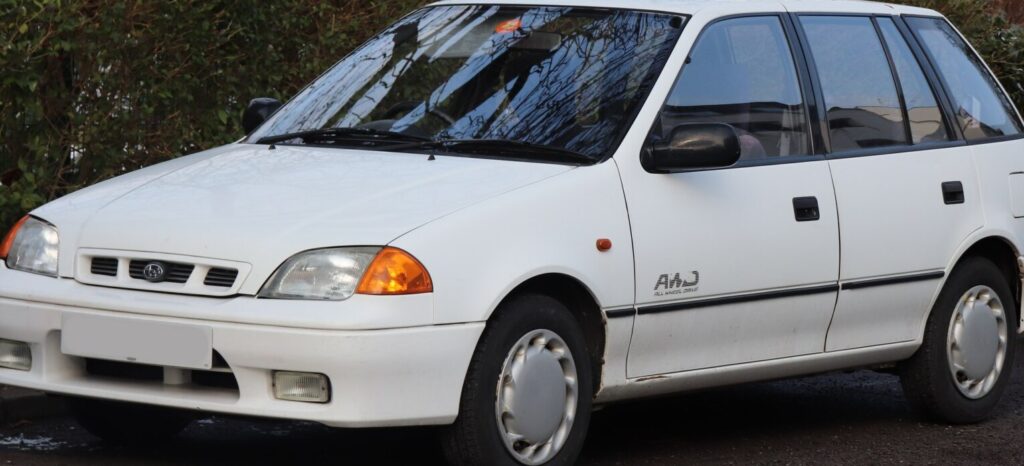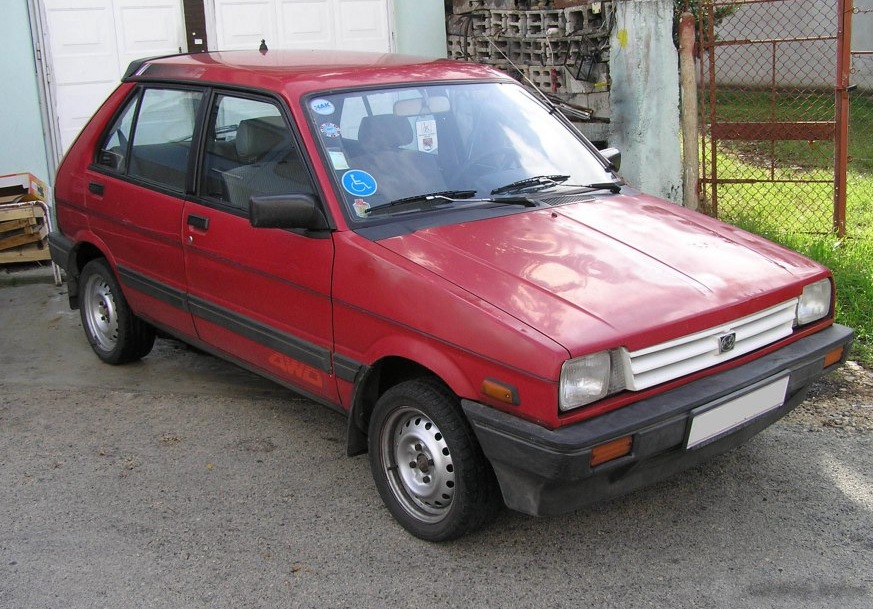
The Subaru Justy I, specifically the KAD series 1200 4WD (5-door) variant producing 74 horsepower, was a subcompact hatchback manufactured by Subaru from 1990 to 1995. Positioned as an entry-level offering within the first generation Justy lineup, it aimed to provide affordable all-wheel drive transportation. This model was primarily sold in Japan and Europe, offering a unique combination of compact size, practicality, and Subaru’s renowned symmetrical all-wheel drive system. It represented Subaru’s attempt to capture a segment of the market seeking a small, economical, and capable vehicle.
Technical Specifications
| Brand | Subaru |
| Model | Justy |
| Generation | Justy I (KAD) |
| Type | 1200 4WD (5 dr) (74 Hp) |
| Start of production | 1990 |
| End of production | 1995 |
| Powertrain Architecture | Internal Combustion engine |
| Body type | Hatchback |
| Seats | 5 |
| Doors | 5 |
| Fuel consumption (urban) | 8.2 l/100 km (28.7 US mpg, 34.4 UK mpg, 12.2 km/l) |
| Fuel consumption (extra urban) | 5.8 l/100 km (40.6 US mpg, 48.7 UK mpg, 17.2 km/l) |
| Fuel consumption (combined) | 8 l/100 km (29.4 US mpg, 35.3 UK mpg, 12.5 km/l) |
| Fuel Type | Petrol (Gasoline) |
| Acceleration 0 – 100 km/h | 13.8 sec |
| Acceleration 0 – 62 mph | 13.8 sec |
| Acceleration 0 – 60 mph | 13.1 sec |
| Maximum speed | 155 km/h (96.31 mph) |
| Weight-to-power ratio | 11.6 kg/Hp |
| Weight-to-torque ratio | 9 kg/Nm |
| Power | 74 Hp @ 5600 rpm |
| Torque | 96 Nm @ 2800 rpm (70.81 lb.-ft. @ 2800 rpm) |
| Engine layout | Front, Transverse |
| Engine Model/Code | J12 |
| Engine displacement | 1190 cm3 (72.62 cu. in.) |
| Number of cylinders | 3 |
| Engine configuration | Inline |
| Cylinder Bore | 78 mm (3.07 in.) |
| Piston Stroke | 83 mm (3.27 in.) |
| Compression ratio | 9.1:1 |
| Number of valves per cylinder | 3 |
| Fuel injection system | Multi-port manifold injection |
| Engine aspiration | Naturally aspirated |
| Valvetrain | OHC |
| Engine oil capacity | 2.8 l (2.96 US qt, 2.46 UK qt) |
| Coolant capacity | 4.9 l (5.18 US qt, 4.31 UK qt) |
| Kerb Weight | 860 kg (1895.98 lbs.) |
| Max. weight | 1350 kg (2976.24 lbs.) |
| Max load | 490 kg (1080.27 lbs.) |
| Trunk (boot) space – minimum | 158 l (5.58 cu. ft.) |
| Trunk (boot) space – maximum | 1000 l (35.31 cu. ft.) |
| Fuel tank capacity | 35 l (9.25 US gal, 7.7 UK gal) |
| Length | 3695 mm (145.47 in.) |
| Width | 1535 mm (60.43 in.) |
| Height | 1420 mm (55.91 in.) |
| Wheelbase | 2285 mm (89.96 in.) |
| Front track | 1330 mm (52.36 in.) |
| Rear track | 1290 mm (50.79 in.) |
| Minimum turning circle | 9.8 m (32.15 ft.) |
| Drive wheel | All wheel drive (4×4) |
| Number of gears | 5 gears, manual transmission |
| Front suspension | Spring Strut |
| Rear suspension | Wishbone |
| Front brakes | Ventilated discs |
| Rear brakes | Drum |
| Assisting systems | ABS (Anti-lock braking system) |
| Steering type | Steering rack and pinion |
| Tires size | 165/65 R 13 S |
INTRODUCTION
The Subaru Justy I (KAD) 1200 4WD, produced between 1990 and 1995, was a significant model for Subaru, particularly in the European and Japanese markets. Built on the KAD platform, it represented a departure from Subaru’s traditionally larger vehicles, offering a more compact and affordable option. The 74 horsepower, 1.2-liter engine coupled with a five-speed manual transmission and all-wheel drive was a key selling point, providing a level of all-weather capability uncommon in its class. It slotted into the Justy range as the more capable, though less powerful, option compared to the rear-wheel drive variants.
Powertrain & Engine Architecture
The heart of the Justy 1200 4WD is the J12 engine, a 1.2-liter (1190cc) inline-three cylinder gasoline engine. This engine utilized a single overhead camshaft (OHC) valvetrain with three valves per cylinder. Fuel delivery was managed by a multi-port fuel injection system, contributing to relatively efficient combustion for its time. The J12 engine, while not known for its outright power, was praised for its smoothness and willingness to rev. The engine’s relatively simple design contributed to its reliability. The five-speed manual transmission was chosen to optimize the engine’s limited power output, providing reasonable acceleration and fuel economy. The transmission featured a conventional layout with synchromesh on all forward gears. The all-wheel drive system was a part-time system, engaging all four wheels when needed, enhancing traction in slippery conditions.
Driving Characteristics
The 1.8L/Automatic Justy 1200 4WD offered a driving experience focused on practicality and surefootedness rather than outright performance. Acceleration from 0-60 mph took around 13.1 seconds, and top speed was limited to 155 km/h (96 mph). The engine’s 74 horsepower and 96 Nm of torque were adequate for everyday driving, but overtaking maneuvers required careful planning. The five-speed manual transmission allowed drivers to keep the engine in its optimal power band. The all-wheel drive system provided excellent traction, particularly on loose surfaces, making it a capable vehicle in inclement weather. Compared to the rear-wheel drive Justy models, the 4WD version offered significantly improved grip and stability, but at the expense of slightly increased fuel consumption and weight.
Equipment & Trim Levels
The Justy 1200 4WD was typically equipped with basic, yet functional, features. Standard equipment included cloth upholstery, a simple dashboard layout, and manual windows and door locks. Power steering was often an optional extra. The interior was designed with practicality in mind, offering ample headroom and reasonable legroom for its size. Optional extras included a radio/cassette player, upgraded seat fabrics, and central locking. The trim level was generally basic, reflecting the car’s position as an entry-level model. The focus was on providing a reliable and affordable vehicle rather than luxury or advanced features.
Chassis & Braking
The Justy 1200 4WD featured a relatively simple chassis design. The front suspension utilized a MacPherson strut setup, while the rear employed a wishbone suspension. This configuration provided a comfortable ride, although handling was not particularly sporty. The braking system consisted of ventilated discs on the front wheels and drum brakes on the rear. Anti-lock braking system (ABS) was available as an option, enhancing safety in emergency braking situations. The steering was a rack and pinion system, providing reasonably precise steering feel. The tires were typically 165/65 R13 size, offering a balance of grip and fuel efficiency.
Market Reception & Comparison
The Subaru Justy 1200 4WD was generally well-received by critics for its affordability, practicality, and all-wheel drive capability. It was seen as a sensible choice for buyers seeking a small, reliable, and capable vehicle. However, its limited power and basic interior were often criticized. Compared to other subcompact hatchbacks of the time, such as the Fiat Uno or the Renault Clio, the Justy offered a unique advantage with its all-wheel drive system. Fuel economy was respectable, averaging around 29.4 US mpg in combined driving. Reliability was generally good, although maintenance costs could be slightly higher due to the all-wheel drive system.
Legacy
The Subaru Justy I (KAD) 1200 4WD holds a modest but significant place in Subaru’s history. It demonstrated the company’s ability to produce a compact and affordable vehicle without sacrificing its core values of reliability and all-wheel drive capability. Today, these cars are relatively rare and are sought after by Subaru enthusiasts and collectors. The J12 engine is known for its durability, and well-maintained examples can still provide reliable transportation. However, finding parts can be challenging due to the car’s age and limited production numbers. The Justy 1200 4WD remains a testament to Subaru’s commitment to providing practical and capable vehicles for a wide range of customers.