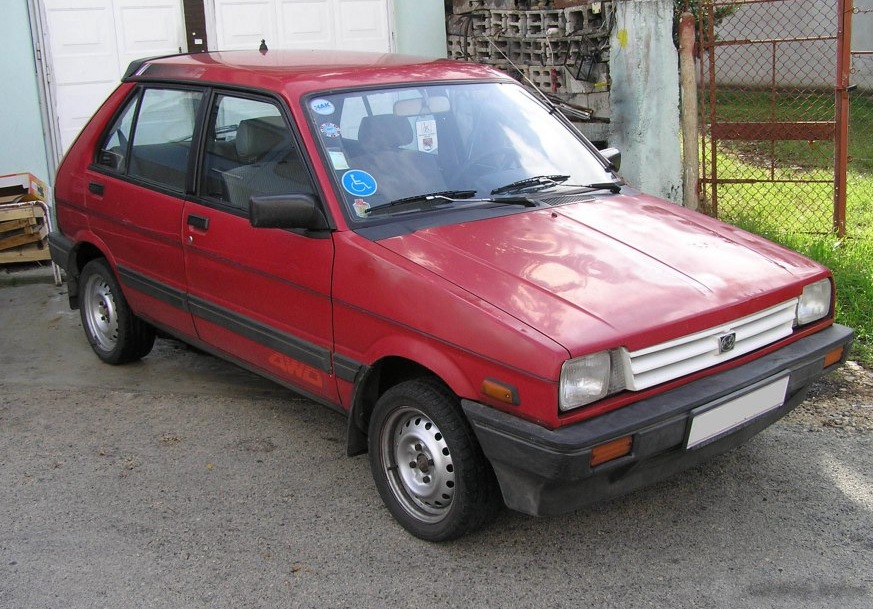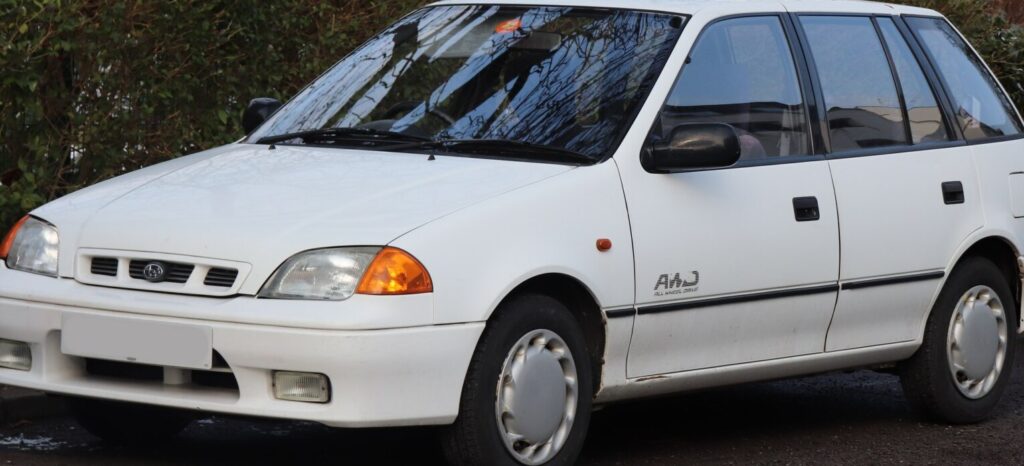
The Subaru Justy II, produced between 1995 and 2001, represented a significant evolution of Subaru’s entry-level offering. Specifically, the 1.3i 4×4 3-door variant, powered by the G13BA engine producing 68 horsepower, occupied a unique niche within the Justy lineup. Falling into the compact hatchback category, this model was primarily aimed at buyers seeking affordable, all-wheel-drive transportation, particularly in markets where inclement weather was common. The JMA and MS chassis codes designate minor variations within the second-generation Justy range, relating to equipment and regional specifications. This particular version was a key part of Subaru’s strategy to offer a practical and economical vehicle with the security of all-wheel drive, a hallmark of the brand.
Technical Specifications
| Brand | Subaru |
| Model | Justy |
| Generation | Justy II (JMA,MS) |
| Type (Engine) | 1.3 i 4×4 (3 dr) (68 Hp) |
| Start of production | 1995 year |
| End of production | 2001 year |
| Powertrain Architecture | Internal Combustion engine |
| Body type | Hatchback |
| Seats | 5 |
| Doors | 3 |
| Fuel consumption (economy) – urban | 8.6 l/100 km (27.4 US mpg, 32.8 UK mpg, 11.6 km/l) |
| Fuel consumption (economy) – extra urban | 6 l/100 km (39.2 US mpg, 47.1 UK mpg, 16.7 km/l) |
| Fuel Type | Petrol (Gasoline) |
| Acceleration 0 – 100 km/h | 13.6 sec |
| Acceleration 0 – 62 mph | 13.6 sec |
| Acceleration 0 – 60 mph | 12.9 sec |
| Maximum speed | 155 km/h (96.31 mph) |
| Weight-to-power ratio | 12.4 kg/Hp, 80.5 Hp/tonne |
| Weight-to-torque ratio | 8.5 kg/Nm, 117.2 Nm/tonne |
| Power | 68 Hp @ 6000 rpm |
| Power per litre | 52.3 Hp/l |
| Torque | 99 Nm @ 3500 rpm (73.02 lb.-ft. @ 3500 rpm) |
| Engine layout | Front, Transverse |
| Engine Model/Code | G13BA |
| Engine displacement | 1299 cm3 (79.27 cu. in.) |
| Number of cylinders | 4 |
| Engine configuration | Inline |
| Cylinder Bore | 74 mm (2.91 in.) |
| Piston Stroke | 75.5 mm (2.97 in.) |
| Compression ratio | 9.5:1 |
| Number of valves per cylinder | 2 |
| Fuel injection system | Multi-port manifold injection |
| Engine aspiration | Naturally aspirated engine |
| Valvetrain | OHC |
| Engine oil capacity | 3.3 l (3.49 US qt | 2.9 UK qt) |
| Coolant | 4.7 l (4.97 US qt | 4.14 UK qt) |
| Kerb Weight | 845 kg (1862.91 lbs.) |
| Max. weight | 1340 kg (2954.19 lbs.) |
| Max load | 495 kg (1091.29 lbs.) |
| Trunk (boot) space – minimum | 135 l (4.77 cu. ft.) |
| Trunk (boot) space – maximum | 350 l (12.36 cu. ft.) |
| Fuel tank capacity | 37 l (9.77 US gal | 8.14 UK gal) |
| Length | 3745 mm (147.44 in.) |
| Width | 1590 mm (62.6 in.) |
| Height | 1350 mm (53.15 in.) |
| Wheelbase | 2265 mm (89.17 in.) |
| Front track | 1365 mm (53.74 in.) |
| Rear (Back) track | 1340 mm (52.76 in.) |
| Minimum turning circle | 9.2 m (30.18 ft.) |
| Drive wheel | All wheel drive (4×4) |
| Number of gears and type of gearbox | 5 gears, manual transmission |
| Front suspension | Spring Strut |
| Rear suspension | Wishbone |
| Front brakes | Ventilated discs |
| Rear brakes | Drum |
| Assisting systems | ABS (Anti-lock braking system) |
| Steering type | Steering rack and pinion |
| Tires size | 165/70 R13 |
Powertrain & Engine Architecture
The heart of the Justy II 1.3i 4×4 was the G13BA engine, a 1.3-liter, inline-four cylinder gasoline engine. This engine, while not particularly powerful, was known for its relative simplicity and durability. It featured a single overhead camshaft (SOHC) valvetrain with two valves per cylinder. Fuel delivery was handled by a multi-point fuel injection system, contributing to reasonable fuel efficiency for the time. The G13BA produced 68 horsepower at 6000 rpm and 99 Nm (73 lb-ft) of torque at 3500 rpm. The engine’s compact size and transverse mounting allowed for a relatively spacious interior for a vehicle of its external dimensions. The transmission was a five-speed manual, chosen for its affordability and efficiency. The all-wheel-drive system was a viscous coupling type, automatically distributing torque between the front and rear axles as needed, providing enhanced traction without the complexity of more advanced systems.
Driving Characteristics
The 1.3i 4×4 Justy was not designed for outright speed. Acceleration from 0 to 60 mph took around 12.9 seconds, and its top speed was approximately 96 mph. However, the all-wheel-drive system provided a noticeable improvement in handling and stability, especially on slippery surfaces. The five-speed manual transmission allowed drivers to keep the engine in its optimal power band, but the limited horsepower meant that overtaking maneuvers required careful planning. Compared to higher-spec Justy models with larger engines, the 1.3i felt noticeably slower, but it offered a more economical driving experience. The gear ratios were tuned for fuel efficiency rather than performance, resulting in a somewhat relaxed driving feel.
Equipment & Trim Levels
The 1.3i 4×4 3-door Justy was typically an entry-level trim. Standard equipment generally included basic features such as cloth upholstery, a simple dashboard layout, and manual windows and door locks. Air conditioning was often an optional extra, as were power steering and a radio/cassette player. The interior was functional and durable, prioritizing practicality over luxury. Safety features were also basic, typically consisting of seatbelts and an anti-lock braking system (ABS) on some models. The 3-door configuration emphasized affordability and a slightly sportier appearance compared to the 5-door version.
Chassis & Braking
The Justy II utilized a relatively simple chassis design. Front suspension consisted of MacPherson strut springs, while the rear employed a wishbone setup. The braking system featured ventilated discs on the front wheels and drum brakes on the rear. The use of drum brakes on the rear was a cost-saving measure common in this class of vehicle. ABS was available as an option, enhancing braking performance and safety. The suspension was tuned for comfort rather than sporty handling, providing a reasonably smooth ride on most road surfaces. The relatively lightweight construction of the vehicle helped to offset the limitations of the braking system.
Market Reception & Comparison
The Subaru Justy II 1.3i 4×4 was generally well-received as an affordable and practical all-wheel-drive vehicle. Critics praised its fuel efficiency and the added security of the all-wheel-drive system, particularly in regions with harsh winters. However, the engine’s limited power was often cited as a drawback. Compared to other small hatchbacks of the time, such as the Ford Fiesta or Volkswagen Polo, the Justy offered a unique selling point with its standard all-wheel drive. Fuel economy was comparable to its competitors, and reliability was generally considered good. The 1.3i model was positioned as the most accessible entry point into the Justy range, appealing to budget-conscious buyers.
Legacy
The Subaru Justy II 1.3i 4×4 has developed a reputation for being a reliable and durable vehicle, particularly when well-maintained. The G13BA engine is known for its longevity, and the all-wheel-drive system continues to function effectively in many examples. In the used car market, these Justys are often sought after by those looking for an affordable and dependable vehicle for commuting or as a winter car. Parts availability can be a challenge in some regions, but the engine’s simplicity makes it relatively easy to repair. While not a performance icon, the Justy II 1.3i 4×4 remains a testament to Subaru’s commitment to providing practical and capable vehicles to a wide range of customers.