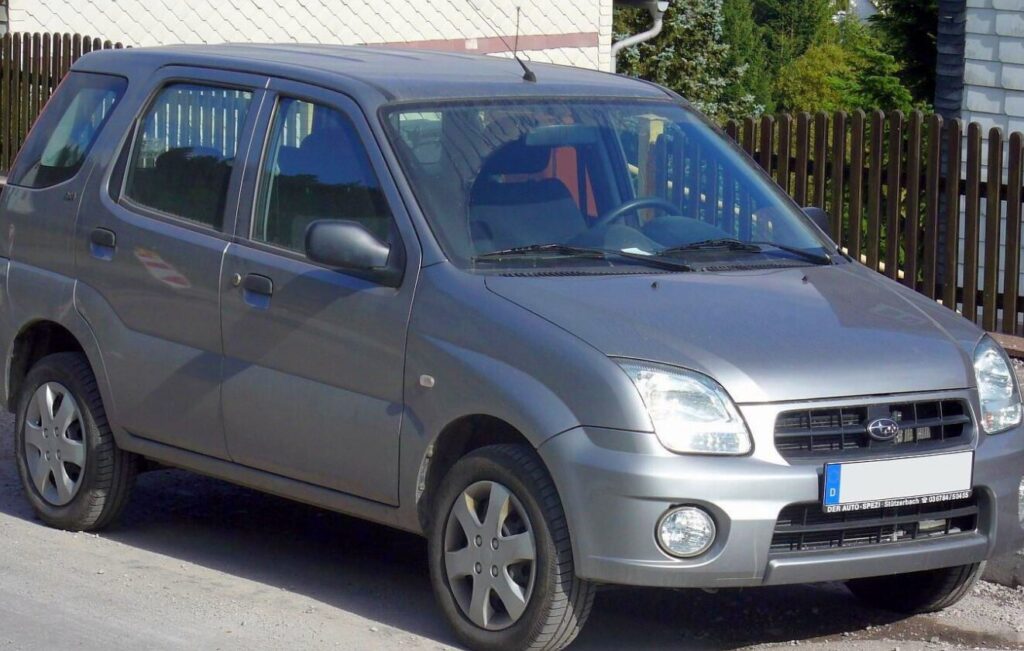
The Subaru Justy III, internally designated the NH or G3X series, represents the third generation of Subaru’s supermini. Produced from 2003 to 2007, this iteration of the Justy was a significant departure from its predecessors, largely due to a collaborative effort with Daihatsu. While sold under the Subaru badge in select markets, including Europe and Japan, it was essentially a rebadged Daihatsu Sirion/Storia. The 1.5 i 16V AWD variant, producing 99 horsepower, occupied a middle ground in the Justy III lineup, offering all-wheel drive capability – a Subaru hallmark – in a relatively affordable and economical package. This model aimed to appeal to buyers seeking a small, practical car with enhanced traction for varied weather conditions.
Technical Specifications
| Brand | Subaru |
| Model | Justy |
| Generation | Justy III (NH, G3X) |
| Type | 1.5 i 16V AWD (99 Hp) |
| Start of production | 2003 |
| End of production | 2007 |
| Powertrain Architecture | Internal Combustion engine |
| Body type | Hatchback |
| Seats | 5 |
| Doors | 5 |
| Fuel consumption (urban) | 9.1 l/100 km (25.8 US mpg, 31 UK mpg) |
| Fuel consumption (extra urban) | 6.1 l/100 km (38.6 US mpg, 46.3 UK mpg) |
| Fuel consumption (combined) | 7.2 l/100 km (32.7 US mpg, 39.2 UK mpg) |
| Fuel Type | Petrol (Gasoline) |
| Acceleration 0 – 100 km/h | 11 sec |
| Acceleration 0 – 62 mph | 11 sec |
| Acceleration 0 – 60 mph | 10.5 sec |
| Maximum speed | 165 km/h (102.53 mph) |
| Weight-to-power ratio | 10.2 kg/Hp |
| Weight-to-torque ratio | 7.6 kg/Nm |
| Power | 99 Hp @ 5900 rpm |
| Torque | 133 Nm @ 4100 rpm (98.1 lb.-ft. @ 4100 rpm) |
| Engine layout | Front, Transverse |
| Engine Model/Code | M15A |
| Engine displacement | 1490 cm3 (90.93 cu. in.) |
| Number of cylinders | 4 |
| Engine configuration | Inline |
| Cylinder Bore | 78 mm (3.07 in.) |
| Piston Stroke | 78 mm (3.07 in.) |
| Compression ratio | 9.5:1 |
| Number of valves per cylinder | 4 |
| Fuel injection system | Multi-port manifold injection |
| Engine aspiration | Naturally aspirated |
| Engine oil capacity | 3.2 l (3.38 US qt, 2.82 UK qt) |
| Coolant capacity | 5.6 l (5.92 US qt, 4.93 UK qt) |
| Kerb Weight | 1010 kg (2226.67 lbs.) |
| Max. weight | 1480 kg (3262.84 lbs.) |
| Max load | 470 kg (1036.17 lbs.) |
| Trunk (boot) space – minimum | 236 l (8.33 cu. ft.) |
| Trunk (boot) space – maximum | 526 l (18.58 cu. ft.) |
| Fuel tank capacity | 41 l (10.83 US gal, 9.02 UK gal) |
| Length | 3770 mm (148.43 in.) |
| Width | 1605 mm (63.19 in.) |
| Height | 1565 mm (61.61 in.) |
| Wheelbase | 2360 mm (92.91 in.) |
| Front track | 1420 mm (55.91 in.) |
| Rear track | 1410 mm (55.51 in.) |
| Drive wheel | All wheel drive (4×4) |
| Number of gears | 5 |
| Gearbox type | Manual transmission |
| Front suspension | Spring Strut |
| Rear suspension | Spring Strut |
| Front brakes | Disc |
| Rear brakes | Disc |
| Assisting systems | ABS (Anti-lock braking system) |
| Steering type | Steering rack and pinion |
| Tires size | 165/70 R14 |
| Wheel rims size | 4.5J x 14 |
Powertrain & Engine Architecture
The heart of the Justy III 1.5 i AWD is the Daihatsu-sourced M15A engine. This 1.5-liter, inline-four cylinder engine utilizes a single overhead camshaft (SOHC) design with four valves per cylinder (16V). The M15A employs multi-point fuel injection, delivering fuel directly to each intake port. This configuration, while not particularly advanced, proved reliable and relatively fuel-efficient. The engine’s 99 horsepower output at 5900 rpm and 133 Nm (98.1 lb-ft) of torque at 4100 rpm were modest, but adequate for the vehicle’s light weight. The engine’s all-aluminum construction helped to keep weight down. The five-speed manual transmission was the standard offering for this variant, providing a reasonably direct connection to the engine. The transmission was designed for durability and ease of maintenance, rather than sporty performance.
Driving Characteristics
The 1.5L engine paired with the manual transmission in the Justy III AWD delivered a practical, if not exhilarating, driving experience. Acceleration to 60 mph took around 10.5 seconds, and top speed was approximately 102.5 mph. The car felt nimble and easy to maneuver in urban environments. The all-wheel-drive system provided enhanced grip, particularly on slippery surfaces, making it a competent performer in inclement weather. Compared to the base front-wheel-drive models, the AWD version offered noticeably improved traction. However, the 99 hp engine required frequent downshifts when tackling hills or overtaking. The gear ratios were tuned for fuel economy rather than outright performance. The manual transmission offered a more engaging driving experience than the optional automatic, providing greater control over the engine’s power band.
Equipment & Trim Levels
The Justy III 1.5 i AWD typically came equipped with basic, but functional, features. Standard equipment included power steering, central locking, electric front windows, and an AM/FM radio. Interior upholstery was typically a durable cloth material. Optional extras included air conditioning, alloy wheels, and a CD player. The dashboard layout was simple and straightforward, prioritizing functionality over aesthetics. Safety features were relatively basic for the time, including ABS brakes and driver/passenger airbags. The trim level for this variant was generally considered mid-range, offering a balance between affordability and features.
Chassis & Braking
The Justy III utilized a relatively simple chassis design, featuring a MacPherson strut front suspension and a torsion beam rear suspension. This setup provided a comfortable ride, although it wasn’t particularly sporty. The car’s light weight contributed to its nimble handling. Braking duties were handled by disc brakes on all four wheels, providing adequate stopping power. The ABS system helped to prevent wheel lockup during hard braking. The suspension was tuned for comfort and practicality, rather than performance. Stabilizer bars were present, but relatively thin, reflecting the car’s focus on everyday usability.
Market Reception & Comparison
The Subaru Justy III 1.5 i AWD received mixed reviews. Critics praised its affordability, fuel efficiency, and all-wheel-drive capability. However, they also noted its lack of refinement and modest performance. Compared to other superminis of the time, such as the Ford Fiesta or Volkswagen Polo, the Justy offered a more basic driving experience. However, its all-wheel-drive system set it apart from many competitors. The 1.5L engine offered a better balance of performance and economy than the smaller 1.3L engine, but it lacked the punch of larger-displacement options. Reliability was generally good, although some owners reported minor issues with the electrical system.
Legacy
The Subaru Justy III, while not a groundbreaking vehicle, served as a practical and affordable option for buyers seeking a small car with all-wheel-drive capability. The M15A engine proved to be a durable and reliable unit, and many examples are still on the road today. In the used car market, the Justy III 1.5 i AWD is often valued for its simplicity, affordability, and all-weather traction. Maintenance costs are generally low, and parts availability is reasonable. While it may not offer the sophistication of more modern superminis, the Justy III remains a viable option for those seeking a no-frills, dependable vehicle.