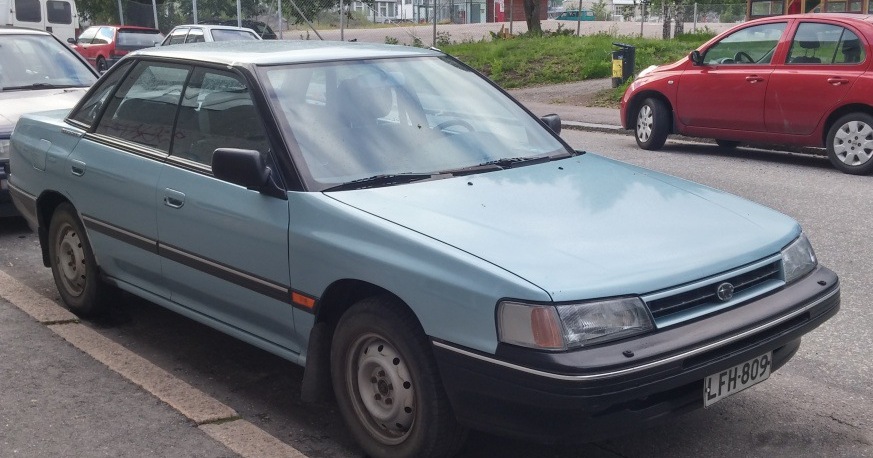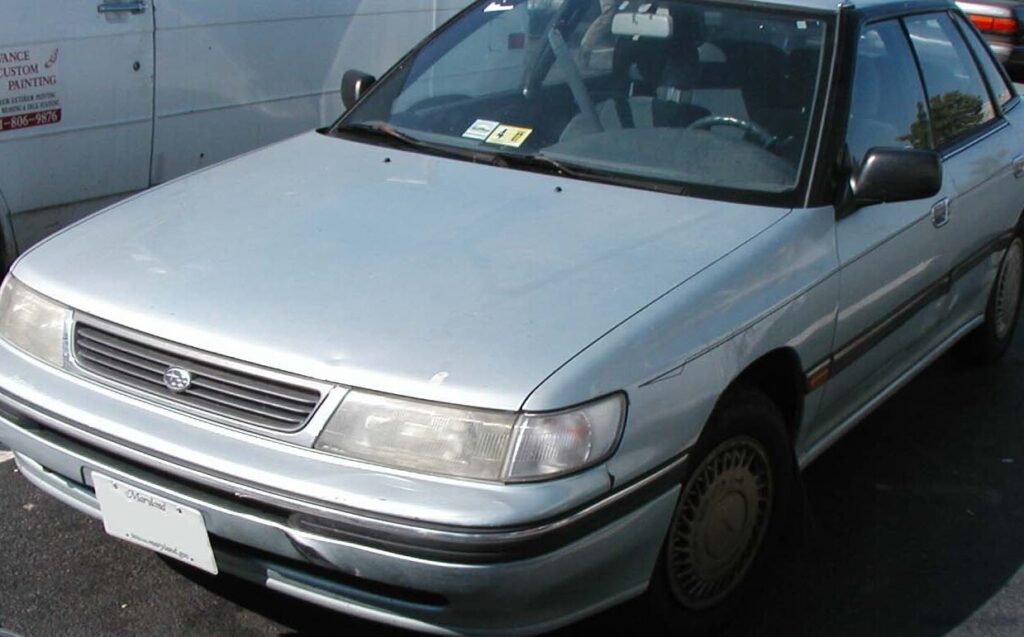
The Subaru Legacy I (BC, facelift released in 1991) 2000, equipped with a 116 horsepower engine and all-wheel drive, represents a significant step in Subaru’s expansion into the mid-size family car market. Produced from 1992 to 1994, this variant occupied a middle ground within the Legacy lineup, offering a balance between performance and affordability. It was a key model for Subaru as they sought to establish a stronger presence in North America and Europe, building on the reputation for reliability and symmetrical all-wheel drive that had been cultivated with earlier models like the Leone.
Technical Specifications
| Brand | Subaru |
| Model | Legacy |
| Generation | Legacy I (BC, facelift 1991) |
| Type (Engine) | 2000 (116 Hp) AWD |
| Start of production | 1992 |
| End of production | 1994 |
| Powertrain Architecture | Internal Combustion engine |
| Body type | Sedan |
| Seats | 5 |
| Doors | 4 |
| Fuel consumption (urban) | 12 l/100 km (19.6 US mpg, 23.5 UK mpg, 8.3 km/l) |
| Fuel consumption (extra urban) | 7.7 l/100 km (30.5 US mpg, 36.7 UK mpg, 13 km/l) |
| Fuel consumption (combined) | 9.7 l/100 km (24.2 US mpg, 29.1 UK mpg, 10.3 km/l) |
| Fuel Type | Petrol (Gasoline) |
| Acceleration 0 – 100 km/h | 9.9 sec |
| Acceleration 0 – 62 mph | 9.9 sec |
| Acceleration 0 – 60 mph | 9.4 sec |
| Maximum speed | 187 km/h (116.2 mph) |
| Weight-to-power ratio | 11 kg/Hp, 91 Hp/tonne |
| Weight-to-torque ratio | 7.8 kg/Nm, 128.6 Nm/tonne |
| Power | 116 Hp @ 5600 rpm |
| Power per litre | 58.2 Hp/l |
| Torque | 164 Nm @ 4400 rpm (120.96 lb.-ft. @ 4400 rpm) |
| Engine layout | Front, Longitudinal |
| Engine Model/Code | EJ20E |
| Engine displacement | 1994 cm3 (121.68 cu. in.) |
| Number of cylinders | 4 |
| Engine configuration | Boxer |
| Cylinder Bore | 92 mm (3.62 in.) |
| Piston Stroke | 75 mm (2.95 in.) |
| Compression ratio | 9.5:1 |
| Number of valves per cylinder | 4 |
| Fuel injection system | Multi-port manifold injection |
| Engine aspiration | Naturally aspirated engine |
| Valvetrain | SOHC |
| Engine oil capacity | 4.5 l (4.76 US qt | 3.96 UK qt) |
| Coolant | 6.1 l (6.45 US qt | 5.37 UK qt) |
| Kerb Weight | 1275 kg (2810.89 lbs.) |
| Max. weight | 1870 kg (4122.64 lbs.) |
| Max load | 595 kg (1311.75 lbs.) |
| Trunk (boot) space – minimum | 405 l (14.3 cu. ft.) |
| Trunk (boot) space – maximum | 630 l (22.25 cu. ft.) |
| Fuel tank capacity | 60 l (15.85 US gal | 13.2 UK gal) |
| Max. roof load | 80 kg (176.37 lbs.) |
| Permitted trailer load with brakes (12%) | 950 kg (2094.39 lbs.) |
| Permitted trailer load without brakes | 500 kg (1102.31 lbs.) |
| Permitted towbar download | 75 kg (165.35 lbs.) |
| Length | 4545 mm (178.94 in.) |
| Width | 1690 mm (66.54 in.) |
| Height | 1380 mm (54.33 in.) |
| Wheelbase | 2580 mm (101.57 in.) |
| Front track | 1465 mm (57.68 in.) |
| Rear (Back) track | 1455 mm (57.28 in.) |
| Ride height (ground clearance) | 170 mm (6.69 in.) |
| Minimum turning circle (turning diameter) | 10.1 m (33.14 ft.) |
| Drive wheel | All wheel drive (4×4) |
| Number of gears and type of gearbox | 5 gears, manual transmission |
| Front suspension | Independent type McPherson |
| Rear suspension | Several levers and rods |
| Front brakes | Ventilated discs |
| Rear brakes | Drum |
| Assisting systems | ABS (Anti-lock braking system) |
| Steering type | Steering rack and pinion |
| Power steering | Hydraulic Steering |
| Tires size | 175/70 R14 |
| Wheel rims size | 14 |
INTRODUCTION
The Subaru Legacy I, launched in 1989 and facelifted in 1991, was Subaru’s attempt to break into the mainstream mid-size sedan market. The 2000 AWD variant, produced from 1992-1994, featured a 1994cc, naturally aspirated, horizontally-opposed (boxer) four-cylinder engine producing 116 horsepower. This model was positioned as a practical and reliable family car, benefiting from Subaru’s established expertise in all-wheel drive technology. It competed with vehicles like the Toyota Camry, Honda Accord, and Nissan Maxima, offering a unique selling proposition with its standard AWD system. The facelift brought subtle styling changes and refinements to the original design.
Powertrain & Engine Architecture
The heart of the Legacy 2000 was the EJ20E engine. This 2.0-liter boxer engine, a hallmark of Subaru engineering, featured a single overhead camshaft (SOHC) design and multi-port fuel injection. The boxer configuration, with its horizontally opposed pistons, offered inherent balance and a lower center of gravity, contributing to improved handling. The EJ20E was known for its durability and relatively simple maintenance requirements. The engine’s 9.5:1 compression ratio and efficient combustion chamber design helped it achieve a reasonable balance between power and fuel economy. The five-speed manual transmission was the standard offering, providing direct control over the engine’s power. The transmission was designed to handle the torque output of the EJ20E and effectively distribute power to all four wheels.
Driving Characteristics
The 116 horsepower and 164 Nm (120.96 lb-ft) of torque delivered by the EJ20E engine, coupled with the all-wheel drive system, provided competent, if not exhilarating, performance. Acceleration from 0 to 60 mph took approximately 9.4 seconds, and the top speed was around 116.2 mph. The all-wheel drive system provided excellent traction in various weather conditions, making it a particularly appealing choice in regions with snow or rain. The manual transmission offered precise gear changes, allowing drivers to maximize the engine’s power. Compared to higher-output Legacy variants, such as those with the turbocharged engine, the 2000 model prioritized fuel efficiency and ease of driving over outright performance. The gear ratios were tuned for everyday usability, providing adequate acceleration in most driving situations.
Equipment & Trim Levels
The 1992-1994 Subaru Legacy 2000 AWD typically came standard with features considered essential for a mid-size family sedan. These included power steering, a basic audio system, cloth upholstery, and air conditioning. ABS (Anti-lock Braking System) was also a standard safety feature. Optional extras included a sunroof, upgraded audio systems, and power windows. Interior trim levels were relatively basic, focusing on functionality and durability rather than luxury. The dashboard layout was straightforward and easy to use, with clearly labeled controls. The Legacy 2000 was generally offered in a single, well-equipped trim level, simplifying the buying process for customers.
Chassis & Braking
The Legacy 2000 featured an independent McPherson strut suspension in the front and a multi-link suspension in the rear. This suspension setup provided a comfortable ride and predictable handling. The front brakes were ventilated discs, offering good stopping power, while the rear brakes were drums. The all-wheel drive system added to the vehicle’s stability and cornering ability. The chassis was designed to be robust and durable, capable of handling the stresses of everyday driving. The steering was a rack-and-pinion system with hydraulic power assistance, providing precise and responsive steering feel.
Market Reception & Comparison
The Subaru Legacy 2000 AWD was generally well-received by automotive critics. It was praised for its standard all-wheel drive, comfortable ride, and reputation for reliability. However, some critics noted that its engine lacked the power of some of its competitors. Fuel economy was considered average for the class. Compared to other Legacy trims, the 2000 model offered a more affordable entry point into the Legacy lineup, making it attractive to budget-conscious buyers. It was a popular choice for families and individuals who prioritized safety and all-weather capability.
Legacy
The Subaru Legacy I (BC) 2000 AWD, while not the most powerful or luxurious variant, has proven to be a remarkably durable and reliable vehicle. Many examples are still on the road today, a testament to Subaru’s engineering quality. In the used car market, these models are often sought after by enthusiasts and those looking for an affordable and dependable all-wheel drive vehicle. The EJ20E engine is known for its longevity, and with proper maintenance, it can provide many years of service. While parts availability may be becoming more challenging, the Legacy 2000 remains a viable option for those seeking a classic Subaru with a proven track record.