Technical Specifications
| Brand | Subaru |
| Model | Legacy |
| Generation | Legacy I (BC, facelift 1991) |
| Type (Engine) | 2200 (136 Hp) AWD |
| Start of production | 1991 |
| End of production | 1994 |
| Powertrain Architecture | Internal Combustion engine |
| Body type | Sedan |
| Seats | 5 |
| Doors | 4 |
| Fuel consumption (urban) | 12.3 l/100 km (19.1 US mpg, 23 UK mpg, 8.1 km/l) |
| Fuel consumption (extra urban) | 7.4 l/100 km (31.8 US mpg, 38.2 UK mpg, 13.5 km/l) |
| Fuel consumption (combined) | 9 l/100 km (26.1 US mpg, 31.4 UK mpg, 11.1 km/l) |
| Fuel Type | Petrol (Gasoline) |
| Acceleration 0 – 100 km/h | 9 sec |
| Acceleration 0 – 62 mph | 9 sec |
| Acceleration 0 – 60 mph | 8.6 sec |
| Maximum speed | 200 km/h (124.27 mph) |
| Weight-to-power ratio | 8.7 kg/Hp, 114.8 Hp/tonne |
| Weight-to-torque ratio | 6.3 kg/Nm, 159.5 Nm/tonne |
| Power | 136 Hp @ 6000 rpm |
| Power per litre | 61.5 Hp/l |
| Torque | 189 Nm @ 4800 rpm (139.4 lb.-ft. @ 4800 rpm) |
| Engine layout | Front, Longitudinal |
| Engine Model/Code | EJ22E |
| Engine displacement | 2212 cm3 (134.98 cu. in.) |
| Number of cylinders | 4 |
| Engine configuration | Boxer |
| Cylinder Bore | 96.9 mm (3.81 in.) |
| Piston Stroke | 75 mm (2.95 in.) |
| Compression ratio | 9.5:1 |
| Number of valves per cylinder | 4 |
| Fuel injection system | Multi-port manifold injection |
| Engine aspiration | Naturally aspirated engine |
| Valvetrain | DOHC |
| Engine oil capacity | 4.5 l (4.76 US qt | 3.96 UK qt) |
| Coolant | 6.2 l (6.55 US qt | 5.46 UK qt) |
| Kerb Weight | 1185 kg (2612.48 lbs.) |
| Max. weight | 1780 kg (3924.23 lbs.) |
| Max load | 595 kg (1311.75 lbs.) |
| Trunk (boot) space – minimum | 405 l (14.3 cu. ft.) |
| Trunk (boot) space – maximum | 630 l (22.25 cu. ft.) |
| Fuel tank capacity | 60 l (15.85 US gal | 13.2 UK gal) |
| Max. roof load | 80 kg (176.37 lbs.) |
| Permitted trailer load with brakes (12%) | 950 kg (2094.39 lbs.) |
| Permitted trailer load without brakes | 500 kg (1102.31 lbs.) |
| Permitted towbar download | 75 kg (165.35 lbs.) |
| Length | 4545 mm (178.94 in.) |
| Width | 1690 mm (66.54 in.) |
| Height | 1400 mm (55.12 in.) |
| Wheelbase | 2580 mm (101.57 in.) |
| Front track | 1465 mm (57.68 in.) |
| Rear (Back) track | 1455 mm (57.28 in.) |
| Ride height (ground clearance) | 170 mm (6.69 in.) |
| Minimum turning circle (turning diameter) | 10.1 m (33.14 ft.) |
| Drive wheel | All wheel drive (4×4) |
| Number of gears and type of gearbox | 5 gears, manual transmission |
| Front suspension | Independent type McPherson |
| Rear suspension | Several levers and rods |
| Front brakes | Ventilated discs |
| Rear brakes | Disc |
| Assisting systems | ABS (Anti-lock braking system) |
| Steering type | Steering rack and pinion |
| Power steering | Hydraulic Steering |
| Tires size | 185/70 R14 |
| Wheel rims size | 14 |
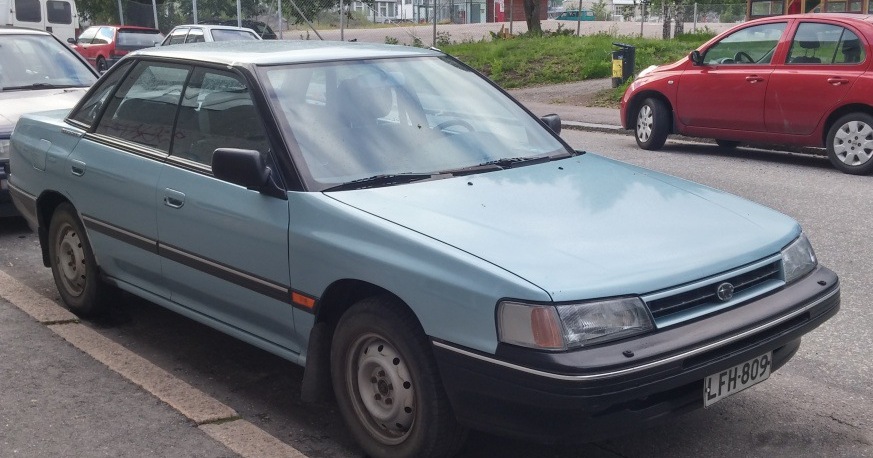
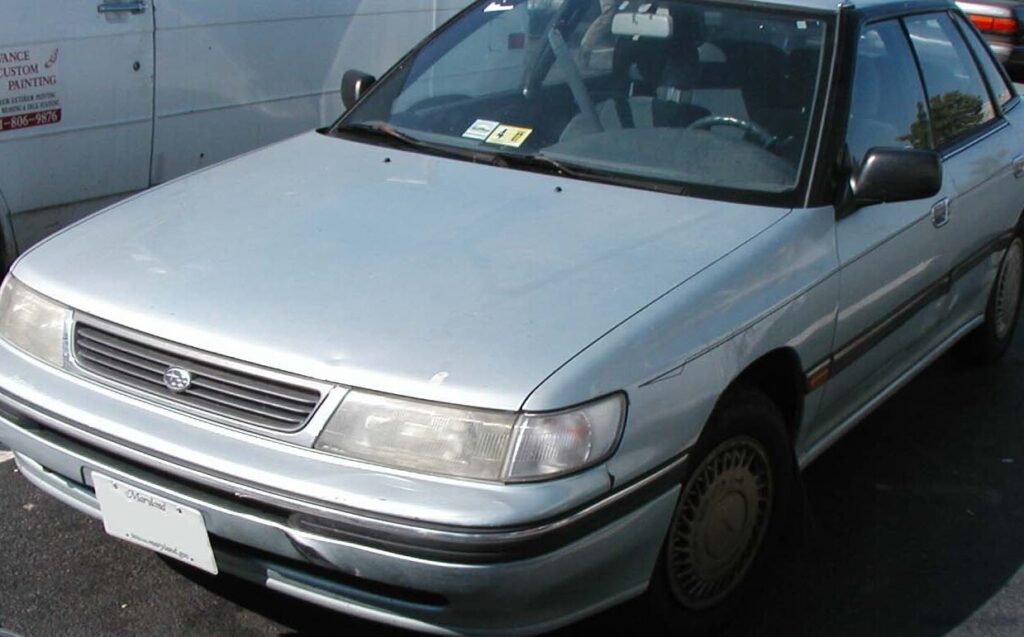
The Subaru Legacy I (BC, with the 1991 facelift) 2200, producing 136 horsepower, marked a significant evolution for Subaru in the mid-size sedan segment. Introduced in 1989 as a replacement for the Leone, the Legacy aimed to deliver a more modern and refined driving experience, with a strong emphasis on all-wheel drive capability. This facelifted version, produced from 1991 to 1994, refined the original BC platform with subtle styling updates and improvements to the powertrain. The 2200 variant, powered by the EJ22E engine, was positioned as a mid-range offering within the Legacy lineup, striking a balance between performance and fuel efficiency, appealing to buyers seeking a practical and capable family vehicle.
Powertrain & Engine Architecture
The core of the Legacy 2200 is the EJ22E, a 2.2-liter naturally aspirated, horizontally-opposed (boxer) four-cylinder engine. Subaru’s signature boxer engine design, with its horizontally moving pistons, provides inherent balance and a lower center of gravity, enhancing the car’s handling. The EJ22E features a multi-port fuel injection system, delivering fuel directly into the intake ports, and a double overhead camshaft (DOHC) valvetrain for optimized airflow and efficient combustion. This engine generates 136 horsepower at 6000 rpm and 189 Nm (139.4 lb-ft) of torque at 4800 rpm. The standard transmission was a 5-speed manual, giving drivers direct control over the engine’s power. The transmission’s gear ratios were calibrated for a blend of acceleration and fuel economy, although the 0-60 mph time of approximately 8.6 seconds reflects the engine’s moderate output.
Driving Characteristics
The Legacy 2200 with the manual transmission provided a reasonably engaging driving experience. While not a performance-oriented sedan, the boxer engine offered a distinctive engine note and a responsive feel. The all-wheel drive system, a defining characteristic of Subaru, ensured excellent traction in diverse weather conditions, making it a practical choice for areas with challenging climates. The 5-speed manual transmission allowed for precise gear selection, maximizing the engine’s power band. Compared to higher-performance Legacy models equipped with turbocharged engines, the 2200 felt less powerful, especially during highway overtaking. However, its lighter weight and simpler mechanicals contributed to a more predictable and manageable driving experience.
Equipment & Trim Levels
The 1991-1994 Legacy 2200 AWD typically came standard with features expected in a mid-size family sedan of that era. These included power steering, a basic audio system, cloth upholstery, and manual windows and locks. Air conditioning was frequently an optional upgrade. The interior design was functional and straightforward, prioritizing practicality over luxury. Higher trim levels offered enhancements such as power windows and locks, upgraded audio systems, and more comfortable seating materials. The overall aesthetic was conservative, reflecting the Japanese design philosophy of the time.
Chassis & Braking
The Legacy 2200 utilized an independent McPherson strut suspension in the front and a multi-link suspension in the rear, delivering a comfortable ride and respectable handling. The all-wheel drive system further enhanced the car’s stability and cornering ability. Braking was handled by ventilated discs at the front and solid discs at the rear. An Anti-lock Braking System (ABS) was available, improving safety by preventing wheel lockup during hard braking. The suspension was tuned for a balance of comfort and control, making it well-suited for everyday driving conditions.
Market Reception & Comparison
The Subaru Legacy was generally well-received by automotive critics for its all-wheel drive capability, comfortable ride, and practical interior. The 2200 variant, while not the most powerful option, was praised for its fuel efficiency and reliability. Compared to competitors like the Honda Accord and Toyota Camry, the Legacy offered a unique selling point with its standard all-wheel drive. However, some critics noted that the engine lacked the refinement and power of some of its rivals. Fuel economy figures of around 26.1 US mpg combined were competitive for the period.
Legacy
The EJ22E engine, while generally reliable, is now showing its age. Common issues include oil leaks, particularly from the valve cover gaskets, and the potential for head gasket failure, a frequent concern for older Subaru engines. The Legacy I, and specifically the 2200 variant, has gained a following among enthusiasts who appreciate its simplicity, durability, and all-wheel drive capability. Today, well-maintained examples are sought after by collectors and those looking for a classic Japanese sedan. Parts availability can be challenging, but a dedicated aftermarket supports the Subaru community. The Legacy I established the foundation for Subaru’s continued success in the all-wheel drive market and remains a significant model in the company’s history.