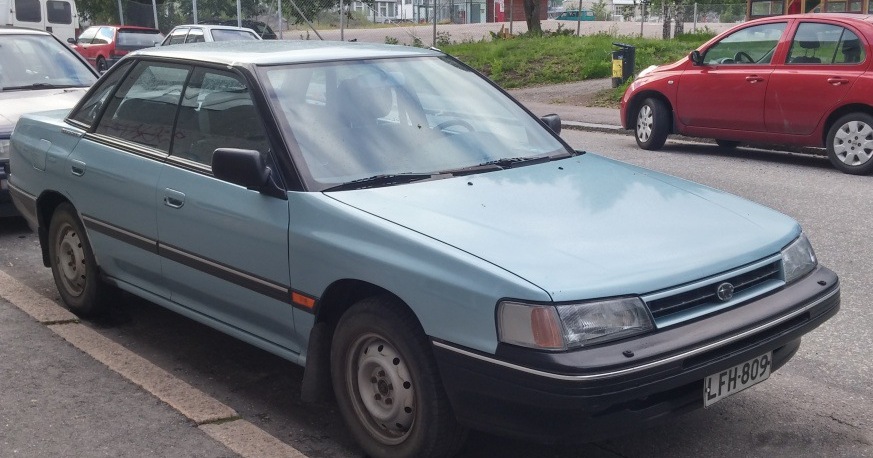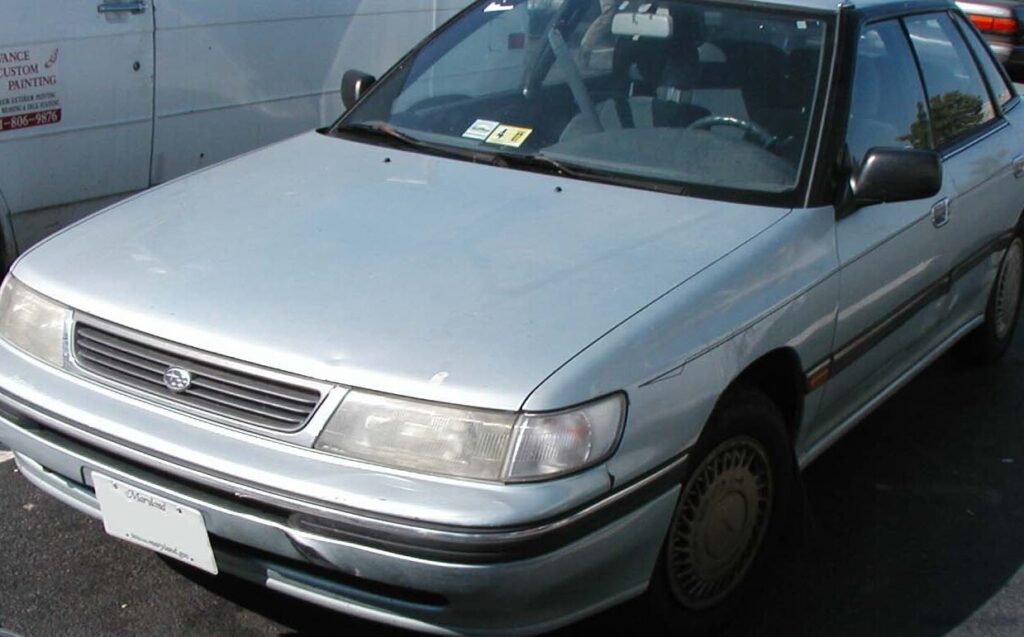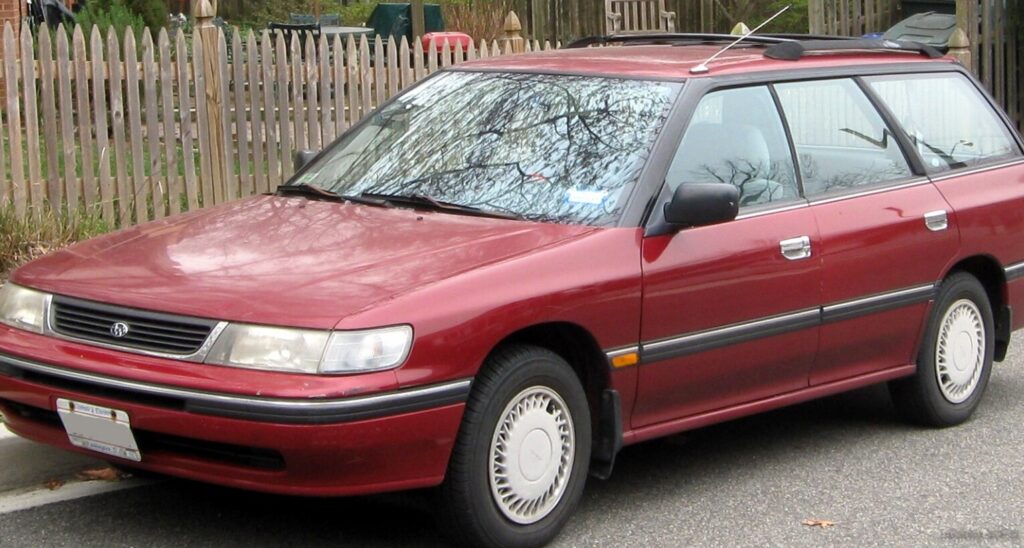
The Subaru Legacy I Station Wagon, specifically the BJF facelift model produced from 1991 to 1994, marked a significant advancement for Subaru in the station wagon segment. This variant, equipped with a 2.0-liter turbocharged engine generating 200 horsepower and featuring all-wheel drive (AWD), was positioned as a performance-focused option within the Legacy lineup. It appealed to buyers desiring a practical family vehicle with enhanced driving dynamics and all-weather capability. The BJF facelift introduced styling updates and refinements to the original Legacy, solidifying its appeal in both the Japanese domestic market and export regions.
Technical Specifications
| Brand | Subaru |
| Model | Legacy |
| Generation | Legacy I Station Wagon (BJF, facelift 1991) |
| Type (Engine) | 2000 turbo (200 Hp) AWD |
| Start of production | 1991 |
| End of production | 1994 |
| Powertrain Architecture | Internal Combustion engine |
| Body type | Station wagon (estate) |
| Seats | 5 |
| Doors | 5 |
| Fuel consumption (urban) | 12.3 l/100 km (19.1 US mpg / 23 UK mpg / 8.1 km/l) |
| Fuel consumption (extra urban) | 7.4 l/100 km (31.8 US mpg / 38.2 UK mpg / 13.5 km/l) |
| Fuel consumption (combined) | 9.6 l/100 km (24.5 US mpg / 29.4 UK mpg / 10.4 km/l) |
| Fuel Type | Petrol (Gasoline) |
| Acceleration 0 – 100 km/h | 7 sec |
| Acceleration 0 – 62 mph | 7 sec |
| Acceleration 0 – 60 mph | 6.7 sec |
| Maximum speed | 220 km/h (136.7 mph) |
| Weight-to-power ratio | 7.2 kg/Hp, 139.9 Hp/tonne |
| Weight-to-torque ratio | 5.5 kg/Nm, 181.8 Nm/tonne |
| Power | 200 Hp @ 6000 rpm |
| Power per litre | 100.3 Hp/l |
| Torque | 260 Nm @ 3600 rpm (191.77 lb.-ft. @ 3600 rpm) |
| Engine layout | Front, Longitudinal |
| Engine Model/Code | EJ20G |
| Engine displacement | 1994 cm3 (121.68 cu. in.) |
| Number of cylinders | 4 |
| Engine configuration | Boxer |
| Cylinder Bore | 92 mm (3.62 in.) |
| Piston Stroke | 75 mm (2.95 in.) |
| Compression ratio | 8:1 |
| Number of valves per cylinder | 4 |
| Fuel injection system | Multi-port manifold injection |
| Engine aspiration | Turbocharger |
| Valvetrain | DOHC |
| Engine oil capacity | 4.5 l (4.76 US qt | 3.96 UK qt) |
| Coolant | 6.1 l (6.45 US qt | 5.37 UK qt) |
| Kerb Weight | 1430 kg (3152.61 lbs.) |
| Max. weight | 1950 kg (4299.01 lbs.) |
| Max load | 520 kg (1146.4 lbs.) |
| Trunk (boot) space – minimum | 420 l (14.83 cu. ft.) |
| Trunk (boot) space – maximum | 1550 l (54.74 cu. ft.) |
| Fuel tank capacity | 60 l (15.85 US gal | 13.2 UK gal) |
| Max. roof load | 100 kg (220.46 lbs.) |
| Permitted trailer load with brakes (12%) | 1000 kg (2204.62 lbs.) |
| Permitted trailer load without brakes | 500 kg (1102.31 lbs.) |
| Permitted towbar download | 75 kg (165.35 lbs.) |
| Length | 4620 mm (181.89 in.) |
| Width | 1690 mm (66.54 in.) |
| Height | 1465 mm (57.68 in.) |
| Wheelbase | 2580 mm (101.57 in.) |
| Front track | 1465 mm (57.68 in.) |
| Rear (Back) track | 1450 mm (57.09 in.) |
| Minimum turning circle | 10.1 m (33.14 ft.) |
| Drive wheel | All wheel drive (4×4) |
| Number of gears and type of gearbox | 5 gears, manual transmission |
| Front suspension | Independent type McPherson |
| Rear suspension | Several levers and rods |
| Front brakes | Disc |
| Rear brakes | Disc |
| Assisting systems | ABS (Anti-lock braking system) |
| Steering type | Steering rack and pinion |
| Power steering | Hydraulic Steering |
| Tires size | 205/60 R15V |
| Wheel rims size | 15 |
Powertrain & Engine Architecture
The core of the Legacy I Station Wagon 2.0 Turbo was the EJ20G engine, a 1994cc, horizontally-opposed (boxer) four-cylinder. This engine embodied Subaru’s engineering philosophy, providing a low center of gravity for enhanced handling. The EJ20G featured a single turbocharger, multi-port fuel injection, and a dual overhead camshaft (DOHC) valvetrain. The 8:1 compression ratio was standard for a turbocharged engine, enabling increased power output without pre-ignition. The engine generated 200 horsepower at 6000 rpm and 260 Nm (191.77 lb-ft) of torque at 3600 rpm. This power was channeled to all four wheels through a standard five-speed manual transmission. The longitudinally mounted engine and symmetrical all-wheel drive system were integral to Subaru’s reputation for stability and traction.
Driving Characteristics
The 2.0-liter turbo engine delivered a significant performance improvement over the naturally aspirated Legacy models. Acceleration from 0 to 60 mph was approximately 6.7 seconds, with a top speed of 220 km/h (136.7 mph). While not a dedicated sports car, the Legacy Turbo offered brisk acceleration and confident passing power. The all-wheel drive system provided exceptional grip in diverse weather conditions, making it a practical choice for drivers in areas prone to snow or rain. The manual transmission provided precise shifts, and the turbocharger delivered a surge of power in the mid-range. Compared to the non-turbo versions, the 2.0 Turbo felt considerably more responsive and engaging to drive.
Equipment & Trim Levels
The Legacy I Station Wagon 2.0 Turbo was typically well-equipped for its era. Standard features included power windows, power locks, and air conditioning. Higher trim levels offered options such as a sunroof, upgraded audio systems, and leather upholstery. The interior was functional and comfortable, prioritizing practicality. The station wagon body style provided generous cargo space, making it suitable for families and those needing to transport larger items. The dashboard layout was straightforward and user-friendly, with clearly labeled controls.
Chassis & Braking
The Legacy I Station Wagon featured an independent McPherson strut front suspension and a multi-link rear suspension. This configuration provided a comfortable ride while maintaining good handling characteristics. Disc brakes were fitted on all four wheels, and an anti-lock braking system (ABS) was standard, enhancing safety. The steering was rack-and-pinion with hydraulic power assistance, offering precise and responsive steering feel. The car’s weight distribution, aided by the boxer engine, contributed to its balanced handling.
Market Reception & Comparison
The Subaru Legacy I Station Wagon 2.0 Turbo received generally positive reviews from automotive critics. It was lauded for its performance, all-wheel drive system, and practicality. Compared to other station wagons of the time, the Legacy Turbo offered a unique blend of features and performance. Fuel economy was reasonable for a turbocharged vehicle, averaging around 24.5 US mpg in combined driving. Reliability was generally good, although turbocharger maintenance was a consideration. The Legacy Turbo competed with other performance-oriented station wagons, such as the Volvo 240 Turbo and the Audi 80 Quattro.
Legacy
The EJ20G engine and the Legacy’s all-wheel drive system became defining characteristics of Subaru’s engineering expertise. The Legacy I Station Wagon 2.0 Turbo remains a desirable vehicle among Subaru enthusiasts. While locating well-maintained examples can be challenging, these cars offer a distinctive driving experience and a glimpse into Subaru’s heritage. The EJ20G engine, while capable, requires consistent maintenance to ensure longevity, particularly concerning the turbocharger. Today, these vehicles are often cherished by collectors and enthusiasts who appreciate their performance and unique character.