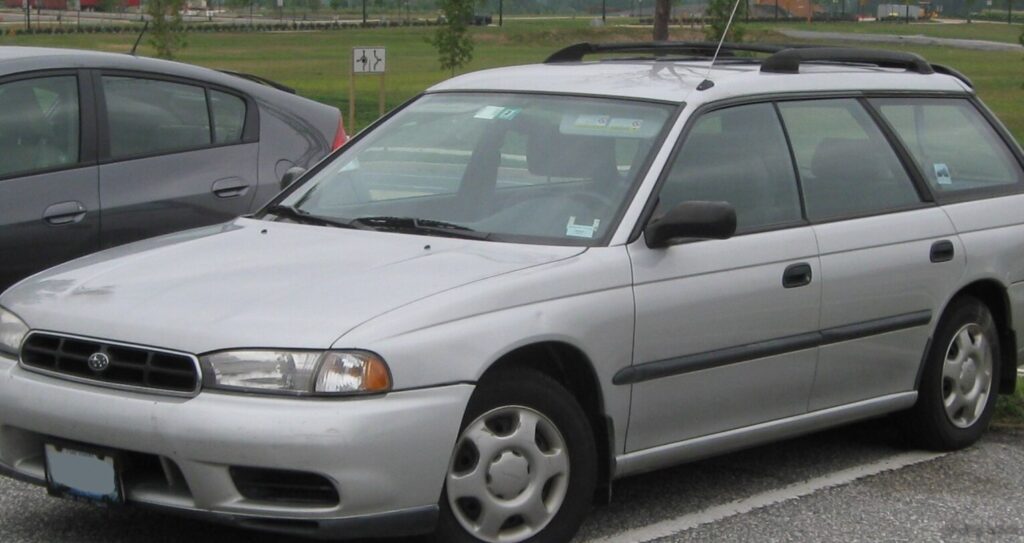
The Subaru Legacy II Station Wagon, internally designated as the BD and BG series, represented Subaru’s second-generation offering in the mid-size wagon segment. Produced between 1993 and 1998, this model built upon the success of the original Legacy, offering increased refinement, safety features, and a continued emphasis on Subaru’s signature symmetrical all-wheel drive system. The 2.0-liter (116 hp) AWD variant occupied a central position within the Legacy II wagon lineup, providing a balance between performance, fuel economy, and affordability. It served as a practical and reliable family vehicle, particularly popular in markets where all-weather capability was highly valued.
Technical Specifications
| Brand | Subaru |
| Model | Legacy |
| Generation | Legacy II Station Wagon (BD,BG) |
| Type (Engine) | 2.0 (116 Hp) AWD |
| Start of production | 1993 |
| End of production | 1998 |
| Powertrain Architecture | Internal Combustion engine |
| Body type | Station wagon (estate) |
| Seats | 5 |
| Doors | 5 |
| Fuel consumption (combined) | 9.2 l/100 km (25.6 US mpg, 30.7 UK mpg, 10.9 km/l) |
| Fuel Type | Petrol (Gasoline) |
| Acceleration 0 – 100 km/h | 10.5 sec |
| Acceleration 0 – 62 mph | 10.5 sec |
| Acceleration 0 – 60 mph | 10 sec |
| Maximum speed | 184 km/h (114.33 mph) |
| Weight-to-power ratio | 11.6 kg/Hp, 86.6 Hp/tonne |
| Weight-to-torque ratio | 7.9 kg/Nm, 126.9 Nm/tonne |
| Power | 116 Hp @ 5600 rpm |
| Power per litre | 58.2 Hp/l |
| Torque | 170 Nm @ 4000 rpm (125.39 lb.-ft. @ 4000 rpm) |
| Engine layout | Front, Longitudinal |
| Engine Model/Code | EJ20 |
| Engine displacement | 1994 cm3 (121.68 cu. in.) |
| Number of cylinders | 4 |
| Engine configuration | Boxer |
| Cylinder Bore | 92 mm (3.62 in.) |
| Piston Stroke | 75 mm (2.95 in.) |
| Compression ratio | 9.5:1 |
| Number of valves per cylinder | 4 |
| Fuel injection system | Multi-port manifold injection |
| Engine aspiration | Naturally aspirated engine |
| Engine oil capacity | 4 l (4.23 US qt | 3.52 UK qt) |
| Coolant capacity | 6 l (6.34 US qt | 5.28 UK qt) |
| Kerb Weight | 1340 kg (2954.19 lbs.) |
| Max. weight | 1870 kg (4122.64 lbs.) |
| Max load | 530 kg (1168.45 lbs.) |
| Trunk (boot) space – minimum | 488 l (17.23 cu. ft.) |
| Trunk (boot) space – maximum | 700 l (24.72 cu. ft.) |
| Fuel tank capacity | 60 l (15.85 US gal | 13.2 UK gal) |
| Length | 4670 mm (183.86 in.) |
| Width | 1695 mm (66.73 in.) |
| Height | 1490 mm (58.66 in.) |
| Wheelbase | 2630 mm (103.54 in.) |
| Front track | 1460 mm (57.48 in.) |
| Rear (Back) track | 1455 mm (57.28 in.) |
| Drive wheel | All wheel drive (4×4) |
| Number of gears and type of gearbox | 5 gears, manual transmission |
| Front suspension | Wishbone |
| Rear suspension | Several levers and rods |
| Front brakes | Ventilated discs |
| Rear brakes | Drum |
| Assisting systems | ABS (Anti-lock braking system) |
| Steering type | Steering rack and pinion |
| Power steering | Hydraulic Steering |
| Tires size | 185/70 R14 |
| Wheel rims size | 14 |
INTRODUCTION
The Subaru Legacy II Station Wagon 2.0 AWD, produced from 1993 to 1998, was a key model in Subaru’s lineup, representing a significant evolution of the original Legacy. Built on the BD/BG platform, this generation offered a more refined driving experience, improved safety features, and a spacious interior. The 2.0-liter engine, designated as the EJ20, provided a balance of power and fuel efficiency, making it a popular choice for families and individuals seeking a practical and reliable all-weather vehicle. This variant was particularly well-suited for regions with inclement weather, thanks to Subaru’s renowned symmetrical all-wheel drive system.
Powertrain & Engine Architecture
At the heart of the Legacy II 2.0 AWD was the EJ20 engine, a 1994cc, naturally aspirated, four-cylinder boxer engine. Subaru’s boxer configuration, with horizontally opposed pistons, offered inherent balance and a low center of gravity, contributing to the car’s stable handling. The EJ20 featured multi-port fuel injection, delivering fuel directly into the intake ports for improved combustion efficiency. The engine produced 116 horsepower at 5600 rpm and 170 Nm (125 lb-ft) of torque at 4000 rpm. This power was delivered to all four wheels through a five-speed manual transmission. The engine’s design prioritized reliability and longevity, utilizing robust components and a relatively simple layout. The use of a timing belt, rather than a chain, meant scheduled replacement was necessary to prevent catastrophic engine failure.
Driving Characteristics
The 2.0-liter engine, paired with the five-speed manual transmission, provided adequate performance for everyday driving. Acceleration from 0 to 60 mph took approximately 10 seconds, and the top speed was around 114 mph. While not a performance-oriented vehicle, the Legacy II 2.0 AWD offered smooth and predictable power delivery. The all-wheel drive system provided excellent traction in various conditions, enhancing stability and control, especially on slippery surfaces. Compared to higher-output versions, such as the 2.2-liter engine, the 2.0-liter model felt less powerful, particularly during overtaking maneuvers. However, it offered better fuel economy and a more relaxed driving experience. The gear ratios were well-matched for everyday use, providing sufficient torque in most situations.
Equipment & Trim Levels
The Legacy II 2.0 AWD typically came equipped with a range of standard features, including power steering, ABS brakes, and a basic audio system. Interior upholstery was typically cloth, with a functional and durable design. Depending on the specific trim level, optional extras could include power windows, power locks, a sunroof, and upgraded audio systems. The dashboard layout was straightforward and user-friendly, with clearly labeled controls. Higher trim levels often featured woodgrain accents and more comfortable seating. The station wagon body style offered a generous amount of cargo space, making it ideal for families and those needing to transport larger items.
Chassis & Braking
The Legacy II utilized a robust chassis with independent front suspension (wishbone) and a multi-link rear suspension. This suspension setup provided a comfortable ride and good handling characteristics. The front brakes were ventilated discs, offering strong stopping power, while the rear brakes were drums. The ABS system helped to prevent wheel lockup during hard braking, enhancing safety. The steering was rack and pinion, providing precise and responsive control. The all-wheel drive system added to the vehicle’s stability and traction, particularly in adverse weather conditions. The suspension was tuned for comfort, but still provided adequate control during cornering.
Market Reception & Comparison
The Subaru Legacy II Station Wagon 2.0 AWD was generally well-received by critics and consumers alike. It was praised for its practicality, reliability, and all-weather capability. Compared to other mid-size wagons of the time, the Legacy II offered a unique combination of features, including the symmetrical all-wheel drive system. Fuel economy was considered average for its class, and reliability was generally good, although the timing belt required regular maintenance. The 2.0-liter engine was seen as a good compromise between performance and fuel efficiency, making it a popular choice for those who didn’t require the extra power of the larger engines. Compared to the 2.2-liter models, the 2.0-liter variant was more affordable and offered slightly better fuel economy.
Legacy
The Subaru Legacy II Station Wagon 2.0 AWD has proven to be a durable and reliable vehicle, with many examples still on the road today. The EJ20 engine, while requiring regular maintenance (particularly timing belt replacement), is known for its longevity. In the used car market, these models are often sought after for their affordability, practicality, and all-wheel drive capability. While not a collector’s item, the Legacy II 2.0 AWD remains a popular choice for those seeking a dependable and versatile vehicle. Its reputation for reliability and its ability to handle challenging weather conditions have cemented its place as a practical and enduring family wagon.