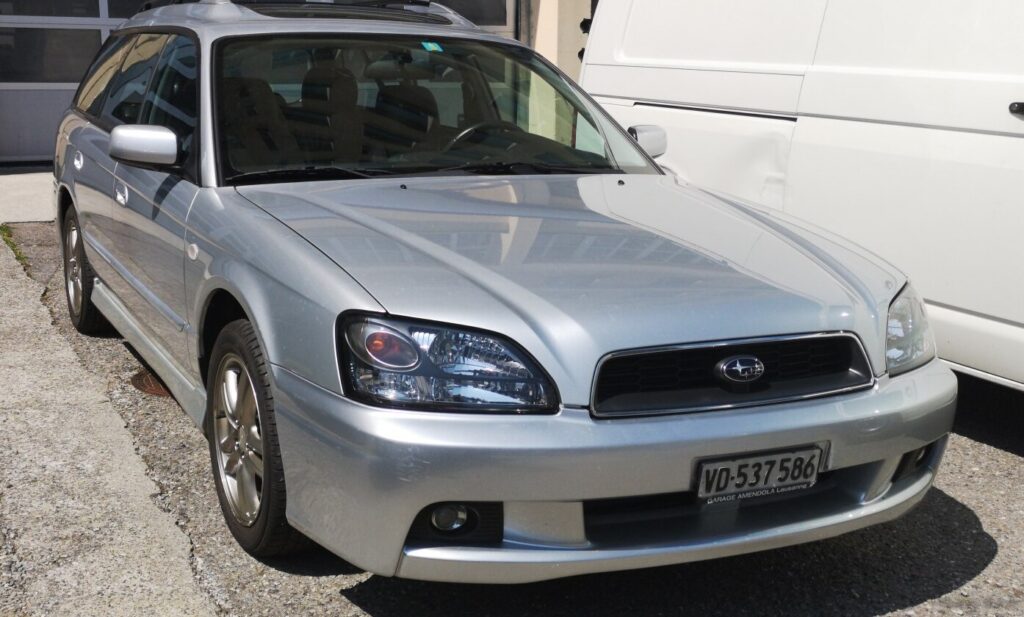
The Subaru Legacy III Station Wagon, specifically the BE/BH series produced from 2001 to 2003, represented a significant evolution of Subaru’s popular family vehicle. This facelifted version of the third-generation Legacy offered a blend of practicality, safety, and Subaru’s signature symmetrical all-wheel drive. The 2.5-liter variant, producing 156 horsepower, occupied a middle ground in the Legacy wagon lineup, positioned above the base 2.2-liter models and below the more performance-oriented turbocharged options. It was primarily marketed towards families and individuals seeking a versatile vehicle capable of handling diverse weather conditions and carrying substantial cargo.
Technical Specifications
| Brand | Subaru |
| Model | Legacy |
| Generation | Legacy III Station Wagon (BE,BH, facelift 2001) |
| Type (Engine) | 2.5 (156 Hp) AWD |
| Start of production | 2001 |
| End of production | 2003 |
| Powertrain Architecture | Internal Combustion engine |
| Body type | Station wagon (estate) |
| Seats | 5 |
| Doors | 5 |
| Fuel Type | Petrol (Gasoline) |
| Power | 156 Hp @ 5600 rpm |
| Power per litre | 63.5 Hp/l |
| Torque | 223 Nm @ 3600 rpm / 164.48 lb.-ft. @ 3600 rpm |
| Engine layout | Front, Longitudinal |
| Engine Model/Code | EJ25 |
| Engine displacement | 2457 cm3 / 149.94 cu. in. |
| Number of cylinders | 4 |
| Engine configuration | Boxer |
| Cylinder Bore | 99.5 mm / 3.92 in. |
| Piston Stroke | 79 mm / 3.11 in. |
| Compression ratio | 10:1 |
| Number of valves per cylinder | 4 |
| Fuel injection system | Multi-port manifold injection |
| Engine aspiration | Naturally aspirated engine |
| Valvetrain | SOHC |
| Engine oil capacity | 4.5 l / 4.76 US qt | 3.96 UK qt |
| Coolant | 6.8 l / 7.19 US qt | 5.98 UK qt |
| Max. weight | 1980 kg / 4365.15 lbs |
| Trunk (boot) space – minimum | 528 l / 18.65 cu. ft |
| Trunk (boot) space – maximum | 1646 l / 58.13 cu. ft |
| Fuel tank capacity | 64 l / 16.91 US gal | 14.08 UK gal |
| Length | 4760 mm / 187.4 in |
| Width | 1745 mm / 68.7 in |
| Height | 1525 mm / 60.04 in |
| Wheelbase | 2650 mm / 104.33 in |
| Front track | 1460 mm / 57.48 in |
| Rear (Back) track | 1455 mm / 57.28 in |
| Ride height (ground clearance) | 160 mm / 6.3 in |
| Minimum turning circle (turning diameter) | 11.5 m / 37.73 ft |
| Drive wheel | All wheel drive (4×4) |
| Number of gears and type of gearbox | 5 gears, manual transmission |
| Front suspension | Independent type McPherson |
| Rear suspension | Independent multi-link suspension |
| Front brakes | Ventilated discs |
| Rear brakes | Disc |
| Assisting systems | ABS (Anti-lock braking system) |
| Steering type | Steering rack and pinion |
| Power steering | Hydraulic Steering |
| Tires size | 205/50 R16 |
| Wheel rims size | 6.5J x 16 |
Powertrain & Engine Architecture
The heart of the 2001-2003 Subaru Legacy III 2.5 wagon was the EJ25 engine, a 2.5-liter naturally aspirated boxer-four. Subaru’s horizontally opposed “boxer” configuration, where pistons move horizontally rather than vertically, provides inherent balance, reducing vibrations and contributing to a smoother driving experience. The EJ25 featured a single overhead camshaft (SOHC) design, operating four valves per cylinder. Fuel delivery was managed by a multi-port fuel injection system, providing precise fuel metering for optimal combustion. The engine produced 156 horsepower at 5600 rpm and 223 Nm (164.48 lb-ft) of torque at 3600 rpm. This engine was paired with a five-speed manual transmission as standard, offering drivers a direct connection to the powertrain. While an automatic transmission was available, it impacted performance and fuel economy.
Driving Characteristics
The 2.5-liter engine in the Legacy wagon provided adequate, though not exhilarating, performance. Acceleration was respectable for everyday driving, but it wasn’t designed for sporty driving. The symmetrical all-wheel drive system provided excellent traction in various conditions, making it a capable vehicle in snow, rain, and on gravel roads. The five-speed manual transmission allowed drivers to keep the engine in its optimal power band, while the automatic transmission, though convenient, resulted in noticeable power loss and less responsive acceleration. The boxer engine’s low center of gravity contributed to stable handling, and the independent suspension provided a comfortable ride, even on uneven surfaces.
Equipment & Trim Levels
The 2.5-liter Legacy wagon typically came equipped with a reasonable level of standard features. These included power windows, power locks, air conditioning, and an AM/FM stereo. Higher trim levels offered upgrades such as alloy wheels, a sunroof, upgraded audio systems, and leather upholstery. Safety features like anti-lock brakes (ABS) were standard across the range. The interior design was functional and straightforward, prioritizing practicality over luxury. The wagon’s spacious interior and large cargo area made it ideal for families and those needing to transport bulky items.
Chassis & Braking
The Legacy wagon utilized a McPherson strut front suspension and a multi-link rear suspension, providing a good balance of ride comfort and handling. Ventilated disc brakes were used on the front wheels, while the rear brakes were typically solid discs. The all-wheel drive system employed a viscous limited-slip center differential, distributing power between the front and rear axles as needed. Steering was rack-and-pinion with hydraulic power assistance, offering precise and responsive steering feel. The vehicle’s relatively low ride height (160mm / 6.3 inches) contributed to its stability and handling.
Market Reception & Comparison
The Subaru Legacy III wagon, particularly the 2.5-liter variant, was well-received by critics and consumers alike. It was praised for its practicality, safety, and all-weather capability. Compared to its competitors, such as the Toyota Camry Wagon or Honda Accord Wagon, the Legacy offered a unique combination of features, including standard all-wheel drive. The 2.5-liter engine provided a good balance of power and fuel economy, although it wasn’t as fuel-efficient as the base 2.2-liter models. The turbocharged variants offered significantly more performance but came at a higher price point. Reliability was generally good, although some owners reported issues with the head gasket, a common problem with early EJ25 engines.
Legacy
The Subaru Legacy III wagon, including the 2.5-liter variant, has maintained a solid reputation for reliability and durability. While not as sought after as some of the more performance-oriented Subaru models, it remains a popular choice for those seeking a practical and dependable family vehicle. The EJ25 engine, despite its potential for head gasket issues, is relatively easy to maintain and repair. Today, well-maintained examples of the 2001-2003 Legacy wagon can be found on the used car market at affordable prices, offering a compelling value proposition for buyers seeking a versatile and capable vehicle.