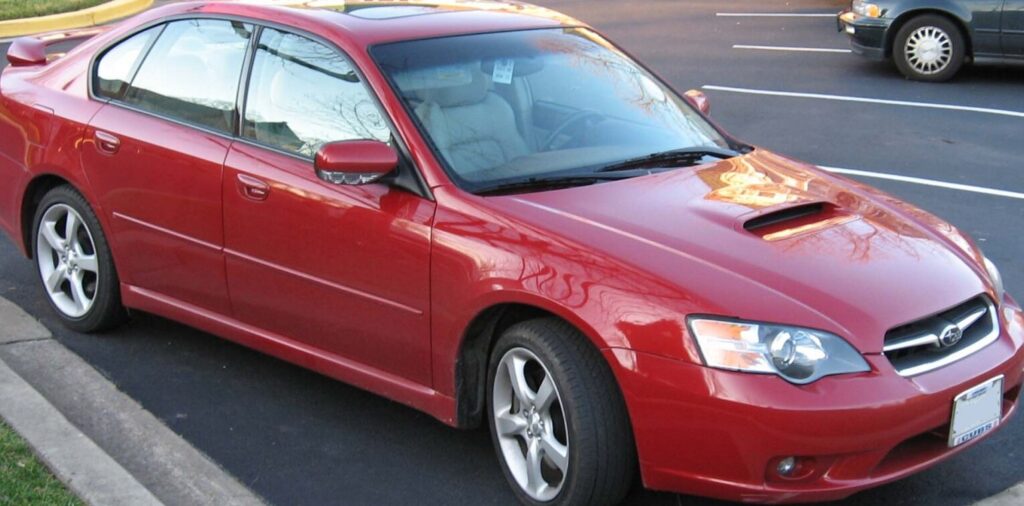
The Subaru Legacy IV 2.0i, equipped with a 138 horsepower engine and an automatic transmission, was a significant model in Subaru’s lineup from 2003 to 2005. Representing the fourth generation of the Legacy (internally designated the BE/BH platform), this variant aimed to provide a comfortable and capable all-weather sedan for families and commuters. It occupied a middle ground within the Legacy range, offering a balance between affordability and features compared to the more powerful turbocharged models and the base 2.5-liter engine option. This model was primarily sold in markets like North America, Europe, and Australia, where Subaru’s symmetrical all-wheel drive system was highly valued.
Technical Specifications
| Brand | Subaru |
| Model | Legacy |
| Generation | Legacy IV |
| Type (Engine) | 2.0i (138 Hp) AWD Automatic |
| Start of production | 2003 |
| End of production | 2005 |
| Powertrain Architecture | Internal Combustion engine |
| Body type | Sedan |
| Seats | 5 |
| Doors | 4 |
| Fuel consumption (urban) | 10.4 l/100 km (22.6 US mpg, 27.2 UK mpg, 9.6 km/l) |
| Fuel consumption (extra urban) | 5.9 l/100 km (39.9 US mpg, 47.9 UK mpg, 16.9 km/l) |
| Fuel consumption (combined) | 7.5 l/100 km (31.4 US mpg, 37.7 UK mpg, 13.3 km/l) |
| CO2 emissions | 178 g/km |
| Fuel Type | Petrol (Gasoline) |
| Acceleration 0 – 100 km/h | 13 sec |
| Acceleration 0 – 62 mph | 13 sec |
| Acceleration 0 – 60 mph | 12.4 sec |
| Maximum speed | 191 km/h (118.68 mph) |
| Emission standard | Euro 3 |
| Weight-to-power ratio | 9.8 kg/Hp, 102.2 Hp/tonne |
| Weight-to-torque ratio | 7.2 kg/Nm, 138.5 Nm/tonne |
| Power | 138 Hp @ 5600 rpm |
| Torque | 187 Nm @ 4400 rpm (137.92 lb.-ft. @ 4400 rpm) |
| Engine layout | Front, Longitudinal |
| Engine Model/Code | EJ202 |
| Engine displacement | 1994 cm3 (121.68 cu. in.) |
| Number of cylinders | 4 |
| Engine configuration | Boxer |
| Cylinder Bore | 92 mm (3.62 in.) |
| Piston Stroke | 75 mm (2.95 in.) |
| Compression ratio | 10:1 |
| Number of valves per cylinder | 4 |
| Fuel injection system | Multi-port manifold injection |
| Engine aspiration | Naturally aspirated engine |
| Engine oil capacity | 4.2 l (4.44 US qt | 3.7 UK qt) |
| Coolant | 6.4 l (6.76 US qt | 5.63 UK qt) |
| Kerb Weight | 1350 kg (2976.24 lbs.) |
| Max. weight | 1900 kg (4188.78 lbs.) |
| Max load | 550 kg (1212.54 lbs.) |
| Trunk (boot) space – minimum | 433 l (15.29 cu. ft.) |
| Fuel tank capacity | 64 l (16.91 US gal | 14.08 UK gal) |
| Max. roof load | 80 kg (176.37 lbs.) |
| Permitted trailer load with brakes (12%) | 1500 kg (3306.93 lbs.) |
| Permitted trailer load without brakes | 700 kg (1543.24 lbs.) |
| Length | 4665 mm (183.66 in.) |
| Width | 1730 mm (68.11 in.) |
| Height | 1425 mm (56.1 in.) |
| Wheelbase | 2670 mm (105.12 in.) |
| Front track | 1495 mm (58.86 in.) |
| Rear (Back) track | 1490 mm (58.66 in.) |
| Drive wheel | All wheel drive (4×4) |
| Number of gears and type of gearbox | 4 gears, automatic transmission |
| Front suspension | Spring Strut |
| Rear suspension | Coil spring |
| Front brakes | Ventilated discs |
| Rear brakes | Disc |
| Assisting systems | ABS (Anti-lock braking system) |
| Steering type | Steering rack and pinion |
| Power steering | Hydraulic Steering |
| Tires size | 205/55 R16 |
| Wheel rims size | 6.5J x 16 |
Powertrain & Engine Architecture
The heart of the Legacy IV 2.0i was the EJ202 engine, a 1994cc (121.68 cu. in.) naturally aspirated, horizontally-opposed (boxer) four-cylinder. This engine was a hallmark of Subaru, known for its smooth operation and low center of gravity, contributing to the car’s handling balance. The EJ202 featured multi-port fuel injection and a single overhead camshaft (SOHC) design with four valves per cylinder. The engine produced 138 horsepower at 5600 rpm and 187 Nm (137.92 lb.-ft.) of torque at 4400 rpm. The automatic transmission was a conventional four-speed unit, designed for smooth shifts and ease of use. While not particularly sporty, it provided adequate performance for everyday driving. The engine code, EJ202, is crucial for identifying specific parts and maintenance requirements.
Driving Characteristics
The 2.0i automatic Legacy offered a comfortable, if not exhilarating, driving experience. Acceleration from 0-60 mph took around 12.4 seconds, and 0-100 km/h in 13 seconds. Compared to the available five-speed manual transmission, the automatic resulted in a slight performance decrease due to power loss through the torque converter. The all-wheel drive system provided excellent traction in various weather conditions, a key selling point for Subaru. The automatic transmission’s gear ratios were tuned for fuel efficiency and smooth cruising, rather than aggressive acceleration. The boxer engine’s inherent balance contributed to reduced vibrations, enhancing ride comfort.
Equipment & Trim Levels
The 2.0i trim typically included standard features such as air conditioning, power windows and locks, a CD player, and ABS brakes. Higher trim levels, often denoted with suffixes like “Limited” or “LX,” added features like leather upholstery, a sunroof, upgraded audio systems, and alloy wheels. Interior upholstery was generally cloth in the base 2.0i, with optional leather available. The dashboard layout was functional and straightforward, prioritizing usability over flashy design. Optional extras included a navigation system (a relatively new feature at the time) and heated front seats.
Chassis & Braking
The Legacy IV utilized a MacPherson strut front suspension and a coil spring rear suspension. The suspension was tuned for a balance between comfort and handling. Braking duties were handled by ventilated discs at the front and solid discs at the rear. ABS was standard, providing enhanced braking control in emergency situations. The chassis was designed to provide a stable and predictable driving experience, with a focus on all-weather capability. Stabilizer bars were included to reduce body roll during cornering.
Market Reception & Comparison
The Legacy IV 2.0i Automatic was generally well-received by automotive critics as a practical and reliable family sedan. It was praised for its all-wheel drive system, comfortable ride, and spacious interior. However, some reviewers noted that the engine lacked the punch of the turbocharged options and that the automatic transmission wasn’t as engaging as the manual. Fuel economy was considered average for its class. Compared to the more powerful 2.5L and turbocharged models, the 2.0i was positioned as the entry-level option, appealing to buyers prioritizing affordability and fuel efficiency over outright performance.
Legacy
The EJ202 engine, while generally reliable, is known to require regular maintenance, particularly regarding oil changes. The timing belt requires replacement at specified intervals to prevent catastrophic engine failure. The automatic transmission, if properly maintained, is also relatively durable. Today, the Legacy IV 2.0i Automatic can be found in the used car market at affordable prices. It remains a viable option for buyers seeking a dependable and all-weather capable sedan, though potential buyers should be aware of the maintenance requirements associated with the EJ202 engine and the age of the vehicle.