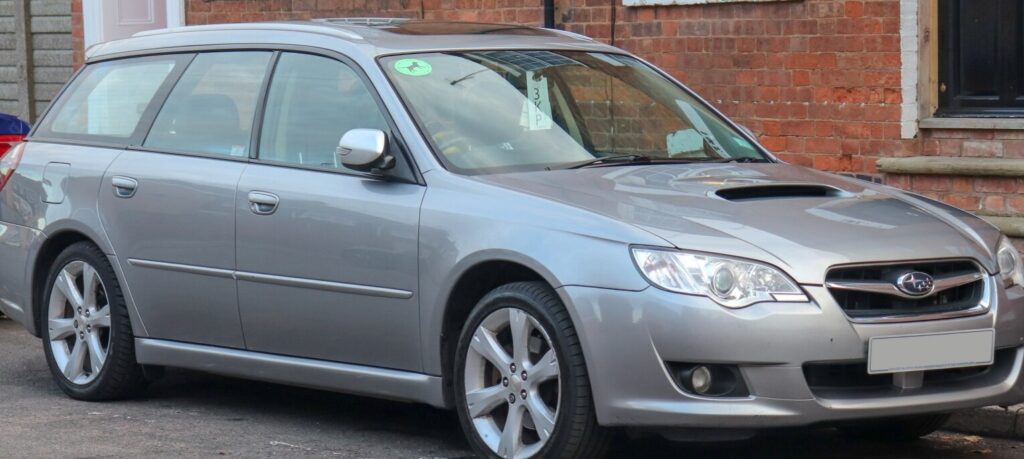
The Subaru Legacy IV Station Wagon, specifically the 2.0R variant with all-wheel drive and an automatic transmission, represented a key offering in Subaru’s lineup from 2007 to 2008. This model was part of the fourth-generation Legacy (BL/BP chassis), which underwent a facelift in 2006, bringing revised styling and some mechanical updates. Positioned as a mid-range trim, the 2.0R offered a balance between performance, practicality, and affordability within the Legacy wagon range, appealing to families and individuals seeking a versatile vehicle with Subaru’s renowned symmetrical all-wheel drive system. It sat above the base 2.5i models and below the more powerful 2.5GT specification.
Technical Specifications
| Brand | Subaru |
| Model | Legacy |
| Generation | Legacy IV Station Wagon (facelift 2006) |
| Type (Engine) | 2.0R (150 Hp) AWD Automatic |
| Start of production | 2007 |
| End of production | 2008 |
| Powertrain Architecture | Internal Combustion engine |
| Body type | Station wagon (estate) |
| Seats | 5 |
| Doors | 5 |
| Fuel consumption (urban) | 11.7 l/100 km (20.1 US mpg, 24.1 UK mpg, 8.5 km/l) |
| Fuel consumption (extra urban) | 6.6 l/100 km (35.6 US mpg, 42.8 UK mpg, 15.2 km/l) |
| Fuel consumption (combined) | 8.5 l/100 km (27.7 US mpg, 33.2 UK mpg, 11.8 km/l) |
| CO2 emissions | 200 g/km |
| Fuel Type | Petrol (Gasoline) |
| Acceleration 0 – 100 km/h | 11.8 sec |
| Acceleration 0 – 62 mph | 11.8 sec |
| Acceleration 0 – 60 mph | 11.2 sec |
| Maximum speed | 191 km/h (118.68 mph) |
| Emission standard | Euro 4 |
| Weight-to-power ratio | 9.9 kg/Hp, 101.4 Hp/tonne |
| Weight-to-torque ratio | 7.6 kg/Nm, 132.4 Nm/tonne |
| Power | 150 Hp @ 6000 rpm |
| Power per litre | 75.2 Hp/l |
| Torque | 196 Nm @ 3200 rpm (144.56 lb.-ft. @ 3200 rpm) |
| Engine layout | Front, Longitudinal |
| Engine Model/Code | EJ204 |
| Engine displacement | 1994 cm3 (121.68 cu. in.) |
| Number of cylinders | 4 |
| Engine configuration | Boxer |
| Cylinder Bore | 92 mm (3.62 in.) |
| Piston Stroke | 75 mm (2.95 in.) |
| Compression ratio | 11.1:1 |
| Number of valves per cylinder | 4 |
| Fuel injection system | Multi-port manifold injection |
| Engine aspiration | Naturally aspirated engine |
| Valvetrain | SOHC |
| Engine oil capacity | 4.2 l (4.44 US qt | 3.7 UK qt) |
| Coolant | 6.4 l (6.76 US qt | 5.63 UK qt) |
| Kerb Weight | 1480 kg (3262.84 lbs.) |
| Max. weight | 1945 kg (4287.99 lbs.) |
| Max load | 465 kg (1025.15 lbs.) |
| Trunk (boot) space – minimum | 459 l (16.21 cu. ft.) |
| Trunk (boot) space – maximum | 1649 l (58.23 cu. ft.) |
| Fuel tank capacity | 64 l (16.91 US gal | 14.08 UK gal) |
| Max. roof load | 100 kg (220.46 lbs.) |
| Permitted trailer load with brakes (12%) | 1600 kg (3527.4 lbs.) |
| Permitted trailer load without brakes | 735 kg (1620.4 lbs.) |
| Permitted towbar download | 82 kg (180.78 lbs.) |
| Length | 4795 mm (188.78 in.) |
| Width | 1730 mm (68.11 in.) |
| Height | 1475 mm (58.07 in.) |
| Wheelbase | 2670 mm (105.12 in.) |
| Front track | 1495 mm (58.86 in.) |
| Rear (Back) track | 1485 mm (58.46 in.) |
| Ride height (ground clearance) | 150 mm (5.91 in.) |
| Minimum turning circle (turning diameter) | 11.6 m (38.06 ft.) |
| Drive wheel | All wheel drive (4×4) |
| Number of gears and type of gearbox | 4 gears, automatic transmission |
| Front suspension | Spring Strut |
| Rear suspension | Coil spring |
| Front brakes | Ventilated discs |
| Rear brakes | Disc |
| Assisting systems | ABS (Anti-lock braking system) |
| Steering type | Steering rack and pinion |
| Power steering | Hydraulic Steering |
| Tires size | 215/45 R17 |
| Wheel rims size | 17 |
Powertrain & Engine Architecture
The heart of the 2.0R was the EJ204 engine, a 2.0-liter (1994 cc) naturally aspirated, horizontally-opposed (boxer) four-cylinder. This engine was a staple of Subaru’s engineering philosophy, known for its smooth operation and inherent balance. The EJ204 featured a single overhead camshaft (SOHC) design and utilized multi-port fuel injection. The engine produced 150 horsepower at 6000 rpm and 196 Nm (144.56 lb-ft) of torque at 3200 rpm. The automatic transmission was a conventional four-speed unit, designed to provide smooth shifts and ease of use. While not particularly advanced, it was a reliable unit well-suited to the engine’s power characteristics.
Driving Characteristics
The 2.0R Automatic offered a comfortable and predictable driving experience. Acceleration was adequate for everyday driving, with a 0-60 mph time of around 11.2 seconds. However, it wasn’t a particularly sporty setup. The automatic transmission, while smooth, lacked the responsiveness of a manual gearbox and could sometimes feel hesitant during quick acceleration. The all-wheel drive system provided excellent traction in various weather conditions, a hallmark of Subaru vehicles. The gear ratios were tuned for fuel efficiency and cruising comfort rather than outright performance. Compared to the manual transmission version of the 2.0R, the automatic felt noticeably slower. The higher-output 2.5GT models offered significantly more power and a more engaging driving experience, but at a higher price point.
Equipment & Trim Levels
The 2.0R trim typically included standard features such as air conditioning, power windows and locks, a CD player with auxiliary input, and keyless entry. Safety features included ABS brakes, front and side airbags. Interior upholstery was typically cloth, with options for leather available. Optional extras could include a sunroof, upgraded audio system, and alloy wheels. The dashboard layout was functional and straightforward, prioritizing usability over flashy design.
Chassis & Braking
The Legacy IV Station Wagon utilized a MacPherson strut front suspension and a coil spring rear suspension. This setup provided a comfortable ride quality, although it wasn’t particularly sporty. The braking system consisted of ventilated discs at the front and solid discs at the rear. ABS was standard, providing enhanced braking performance and stability. The suspension was tuned to balance ride comfort with handling, making it suitable for both city driving and highway cruising.
Market Reception & Comparison
The 2.0R Automatic was generally well-received as a practical and reliable family vehicle. Critics praised its all-wheel drive system and spacious interior. However, some noted that the engine and automatic transmission combination lacked the performance of other options in the Legacy lineup, and the fuel economy, while reasonable, wasn’t class-leading. Compared to the 2.5i models, the 2.0R offered a modest power increase. Compared to the 2.5GT, it was significantly less powerful but also more affordable and fuel-efficient.
Legacy
The EJ204 engine, when properly maintained, proved to be a durable and reliable powerplant. The four-speed automatic transmission also had a good reputation for longevity. Today, used examples of the 2007-2008 Legacy IV Station Wagon 2.0R Automatic are relatively affordable and can be found in good condition. Common maintenance items include regular oil changes, timing belt replacement (typically around 105,000 miles), and inspection of the cooling system. The all-wheel drive system remains a significant selling point, and these vehicles continue to appeal to buyers seeking a practical and capable wagon with Subaru’s renowned reliability.