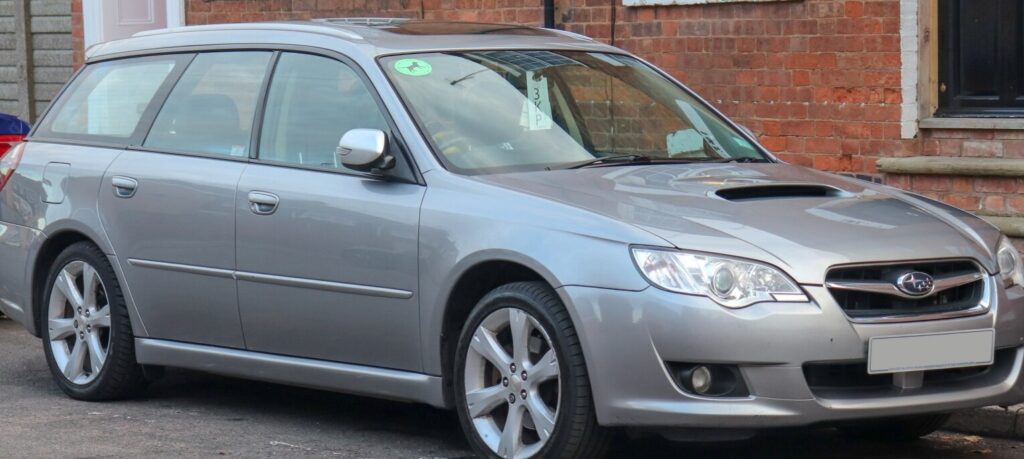
The Subaru Legacy IV Station Wagon, specifically the 2.0R variant produced during the 2006 and 2007 model years, represented a significant iteration of Subaru’s popular mid-size wagon. This facelifted version of the fourth-generation Legacy (introduced in 2003) aimed to refine the vehicle’s styling and enhance its appeal in a competitive market. Positioned as a step up from the base 2.5i models, the 2.0R offered a more performance-oriented driving experience while retaining the practicality and all-weather capability Subaru was known for. It was primarily sold in markets like North America, Europe, and Australia, where station wagons remained a popular body style. The 2.0R trim occupied a middle ground in the Legacy lineup, offering a balance between affordability and features, appealing to families and individuals seeking a versatile vehicle.
Technical Specifications
| Brand | Subaru |
| Model | Legacy |
| Generation | Legacy IV Station Wagon (facelift 2006) |
| Type (Engine) | 2.0R (165 Hp) AWD |
| Start of production | 2006 |
| End of production | 2007 |
| Powertrain Architecture | Internal Combustion engine |
| Body type | Station wagon (estate) |
| Seats | 5 |
| Doors | 5 |
| Fuel consumption (urban) | 12.5 l/100 km (18.8 US mpg, 22.6 UK mpg, 8 km/l) |
| Fuel consumption (extra urban) | 6.9 l/100 km (34.1 US mpg, 40.9 UK mpg, 14.5 km/l) |
| Fuel consumption (combined) | 9 l/100 km (26.1 US mpg, 31.4 UK mpg, 11.1 km/l) |
| CO2 emissions | 212 g/km |
| Fuel Type | Petrol (Gasoline) |
| Acceleration 0 – 100 km/h | 9.8 sec |
| Acceleration 0 – 62 mph | 9.8 sec |
| Acceleration 0 – 60 mph | 9.3 sec |
| Maximum speed | 204 km/h (126.76 mph) |
| Emission standard | Euro 4 |
| Weight-to-power ratio | 8.9 kg/Hp, 111.9 Hp/tonne |
| Weight-to-torque ratio | 7.9 kg/Nm, 126.8 Nm/tonne |
| Power | 165 Hp @ 6800 rpm |
| Power per litre | 82.7 Hp/l |
| Torque | 187 Nm @ 3200 rpm (137.92 lb.-ft. @ 3200 rpm) |
| Engine layout | Front, Longitudinal |
| Engine Model/Code | EJ204 |
| Engine displacement | 1994 cm3 (121.68 cu. in.) |
| Number of cylinders | 4 |
| Engine configuration | Boxer |
| Cylinder Bore | 92 mm (3.62 in.) |
| Piston Stroke | 75 mm (2.95 in.) |
| Compression ratio | 10.2:1 |
| Number of valves per cylinder | 4 |
| Fuel injection system | Multi-port manifold injection |
| Engine aspiration | Naturally aspirated engine |
| Valvetrain | DOHC |
| Engine oil capacity | 4.2 l (4.44 US qt | 3.7 UK qt) |
| Coolant | 6.5 l (6.87 US qt | 5.72 UK qt) |
| Kerb Weight | 1475 kg (3251.82 lbs.) |
| Max. weight | 1935 kg (4265.94 lbs.) |
| Max load | 460 kg (1014.13 lbs.) |
| Trunk (boot) space – minimum | 459 l (16.21 cu. ft.) |
| Trunk (boot) space – maximum | 1649 l (58.23 cu. ft.) |
| Fuel tank capacity | 64 l (16.91 US gal | 14.08 UK gal) |
| Max. roof load | 100 kg (220.46 lbs.) |
| Permitted trailer load with brakes (12%) | 1600 kg (3527.4 lbs.) |
| Permitted trailer load without brakes | 730 kg (1609.37 lbs.) |
| Length | 4795 mm (188.78 in.) |
| Width | 1730 mm (68.11 in.) |
| Height | 1475 mm (58.07 in.) |
| Wheelbase | 2670 mm (105.12 in.) |
| Front track | 1495 mm (58.86 in.) |
| Rear (Back) track | 1485 mm (58.46 in.) |
| Ride height (ground clearance) | 150 mm (5.91 in.) |
| Minimum turning circle (turning diameter) | 11.6 m (38.06 ft.) |
| Drive wheel | All wheel drive (4×4) |
| Number of gears and type of gearbox | 5 gears, manual transmission |
| Front suspension | Spring Strut |
| Rear suspension | Coil spring |
| Front brakes | Ventilated discs |
| Rear brakes | Disc |
| Assisting systems | ABS (Anti-lock braking system) |
| Steering type | Steering rack and pinion |
| Power steering | Hydraulic Steering |
| Tires size | 215/45 R17 |
| Wheel rims size | 17 |
Powertrain & Engine Architecture
The heart of the 2006-2007 Subaru Legacy 2.0R was the EJ204 engine, a 2.0-liter (1994 cc) naturally aspirated, horizontally-opposed (boxer) four-cylinder. This engine was a hallmark of Subaru’s engineering, known for its smooth operation and inherent balance. The EJ204 featured a single overhead camshaft (SOHC) design per cylinder bank, operating four valves per cylinder. Fuel delivery was handled by a multi-point fuel injection system. The engine produced 165 horsepower at 6,800 rpm and 187 Nm (137.92 lb-ft) of torque at 3,200 rpm. The engine’s longitudinal mounting and the symmetrical all-wheel-drive system contributed to the car’s balanced handling. The 2.0R was typically paired with a five-speed manual transmission, although a four-speed automatic transmission was also available. The automatic transmission, while offering convenience, was sometimes criticized for its relatively conservative gear ratios, impacting acceleration compared to the manual version.
Driving Characteristics
The 2.0R offered a noticeable step up in performance compared to the base 2.5i models. While not a sports car, the 165 hp engine provided adequate power for everyday driving and highway cruising. Acceleration from 0 to 60 mph took around 9.3-9.8 seconds, depending on transmission. The symmetrical all-wheel-drive system provided excellent traction in various weather conditions, a key selling point for Subaru. The automatic transmission, while smooth, resulted in slightly slower acceleration and a less engaging driving experience than the manual. The boxer engine’s low center of gravity contributed to the car’s stable handling, and the steering was generally responsive.
Equipment & Trim Levels
The 2.0R trim typically included features such as air conditioning, power windows and locks, a CD player, and alloy wheels. Higher trim levels offered options like a sunroof, leather upholstery, heated front seats, and a premium sound system. Safety features included anti-lock brakes (ABS) and front airbags. The interior design was functional and relatively understated, focusing on practicality and durability. The facelifted 2006 model year brought minor cosmetic updates to the interior, including revised dashboard trim and seat fabrics.
Chassis & Braking
The Legacy IV Station Wagon utilized a MacPherson strut front suspension and a double-wishbone rear suspension. This setup provided a comfortable ride while maintaining reasonable handling characteristics. The 2.0R models typically featured ventilated disc brakes on the front wheels and solid disc brakes on the rear. The ABS system helped to maintain control during hard braking. The suspension was tuned to prioritize comfort and stability, making it well-suited for long-distance driving and carrying passengers or cargo.
Market Reception & Comparison
The 2.0R was generally well-received by automotive critics as a practical and capable all-weather wagon. It was praised for its spacious interior, comfortable ride, and standard all-wheel drive. However, the automatic transmission was sometimes criticized for its lack of responsiveness. Compared to the base 2.5i models, the 2.0R offered a more engaging driving experience and slightly better fuel economy. Compared to the more powerful 2.5GT models (equipped with a turbocharged engine), the 2.0R was less expensive and more fuel-efficient, but it lacked the GT’s outright performance.
Legacy
The EJ204 engine, while generally reliable, is known to be susceptible to head gasket issues, a common problem with early 2000s Subaru engines. Regular maintenance, including timely coolant changes, is crucial to prevent this issue. The automatic transmission, if properly maintained, is generally durable. Today, the 2006-2007 Subaru Legacy 2.0R Station Wagon can be found on the used car market at relatively affordable prices. It remains a popular choice for those seeking a practical, reliable, and all-weather wagon, particularly in regions with harsh winters. Its reputation for durability and the availability of aftermarket parts contribute to its continued appeal.