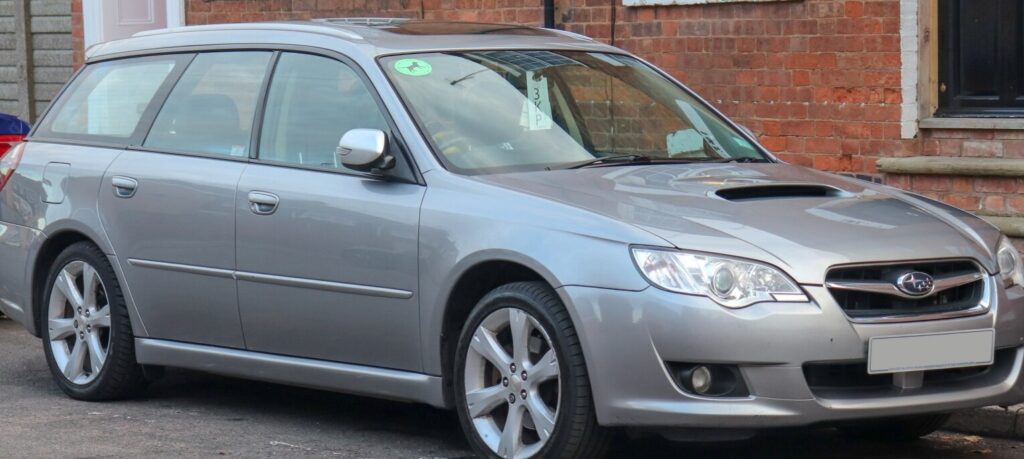
The Subaru Legacy IV Station Wagon, specifically the 2.5i variant with all-wheel drive (AWD), represented a significant offering in Subaru’s lineup from 2007 to 2009. This model, a facelift of the fourth-generation Legacy (BP/BL platform), aimed to blend practicality, safety, and Subaru’s signature symmetrical all-wheel-drive system into a family-oriented package. The 2.5i trim sat in the mid-range of the Legacy wagon offerings, positioned above the base 2.5i models and below the more performance-oriented turbocharged variants. It was primarily marketed towards families and individuals seeking a versatile vehicle capable of handling diverse weather conditions and light-duty cargo needs.
Technical Specifications
| Brand | Subaru |
| Model | Legacy |
| Generation | Legacy IV Station Wagon (facelift 2006) |
| Type (Engine) | 2.5i (173 Hp) AWD |
| Start of production | 2007 |
| End of production | 2009 |
| Powertrain Architecture | Internal Combustion engine |
| Body type | Station wagon (estate) |
| Seats | 5 |
| Doors | 5 |
| Fuel consumption (urban) | 11.9 l/100 km (19.8 US mpg, 23.7 UK mpg, 8.4 km/l) |
| Fuel consumption (extra urban) | 6.7 l/100 km (35.1 US mpg, 42.2 UK mpg, 14.9 km/l) |
| Fuel consumption (combined) | 8.6 l/100 km (27.4 US mpg, 32.8 UK mpg, 11.6 km/l) |
| CO2 emissions | 203 g/km |
| Fuel Type | Petrol (Gasoline) |
| Acceleration 0 – 100 km/h | 9.6 sec |
| Acceleration 0 – 62 mph | 9.6 sec |
| Acceleration 0 – 60 mph | 9.1 sec |
| Maximum speed | 211 km/h (131.11 mph) |
| Emission standard | Euro 4 |
| Weight-to-power ratio | 8.6 kg/Hp, 116.5 Hp/tonne |
| Weight-to-torque ratio | 6.5 kg/Nm, 152.9 Nm/tonne |
| Power | 173 Hp @ 6000 rpm |
| Power per litre | 70.4 Hp/l |
| Torque | 227 Nm @ 4400 rpm (167.43 lb.-ft. @ 4400 rpm) |
| Engine layout | Front, Longitudinal |
| Engine Model/Code | EJ253 |
| Engine displacement | 2457 cm3 (149.94 cu. in.) |
| Number of cylinders | 4 |
| Engine configuration | Boxer |
| Cylinder Bore | 99.5 mm (3.92 in.) |
| Piston Stroke | 79 mm (3.11 in.) |
| Compression ratio | 10:1 |
| Number of valves per cylinder | 4 |
| Fuel injection system | Multi-port manifold injection |
| Engine aspiration | Naturally aspirated engine |
| Valvetrain | SOHC |
| Engine oil capacity | 4.2 l (4.44 US qt | 3.7 UK qt) |
| Coolant | 6.5 l (6.87 US qt | 5.72 UK qt) |
| Kerb Weight | 1485 kg (3273.86 lbs.) |
| Max. weight | 1935 kg (4265.94 lbs.) |
| Max load | 450 kg (992.08 lbs.) |
| Trunk (boot) space – minimum | 459 l (16.21 cu. ft.) |
| Trunk (boot) space – maximum | 1649 l (58.23 cu. ft.) |
| Fuel tank capacity | 64 l (16.91 US gal | 14.08 UK gal) |
| Max. roof load | 100 kg (220.46 lbs.) |
| Permitted trailer load with brakes (12%) | 1800 kg (3968.32 lbs.) |
| Permitted trailer load without brakes | 735 kg (1620.4 lbs.) |
| Permitted towbar download | 82 kg (180.78 lbs.) |
| Length | 4795 mm (188.78 in.) |
| Width | 1730 mm (68.11 in.) |
| Height | 1475 mm (58.07 in.) |
| Wheelbase | 2670 mm (105.12 in.) |
| Front track | 1495 mm (58.86 in.) |
| Rear (Back) track | 1485 mm (58.46 in.) |
| Ride height (ground clearance) | 150 mm (5.91 in.) |
| Minimum turning circle (turning diameter) | 11.6 m (38.06 ft.) |
| Drive wheel | All wheel drive (4×4) |
| Number of gears and type of gearbox | 5 gears, manual transmission |
| Front suspension | Spring Strut |
| Rear suspension | Coil spring |
| Front brakes | Ventilated discs |
| Rear brakes | Disc |
| Assisting systems | ABS (Anti-lock braking system) |
| Steering type | Steering rack and pinion |
| Power steering | Hydraulic Steering |
| Tires size | 215/45 R17 |
| Wheel rims size | 7.0J x 17 |
Powertrain & Engine Architecture
The heart of the 2007-2009 Subaru Legacy 2.5i Station Wagon was the EJ253 engine, a 2.5-liter naturally aspirated boxer-four cylinder. This engine was a hallmark of Subaru’s engineering, known for its horizontally opposed pistons which contribute to a lower center of gravity and reduced vibration. The EJ253 featured a single overhead camshaft (SOHC) design and multi-port fuel injection. The engine produced 173 horsepower at 6000 rpm and 227 Nm (167.43 lb-ft) of torque at 4400 rpm. The engine’s 10:1 compression ratio was typical for a naturally aspirated gasoline engine of this era. The engine was paired with a 5-speed manual transmission in the base models, but a 4-speed automatic transmission was also available, and was a common choice for buyers prioritizing ease of use. The automatic transmission was electronically controlled and featured adaptive learning to optimize shift points based on driving conditions.
Driving Characteristics
The 2.5i with the automatic transmission offered a comfortable and predictable driving experience. Acceleration from 0-60 mph took approximately 9.1 seconds, which was adequate for everyday driving but not particularly sporty. The automatic transmission, while smooth, wasn’t known for its quick shifts or aggressive downshifting. Power delivery was linear, with the engine providing sufficient torque for merging onto highways and passing slower vehicles. The symmetrical all-wheel-drive system provided excellent traction in various weather conditions, making the Legacy a confident handler on slippery surfaces. Compared to the turbocharged Legacy models, the 2.5i felt less powerful, but it also offered better fuel economy and a more relaxed driving experience. The manual transmission version offered a more engaging drive, but the automatic was favored by many for its convenience.
Equipment & Trim Levels
The 2.5i trim included standard features such as air conditioning, power windows and locks, a CD player with auxiliary input, and keyless entry. Higher trim levels added features like a sunroof, leather upholstery, heated front seats, and a premium audio system. Safety features were a strong point for the Legacy, with standard equipment including anti-lock brakes (ABS), front and side airbags, and curtain airbags. Optional extras included a navigation system and a rear entertainment system.
Chassis & Braking
The Legacy IV Station Wagon utilized a MacPherson strut front suspension and a double-wishbone rear suspension. This setup provided a good balance of ride comfort and handling. The chassis was designed to be rigid, contributing to improved stability and responsiveness. The braking system consisted of ventilated discs on the front wheels and solid discs on the rear. ABS was standard, providing enhanced braking control in emergency situations. The suspension tuning was geared towards comfort, with a focus on absorbing bumps and providing a smooth ride.
Market Reception & Comparison
The Subaru Legacy IV Station Wagon 2.5i was generally well-received by automotive critics. It was praised for its spacious interior, comfortable ride, standard all-wheel drive, and strong safety ratings. However, some critics noted that the engine lacked the punch of its turbocharged counterparts and that the automatic transmission could feel sluggish at times. Compared to competitors like the Toyota Camry Wagon and Honda Accord Wagon, the Legacy offered a unique combination of all-wheel drive and a boxer engine. Fuel economy was average for its class, with combined fuel consumption around 27.4 US mpg. Reliability was generally good, although some owners reported issues with the automatic transmission over the long term.
Legacy
The EJ253 engine, while generally reliable, is known to be susceptible to head gasket failures, a common issue with Subaru boxer engines. Regular maintenance, including timely coolant changes, is crucial to prevent this problem. The 4-speed automatic transmission, while durable, is not as refined as more modern transmissions. Today, the 2007-2009 Subaru Legacy 2.5i Station Wagon remains a viable option in the used car market, particularly for buyers seeking a practical, safe, and all-weather capable vehicle. Its relatively simple mechanical design and readily available parts make it a relatively affordable to maintain, although finding well-maintained examples is becoming increasingly difficult.