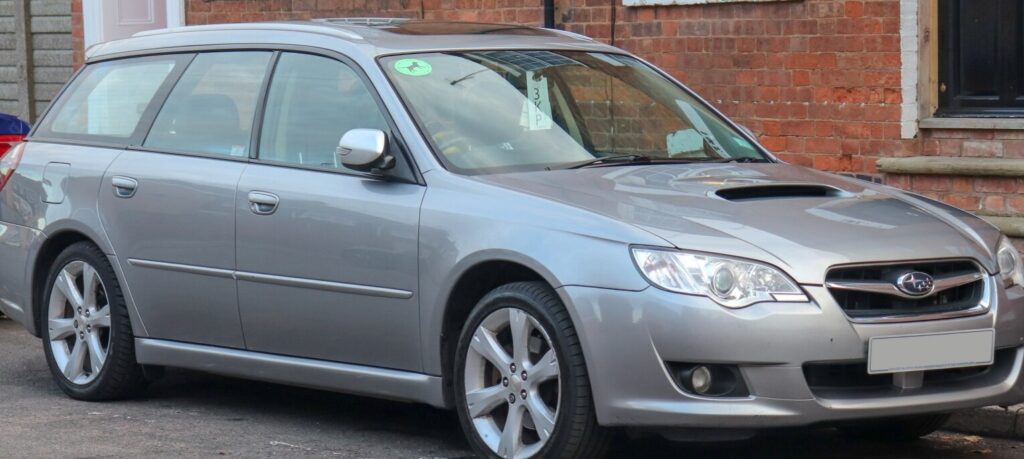
The Subaru Legacy IV Station Wagon, specifically the 3.0R variant produced from 2006 to 2009, represented the top-tier offering in the fourth generation Legacy lineup. This facelifted model, introduced in 2006, combined a potent 3.0-liter boxer engine with a five-speed automatic transmission and Subaru’s renowned symmetrical all-wheel drive system. Positioned as a premium family vehicle, the 3.0R aimed to deliver a blend of performance, practicality, and all-weather capability, primarily targeting buyers in markets where station wagons remained popular, such as Europe, Canada, and parts of the United States. It built upon the established Legacy platform (BL/BP chassis) known for its robust construction and comfortable ride.
Technical Specifications
| Brand | Subaru |
| Model | Legacy |
| Generation | Legacy IV Station Wagon (facelift 2006) |
| Type (Engine) | 3.0R (245 Hp) AWD Automatic |
| Start of production | 2006 |
| End of production | 2009 |
| Powertrain Architecture | Internal Combustion engine |
| Body type | Station wagon (estate) |
| Seats | 5 |
| Doors | 5 |
| Fuel consumption (urban) | 13.8 l/100 km (17 US mpg, 20.5 UK mpg, 7.2 km/l) |
| Fuel consumption (extra urban) | 7.4 l/100 km (31.8 US mpg, 38.2 UK mpg, 13.5 km/l) |
| Fuel consumption (combined) | 9.8 l/100 km (24 US mpg, 28.8 UK mpg, 10.2 km/l) |
| CO2 emissions | 231 g/km |
| Fuel Type | Petrol (Gasoline) |
| Acceleration 0 – 100 km/h | 8.4 sec |
| Acceleration 0 – 62 mph | 8.4 sec |
| Acceleration 0 – 60 mph | 8 sec |
| Maximum speed | 237 km/h (147.26 mph) |
| Emission standard | Euro 4 |
| Weight-to-power ratio | 6.6 kg/Hp, 151.2 Hp/tonne |
| Weight-to-torque ratio | 5.5 kg/Nm, 183.3 Nm/tonne |
| Power | 245 Hp @ 6600 rpm |
| Power per litre | 81.7 Hp/l |
| Torque | 297 Nm @ 4200 rpm (219.06 lb.-ft. @ 4200 rpm) |
| Engine layout | Front, Longitudinal |
| Engine Model/Code | EZ30D |
| Engine displacement | 3000 cm3 (183.07 cu. in.) |
| Number of cylinders | 6 |
| Engine configuration | Boxer |
| Cylinder Bore | 89.2 mm (3.51 in.) |
| Piston Stroke | 80 mm (3.15 in.) |
| Compression ratio | 10.7:1 |
| Number of valves per cylinder | 4 |
| Fuel injection system | Multi-port manifold injection |
| Engine aspiration | Naturally aspirated engine |
| Valvetrain | DOHC |
| Engine oil capacity | 5.5 l (5.81 US qt | 4.84 UK qt) |
| Coolant | 7.2 l (7.61 US qt | 6.34 UK qt) |
| Kerb Weight | 1620 kg (3571.49 lbs.) |
| Max. weight | 2050 kg (4519.48 lbs.) |
| Max load | 430 kg (947.99 lbs.) |
| Trunk (boot) space – minimum | 459 l (16.21 cu. ft.) |
| Trunk (boot) space – maximum | 1649 l (58.23 cu. ft.) |
| Fuel tank capacity | 64 l (16.91 US gal | 14.08 UK gal) |
| Max. roof load | 100 kg (220.46 lbs.) |
| Permitted trailer load with brakes (12%) | 2000 kg (4409.25 lbs.) |
| Permitted trailer load without brakes | 750 kg (1653.47 lbs.) |
| Permitted towbar download | 82 kg (180.78 lbs.) |
| Length | 4795 mm (188.78 in.) |
| Width | 1730 mm (68.11 in.) |
| Height | 1475 mm (58.07 in.) |
| Wheelbase | 2670 mm (105.12 in.) |
| Front track | 1495 mm (58.86 in.) |
| Rear (Back) track | 1485 mm (58.46 in.) |
| Ride height (ground clearance) | 150 mm (5.91 in.) |
| Minimum turning circle (turning diameter) | 11.6 m (38.06 ft.) |
| Drive wheel | All wheel drive (4×4) |
| Number of gears and type of gearbox | 5 gears, automatic transmission |
| Front suspension | Spring Strut |
| Rear suspension | Coil spring |
| Front brakes | Ventilated discs |
| Rear brakes | Disc |
| Assisting systems | ABS (Anti-lock braking system) |
| Steering type | Steering rack and pinion |
| Power steering | Hydraulic Steering |
| Tires size | 215/45 R17 |
| Wheel rims size | 7.0J x 17 |
Powertrain & Engine Architecture
The heart of the 3.0R was the EZ30D 3.0-liter horizontally-opposed (boxer) six-cylinder engine. This engine was a key feature of Subaru’s engineering philosophy, offering a low center of gravity for improved handling. The EZ30D utilized a single overhead camshaft (SOHC) design per cylinder bank, operating with four valves per cylinder. Fuel delivery was managed by a multi-point fuel injection system. The engine produced 245 horsepower at 6,600 rpm and 297 Nm (219 lb-ft) of torque at 4,200 rpm. The five-speed automatic transmission was designed to provide smooth shifts and efficient power delivery. It featured adaptive learning to adjust shift points based on driving style. The transmission was specifically tuned to work with the all-wheel-drive system, optimizing torque distribution for various road conditions.
Driving Characteristics
The 3.0R offered a noticeably more refined driving experience compared to the four-cylinder Legacy models. The boxer engine provided a unique engine note and smooth power delivery. Acceleration from 0 to 60 mph was achieved in around 8 seconds, making it competitive with other mid-size wagons of the time. The automatic transmission, while not as engaging as a manual, offered convenient operation for daily driving. The symmetrical all-wheel drive system provided excellent traction in all weather conditions, enhancing stability and control. The gear ratios were optimized for a balance between acceleration and fuel economy, though the combined fuel consumption of 9.8 l/100 km (24 mpg) was typical for a vehicle of this size and performance.
Equipment & Trim Levels
The 3.0R typically came well-equipped with standard features such as automatic climate control, power windows and locks, a premium audio system, and alloy wheels. Leather upholstery was often standard, along with woodgrain interior trim. Optional extras included a sunroof, navigation system, and upgraded sound systems. Safety features like ABS, traction control, and multiple airbags were standard across the Legacy range. The 3.0R represented the highest trim level, offering a more luxurious and feature-rich experience than the base or 2.5i models.
Chassis & Braking
The Legacy IV Station Wagon featured a MacPherson strut front suspension and a double-wishbone rear suspension, providing a comfortable ride and predictable handling. The 3.0R variant often included thicker stabilizer bars to reduce body roll during cornering. Braking duties were handled by ventilated disc brakes at the front and solid disc brakes at the rear. The ABS system helped to maintain steering control during hard braking. The all-wheel-drive system contributed to enhanced stability and braking performance, particularly on slippery surfaces.
Market Reception & Comparison
The 3.0R was generally well-received by automotive critics, who praised its smooth engine, comfortable ride, and all-weather capability. However, its fuel economy was often cited as a drawback compared to the more economical four-cylinder models. Compared to the 2.5i Legacy, the 3.0R offered significantly more power and a more refined driving experience, but at a higher price point. Against competitors like the Volvo V70 and Audi A6 Avant, the Legacy 3.0R offered a compelling combination of performance, practicality, and value.
Legacy
The EZ30D engine, while generally reliable, is known to require regular maintenance, particularly regarding oil changes. The timing belt requires replacement at specified intervals to prevent engine damage. The automatic transmission, if properly maintained, is generally durable. Today, well-maintained examples of the 2006-2009 Legacy 3.0R Station Wagon are sought after by enthusiasts who appreciate its unique combination of performance, practicality, and Subaru’s all-wheel-drive system. Its relative rarity and the enduring appeal of the boxer engine contribute to its collectibility in the used car market. Parts availability remains good, though some specific trim pieces may become increasingly difficult to find.