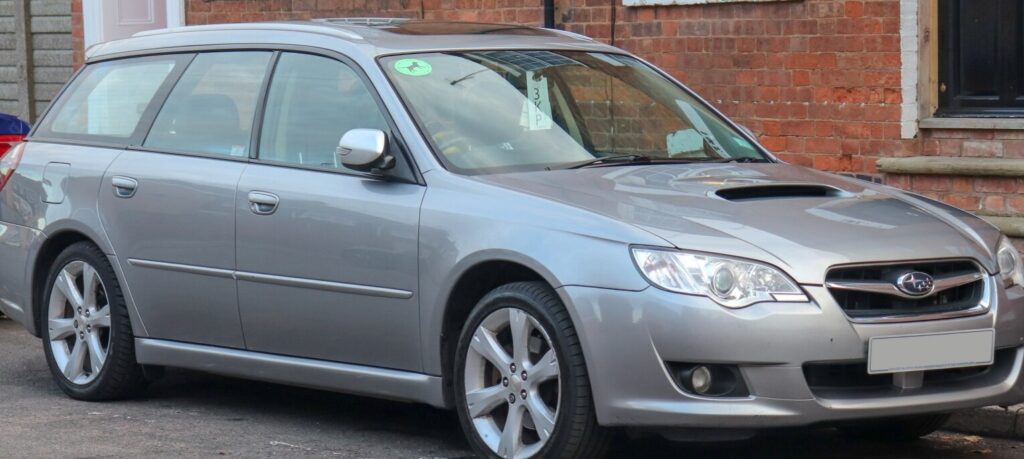
The Subaru Legacy IV Station Wagon, specifically the 3.0R spec.B variant produced from 2006 to 2009, represents a high-performance iteration of Subaru’s popular family wagon. This facelifted version of the fourth-generation Legacy (introduced in 2003) aimed to deliver a blend of practicality, all-weather capability, and engaging driving dynamics. Positioned as the top-tier trim level, the 3.0R spec.B catered to buyers seeking a more spirited driving experience than the base models offered, while still retaining the Legacy’s reputation for reliability and safety. It was primarily marketed in markets like Japan, Australia, and Europe, where the demand for capable and versatile wagons remained strong.
Technical Specifications
| Brand | Subaru |
| Model | Legacy |
| Generation | Legacy IV Station Wagon (facelift 2006) |
| Type | 3.0R spec.B (245 Hp) AWD |
| Start of production | 2006 |
| End of production | 2009 |
| Powertrain Architecture | Internal Combustion engine |
| Body type | Station wagon (estate) |
| Seats | 5 |
| Doors | 5 |
| Fuel consumption (urban) | 17.8 l/100 km (13.2 US mpg, 15.9 UK mpg, 5.6 km/l) |
| Fuel consumption (extra urban) | 9.1 l/100 km (25.8 US mpg, 31 UK mpg, 11 km/l) |
| Fuel consumption (combined) | 12.3 l/100 km (19.1 US mpg, 23 UK mpg, 8.1 km/l) |
| CO2 emissions | 290 g/km |
| Fuel Type | Petrol (Gasoline) |
| Acceleration 0 – 100 km/h | 7 sec |
| Acceleration 0 – 62 mph | 7 sec |
| Acceleration 0 – 60 mph | 6.7 sec |
| Maximum speed | 233 km/h (144.78 mph) |
| Emission standard | Euro 4 |
| Weight-to-power ratio | 6.7 kg/Hp, 149.8 Hp/tonne |
| Weight-to-torque ratio | 5.5 kg/Nm, 181.7 Nm/tonne |
| Power | 245 Hp @ 6600 rpm |
| Power per litre | 81.7 Hp/l |
| Torque | 297 Nm @ 4200 rpm (219.06 lb.-ft. @ 4200 rpm) |
| Engine layout | Front, Longitudinal |
| Engine Model/Code | EZ30D |
| Engine displacement | 3000 cm3 (183.07 cu. in.) |
| Number of cylinders | 6 |
| Engine configuration | Boxer |
| Cylinder Bore | 89.2 mm (3.51 in.) |
| Piston Stroke | 80 mm (3.15 in.) |
| Compression ratio | 10.7:1 |
| Number of valves per cylinder | 4 |
| Fuel injection system | Multi-port manifold injection |
| Engine aspiration | Naturally aspirated engine |
| Valvetrain | DOHC |
| Engine oil capacity | 5.5 l (5.81 US qt | 4.84 UK qt) |
| Coolant | 7.2 l (7.61 US qt | 6.34 UK qt) |
| Kerb Weight | 1635 kg (3604.56 lbs.) |
| Max. weight | 2050 kg (4519.48 lbs.) |
| Max load | 415 kg (914.92 lbs.) |
| Trunk (boot) space – minimum | 459 l (16.21 cu. ft.) |
| Trunk (boot) space – maximum | 1649 l (58.23 cu. ft.) |
| Fuel tank capacity | 64 l (16.91 US gal | 14.08 UK gal) |
| Max. roof load | 100 kg (220.46 lbs.) |
| Permitted trailer load with brakes (12%) | 2000 kg (4409.25 lbs.) |
| Permitted trailer load without brakes | 750 kg (1653.47 lbs.) |
| Permitted towbar download | 82 kg (180.78 lbs.) |
| Length | 4795 mm (188.78 in.) |
| Width | 1730 mm (68.11 in.) |
| Height | 1475 mm (58.07 in.) |
| Wheelbase | 2670 mm (105.12 in.) |
| Front track | 1495 mm (58.86 in.) |
| Rear (Back) track | 1485 mm (58.46 in.) |
| Ride height (ground clearance) | 150 mm (5.91 in.) |
| Minimum turning circle (turning diameter) | 11.6 m (38.06 ft.) |
| Drive wheel | All wheel drive (4×4) |
| Number of gears and type of gearbox | 6 gears, manual transmission |
| Front suspension | Spring Strut |
| Rear suspension | Coil spring |
| Front brakes | Ventilated discs |
| Rear brakes | Disc |
| Assisting systems | ABS (Anti-lock braking system) |
| Steering type | Steering rack and pinion |
| Power steering | Hydraulic Steering |
| Tires size | 215/45 R17 |
| Wheel rims size | 7.0J x 17 |
Powertrain & Engine Architecture
The heart of the 3.0R spec.B is the EZ30D 3.0-liter horizontally-opposed (boxer) six-cylinder engine. This engine, a hallmark of Subaru’s engineering, delivers 245 horsepower at 6,600 rpm and 297 Nm (219 lb-ft) of torque at 4,200 rpm. The boxer configuration, with its pistons moving horizontally, contributes to a lower center of gravity, enhancing stability and handling. The EZ30D utilizes multi-port fuel injection and a double overhead camshaft (DOHC) valvetrain with four valves per cylinder. This engine was known for its smooth power delivery and distinctive exhaust note. The 3.0R spec.B was exclusively offered with a six-speed manual transmission, a key differentiator from other Legacy variants that often featured automatic options. This manual gearbox was chosen to maximize driver engagement and fully utilize the engine’s power potential.
Driving Characteristics
The 3.0R spec.B offered a noticeably more engaging driving experience compared to lower-spec Legacy wagons. The six-speed manual transmission allowed for precise gear selection, and the engine’s torque curve provided strong acceleration throughout the rev range. While not a sports car, the Legacy 3.0R spec.B offered brisk performance, achieving 0-60 mph in around 6.7 seconds. Subaru’s symmetrical all-wheel-drive system provided excellent traction in all weather conditions, making it a capable and confident vehicle year-round. The suspension was tuned for a balance between comfort and handling, offering a firm but not harsh ride. Compared to the 2.5-liter naturally aspirated or turbocharged models, the 3.0R spec.B provided a significant power upgrade, resulting in a more responsive and enjoyable driving experience.
Equipment & Trim Levels
The “spec.B” designation signified a higher level of equipment and refinement. Standard features included sport seats with enhanced bolstering, a leather-wrapped steering wheel and shift knob, and unique exterior styling cues such as a rear spoiler and alloy wheels. Interior trim typically featured dark metallic accents. Optional extras could include a premium audio system, sunroof, and navigation system. The spec.B trim was designed to appeal to enthusiasts who appreciated a more premium and performance-oriented package.
Chassis & Braking
The Legacy IV Station Wagon featured a MacPherson strut front suspension and a double-wishbone rear suspension. The spec.B variant often included stiffer springs and dampers for improved handling. Braking duties were handled by ventilated discs at the front and solid discs at the rear, equipped with an Anti-lock Braking System (ABS). The all-wheel-drive system utilized a variable torque distribution system, automatically adjusting power delivery between the front and rear axles based on road conditions and driver input.
Market Reception & Comparison
The 3.0R spec.B was generally well-received by automotive critics, who praised its performance, handling, and practicality. However, its fuel economy was often cited as a drawback, with combined fuel consumption around 12.3 l/100 km (19.1 US mpg). Compared to the 2.5i models, the 3.0R spec.B offered a significant performance advantage but came at a higher price point and with increased running costs. The 2.5 GT models, equipped with a turbocharged engine, offered similar performance but with a different driving character. The 3.0R spec.B appealed to buyers who preferred the smooth, naturally aspirated power delivery of the boxer six-cylinder engine.
Legacy
The EZ30D engine, while generally reliable, is known to require regular maintenance, including oil changes and timing belt replacements. The Legacy IV Station Wagon, particularly the 3.0R spec.B variant, has developed a following among enthusiasts who appreciate its unique combination of performance, practicality, and all-weather capability. Today, well-maintained examples are sought after in the used car market, often commanding a premium price. The 3.0R spec.B stands as a testament to Subaru’s commitment to building capable and engaging vehicles that offer a distinctive driving experience.