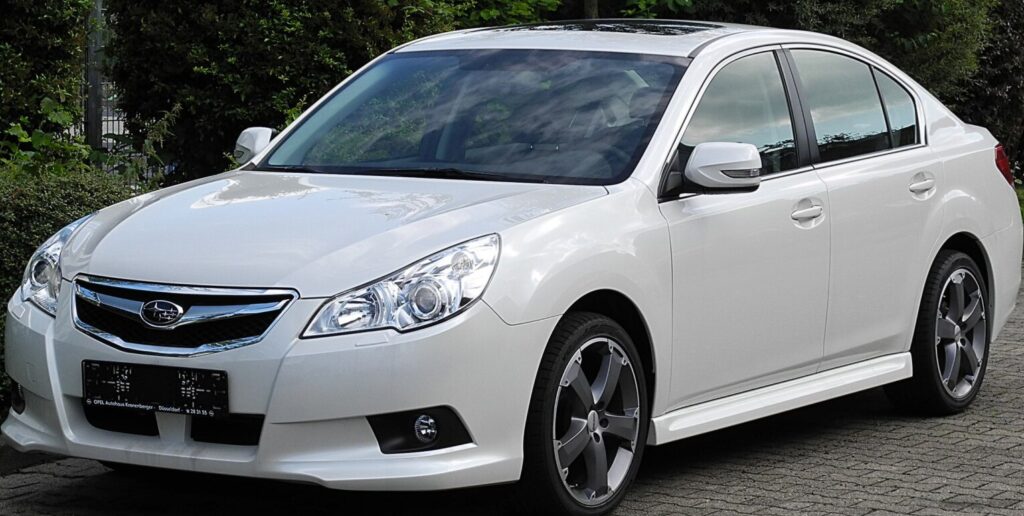
The Subaru Legacy V 2.5 GT, produced between 2009 and 2012, represented the performance-oriented pinnacle of the fifth-generation Legacy (BL/BP chassis). Positioned as the flagship trim, it offered a significant step up in power and handling compared to the base models, appealing to drivers seeking a sporty and capable all-weather sedan. This variant was primarily sold in markets where Subaru had a strong presence, including North America, Australia, and parts of Europe, offering a compelling alternative to more mainstream mid-size sedans.
Technical Specifications
| Brand | Subaru |
| Model | Legacy |
| Generation | Legacy V |
| Type (Engine) | 2.5 GT (265 Hp) AWD |
| Start of production | 2009 |
| End of production | 2012 |
| Powertrain Architecture | Internal Combustion engine |
| Body type | Sedan |
| Seats | 5 |
| Doors | 4 |
| Fuel consumption (urban) | 13 l/100 km (18.1 US mpg, 21.7 UK mpg, 7.7 km/l) |
| Fuel consumption (extra urban) | 9.4 l/100 km (25 US mpg, 30.1 UK mpg, 10.6 km/l) |
| Fuel Type | Petrol (Gasoline) |
| Acceleration 0 – 100 km/h | 6.2 sec |
| Acceleration 0 – 62 mph | 6.2 sec |
| Acceleration 0 – 60 mph | 5.9 sec |
| Maximum speed | 245 km/h (152.24 mph) |
| Weight-to-power ratio | 6 kg/Hp, 168 Hp/tonne |
| Weight-to-torque ratio | 4.5 kg/Nm, 221.9 Nm/tonne |
| Power | 265 Hp @ 5600 rpm |
| Power per litre | 107.9 Hp/l |
| Torque | 350 Nm @ 2000-5200 rpm (258.15 lb.-ft. @ 2000-5200 rpm) |
| Engine layout | Front, Longitudinal |
| Engine Model/Code | EJ255 |
| Engine displacement | 2457 cm3 (149.94 cu. in.) |
| Number of cylinders | 4 |
| Engine configuration | Boxer |
| Cylinder Bore | 99.5 mm (3.92 in.) |
| Piston Stroke | 79 mm (3.11 in.) |
| Compression ratio | 8.4:1 |
| Number of valves per cylinder | 4 |
| Fuel injection system | Multi-port manifold injection |
| Engine aspiration | Turbocharger, Intercooler |
| Valvetrain | DOHC |
| Engine oil capacity | 4.3 l (4.54 US qt | 3.78 UK qt) |
| Coolant | 6.5 l (6.87 US qt | 5.72 UK qt) |
| Kerb Weight | 1577 kg (3476.69 lbs.) |
| Trunk (boot) space – minimum | 486 l (17.16 cu. ft.) |
| Fuel tank capacity | 70 l (18.49 US gal | 15.4 UK gal) |
| Length | 4735 mm (186.42 in.) |
| Width | 1780 mm (70.08 in.) |
| Width including mirrors | 1820 mm (71.65 in.) |
| Height | 1505 mm (59.25 in.) |
| Wheelbase | 2750 mm (108.27 in.) |
| Front track | 1550 mm (61.02 in.) |
| Rear (Back) track | 1555 mm (61.22 in.) |
| Minimum turning circle | 11.2 m (36.75 ft.) |
| Drive wheel | All wheel drive (4×4) |
| Number of gears and type of gearbox | 5 gears, manual transmission |
| Front suspension | Independent type McPherson |
| Rear suspension | Double wishbone |
| Front brakes | Ventilated discs |
| Rear brakes | Ventilated discs |
| Assisting systems | ABS (Anti-lock braking system) |
| Steering type | Steering rack and pinion |
| Tires size | 225/45 R18 91W |
| Wheel rims size | 7.0J x 18 |
Powertrain & Engine Architecture
The heart of the Legacy 2.5 GT was the EJ255, a 2.5-liter turbocharged boxer-four engine. This engine was a significant departure from the naturally aspirated engines found in lower Legacy trims. The EJ255 featured a single twin-scroll turbocharger with an intercooler, boosting power output to 265 horsepower and 258 lb-ft of torque. The engine utilized multi-port fuel injection and a dual overhead camshaft (DOHC) valvetrain. The boxer configuration, with its horizontally opposed pistons, contributed to a low center of gravity, enhancing handling characteristics. The 2.5 GT was exclusively offered with a 5-speed manual transmission, providing drivers with full control over the engine’s power. The transmission was robustly built to handle the increased torque output of the turbocharged engine.
Driving Characteristics
The 2.5 GT delivered a noticeably more engaging driving experience than other Legacy variants. Acceleration was brisk, with 0-60 mph times consistently in the high 5-second range. The turbocharger provided a broad torque curve, making the car responsive in a variety of driving situations. The manual transmission allowed for precise gear selection, and the all-wheel-drive system provided excellent traction in all weather conditions. Compared to the naturally aspirated 2.5i models, the 2.5 GT felt significantly more powerful and capable. While the suspension was tuned for comfort, it also offered good body control and minimized roll during cornering. The steering was precise and well-weighted, providing a confident feel on the road.
Equipment & Trim Levels
The 2.5 GT came standard with a comprehensive list of features, including leather upholstery, heated front seats, a premium audio system, automatic climate control, and alloy wheels. Optional extras included a power moonroof, navigation system, and a rear spoiler. The interior design was functional and well-appointed, with a focus on comfort and convenience. The instrument panel featured unique gauges and trim specific to the GT model. Exterior styling cues included a more aggressive front bumper, side skirts, and a rear diffuser.
Chassis & Braking
The Legacy 2.5 GT featured a fully independent suspension system, with McPherson struts at the front and a double-wishbone setup at the rear. This suspension configuration provided a comfortable ride while maintaining good handling characteristics. The car was equipped with ventilated disc brakes on all four wheels, providing ample stopping power. An anti-lock braking system (ABS) was standard, enhancing safety and control during emergency braking situations. The all-wheel-drive system utilized a variable torque distribution system, automatically adjusting the amount of power sent to each wheel based on road conditions and driver input.
Market Reception & Comparison
The Legacy 2.5 GT was generally well-received by automotive critics, who praised its performance, handling, and all-weather capability. It was often compared to other sporty mid-size sedans, such as the Acura TL and the Mazda6. While the Legacy 2.5 GT offered a compelling combination of features and performance, it was often criticized for its fuel economy, which was lower than that of the base models. Reliability was generally good, although some owners reported issues with the turbocharger and the cooling system. Compared to the naturally aspirated Legacy models, the 2.5 GT required more frequent maintenance and was more expensive to repair.
Legacy
The Subaru Legacy 2.5 GT remains a popular choice among enthusiasts seeking a capable and affordable performance sedan. The EJ255 engine is known for its durability and potential for modification. The car’s all-wheel-drive system and robust construction make it a reliable choice for drivers in regions with harsh weather conditions. In the used car market, the 2.5 GT commands a premium over other Legacy variants, reflecting its performance and desirability. Well-maintained examples are becoming increasingly rare, making them sought-after collectibles for Subaru enthusiasts.