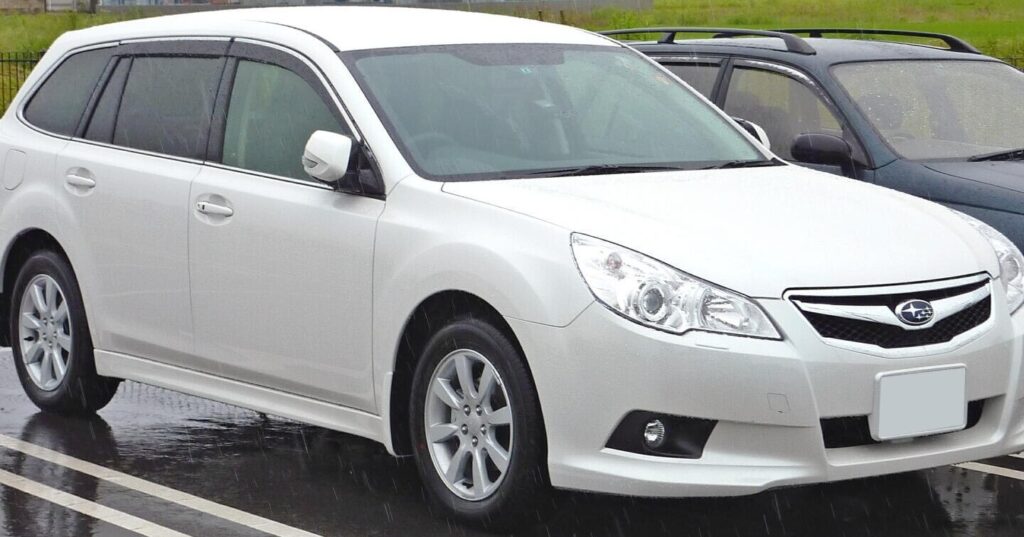
The Subaru Legacy V Station Wagon 2.0i (150 Hp) AWD Lineartronic represents a specific configuration within the fifth generation of Subaru’s Legacy wagon, produced between 2009 and 2012. This variant aimed to provide a balance of practicality, all-weather capability, and reasonable fuel economy within the Legacy lineup. Positioned as a mid-range offering, it catered to buyers seeking the versatility of a wagon with Subaru’s renowned symmetrical all-wheel drive system, but without the higher price tag of the more powerful engine options. It was primarily sold in markets where wagons remained popular, including Europe, Australia, and Canada, with limited availability in the United States where the sedan version dominated sales.
Technical Specifications
| Brand | Subaru |
| Model | Legacy |
| Generation | Legacy V Station Wagon |
| Type (Engine) | 2.0i (150 Hp) AWD Lineartronic |
| Start of production | 2009 |
| End of production | 2012 |
| Powertrain Architecture | Internal Combustion engine |
| Body type | Station wagon (estate) |
| Seats | 5 |
| Doors | 5 |
| Fuel consumption (urban) | 11.7 l/100 km (20.1 US mpg, 24.1 UK mpg, 8.5 km/l) |
| Fuel consumption (extra urban) | 6.8 l/100 km (34.6 US mpg, 41.5 UK mpg, 14.7 km/l) |
| Fuel consumption (combined) | 8.6 l/100 km (27.4 US mpg, 32.8 UK mpg, 11.6 km/l) |
| CO2 emissions | 199 g/km |
| Fuel Type | Petrol (Gasoline) |
| Acceleration 0 – 100 km/h | 9.8 sec |
| Acceleration 0 – 62 mph | 9.8 sec |
| Acceleration 0 – 60 mph | 9.3 sec |
| Maximum speed | 206 km/h (128 mph) |
| Emission standard | Euro 5 |
| Weight-to-power ratio | 10.2 kg/Hp, 97.7 Hp/tonne |
| Weight-to-torque ratio | 7.8 kg/Nm, 127.7 Nm/tonne |
| Power | 150 Hp @ 6000 rpm |
| Power per litre | 75.2 Hp/l |
| Torque | 196 Nm @ 3000 rpm (144.56 lb.-ft. @ 3000 rpm) |
| Engine layout | Front, Longitudinal |
| Engine Model/Code | EJ204 |
| Engine displacement | 1994 cm3 (121.68 cu. in.) |
| Number of cylinders | 4 |
| Engine configuration | Boxer |
| Cylinder Bore | 84 mm (3.31 in.) |
| Piston Stroke | 90 mm (3.54 in.) |
| Compression ratio | 10.5:1 |
| Number of valves per cylinder | 4 |
| Fuel injection system | Multi-port manifold injection |
| Engine aspiration | Naturally aspirated engine |
| Valvetrain | DOHC |
| Engine oil capacity | 4.2 l (4.44 US qt | 3.7 UK qt) |
| Coolant | 6.5 l (6.87 US qt | 5.72 UK qt) |
| Kerb Weight | 1535 kg (3384.1 lbs.) |
| Max. weight | 2010 kg (4431.29 lbs.) |
| Max load | 475 kg (1047.2 lbs.) |
| Trunk (boot) space – minimum | 526 l (18.58 cu. ft.) |
| Trunk (boot) space – maximum | 1660 l (58.62 cu. ft.) |
| Fuel tank capacity | 65 l (17.17 US gal | 14.3 UK gal) |
| Max. roof load | 80 kg (176.37 lbs.) |
| Permitted trailer load with brakes (12%) | 1500 kg (3306.93 lbs.) |
| Permitted trailer load without brakes | 730 kg (1609.37 lbs.) |
| Length | 4775 mm (187.99 in.) |
| Width | 1780 mm (70.08 in.) |
| Height | 1535 mm (60.43 in.) |
| Wheelbase | 2750 mm (108.27 in.) |
| Front track | 1565 mm (61.61 in.) |
| Rear (Back) track | 1570 mm (61.81 in.) |
| Minimum turning circle | 11.4 m (37.4 ft.) |
| Drive wheel | All wheel drive (4×4) |
| Number of gears and type of gearbox | automatic transmission Lineartronic |
| Front suspension | Independent type McPherson |
| Rear suspension | Double wishbone |
| Front brakes | Ventilated discs |
| Rear brakes | Disc |
| Assisting systems | ABS (Anti-lock braking system) |
| Steering type | Steering rack and pinion |
| Tires size | 205/60 R16H |
| Wheel rims size | 6.5J x 16 |
Powertrain & Engine Architecture
The heart of the 2.0i Lineartronic variant is the EJ204 engine, a 1994cc naturally aspirated, horizontally-opposed (boxer) four-cylinder. This engine is a hallmark of Subaru engineering, known for its smooth operation and inherent balance. The EJ204 utilizes a multi-point fuel injection system and a double overhead camshaft (DOHC) valvetrain with four valves per cylinder. The engine produces 150 horsepower at 6000 rpm and 196 Nm (144.56 lb-ft) of torque at 3000 rpm. Paired with this engine is Subaru’s Lineartronic continuously variable transmission (CVT). This CVT, unlike traditional stepped automatic transmissions, provides a virtually infinite number of gear ratios, optimizing engine speed for fuel efficiency or performance. The Lineartronic transmission in this application features simulated “shift points” to mimic the feel of a conventional automatic, addressing some driver preferences.
Driving Characteristics
The 2.0i Lineartronic Legacy wagon offers a comfortable and predictable driving experience. The CVT contributes to smooth acceleration, although it lacks the immediate response of a traditional automatic or manual transmission. Acceleration from 0-60 mph takes approximately 9.3 seconds, making it adequate for everyday driving but not particularly sporty. The all-wheel drive system provides excellent traction in various weather conditions, a key selling point for Subaru. The CVT is programmed to hold lower “gear” ratios under hard acceleration, maximizing engine power, but the engine can feel somewhat strained at higher RPMs. Compared to the 2.5L turbocharged variants, the 2.0i is noticeably less powerful, but it offers better fuel economy and a more relaxed driving experience.
Equipment & Trim Levels
The 2.0i Lineartronic trim typically included standard features such as air conditioning, power windows and locks, a CD player with auxiliary input, and alloy wheels. Safety features included ABS, electronic brakeforce distribution, and multiple airbags. Higher trim levels offered options like a sunroof, leather upholstery, heated front seats, and a premium audio system. Interior materials were generally of good quality, though not as luxurious as some competitors. The dashboard layout was functional and straightforward, prioritizing ease of use.
Chassis & Braking
The Legacy V wagon utilizes an independent McPherson strut suspension in the front and a double wishbone suspension in the rear. This setup provides a comfortable ride and good handling characteristics. The front brakes are ventilated discs, while the rear brakes are solid discs. The steering is a rack-and-pinion system, providing precise and responsive control. The all-wheel drive system employs a viscous coupling center differential, distributing power between the front and rear axles as needed. Stabilizer bars are fitted to both the front and rear axles to reduce body roll during cornering.
Market Reception & Comparison
The 2.0i Lineartronic Legacy wagon was generally well-received by automotive critics as a practical and capable family vehicle. It was praised for its spacious interior, comfortable ride, and all-weather capability. However, some reviewers noted the engine’s lack of outright power and the CVT’s sometimes-unconventional driving feel. Compared to other wagons in its class, such as the Volkswagen Passat wagon or the Ford Mondeo wagon, the Legacy offered a unique combination of all-wheel drive and a boxer engine. Fuel economy was competitive, averaging around 27.4 US mpg in combined driving. Reliability was generally good, although some owners reported minor issues with the CVT.
Legacy
The EJ204 engine and Lineartronic transmission combination proved to be relatively reliable in the long term, with many examples still on the road today. The Lineartronic CVT, while initially met with some skepticism, has proven to be a durable and efficient transmission when properly maintained. The Legacy V wagon, in general, has developed a reputation as a dependable and practical vehicle, making it a popular choice in the used car market. However, as with any used vehicle, potential buyers should be aware of the importance of regular maintenance, particularly CVT fluid changes, to ensure continued reliability.