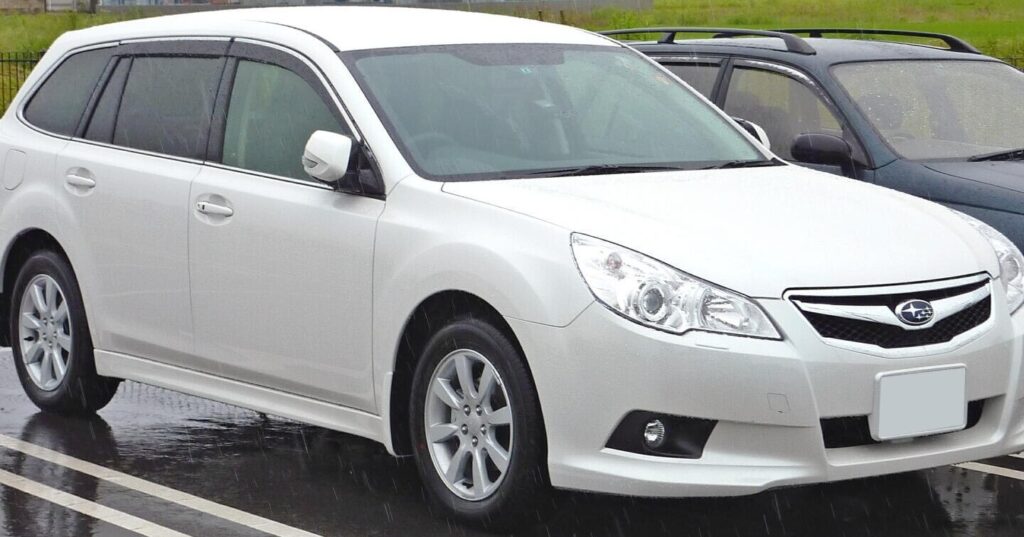
The Subaru Legacy V Station Wagon 2.5i, equipped with a 170 horsepower engine and Lineartronic continuously variable transmission (CVT), was a key offering in Subaru’s lineup from 2009 to 2012. Representing the fifth generation of the Legacy wagon (known as the Liberty in Australia), this variant aimed to provide a blend of practicality, safety, and Subaru’s signature symmetrical all-wheel drive. It occupied a mid-range position within the Legacy V wagon family, offering a step up in performance from the base 2.0L models while remaining more accessible than the more powerful 3.6R options. This model was primarily sold in markets like North America, Europe, and Australia, where the station wagon body style remained popular.
Technical Specifications
| Brand | Subaru |
| Model | Legacy |
| Generation | Legacy V Station Wagon |
| Type (Engine) | 2.5i (170 Hp) AWD Lineartronic |
| Start of production | 2009 |
| End of production | 2012 |
| Powertrain Architecture | Internal Combustion engine |
| Body type | Station wagon (estate) |
| Seats | 5 |
| Doors | 5 |
| Fuel consumption (urban) | 11.1 l/100 km (21.2 US mpg) |
| Fuel consumption (extra urban) | 6.4 l/100 km (36.8 US mpg) |
| Fuel consumption (combined) | 8.1 l/100 km (29 US mpg) |
| CO2 emissions | 188 g/km |
| Fuel Type | Petrol (Gasoline) |
| Acceleration 0 – 100 km/h | 10.3 sec |
| Acceleration 0 – 62 mph | 10.3 sec |
| Acceleration 0 – 60 mph | 9.8 sec |
| Maximum speed | 205 km/h (127.38 mph) |
| Emission standard | Euro 5 |
| Weight-to-power ratio | 9.3 kg/Hp |
| Weight-to-torque ratio | 6.9 kg/Nm |
| Power | 170 Hp @ 5600 rpm |
| Torque | 230 Nm @ 4000 rpm (169.64 lb.-ft. @ 4000 rpm) |
| Engine layout | Front, Longitudinal |
| Engine Model/Code | EJ253 |
| Engine displacement | 2457 cm3 (149.94 cu. in.) |
| Number of cylinders | 4 |
| Engine configuration | Boxer |
| Cylinder Bore | 99.5 mm (3.92 in.) |
| Piston Stroke | 79 mm (3.11 in.) |
| Compression ratio | 10:1 |
| Number of valves per cylinder | 4 |
| Fuel injection system | Multi-port manifold injection |
| Engine aspiration | Naturally aspirated engine |
| Valvetrain | SOHC |
| Engine oil capacity | 4.2 l (4.44 US qt | 3.7 UK qt) |
| Coolant capacity | 6.4 l (6.76 US qt | 5.63 UK qt) |
| Kerb Weight | 1585 kg (3494.33 lbs.) |
| Max. weight | 2030 kg (4475.38 lbs.) |
| Max load | 445 kg (981.06 lbs.) |
| Trunk (boot) space – minimum | 526 l (18.58 cu. ft.) |
| Trunk (boot) space – maximum | 1660 l (58.62 cu. ft.) |
| Fuel tank capacity | 65 l (17.17 US gal | 14.3 UK gal) |
| Max. roof load | 80 kg (176.37 lbs.) |
| Permitted trailer load with brakes (12%) | 1800 kg (3968.32 lbs.) |
| Permitted trailer load without brakes | 720 kg (1587.33 lbs.) |
| Length | 4775 mm (187.99 in.) |
| Width | 1780 mm (70.08 in.) |
| Height | 1535 mm (60.43 in.) |
| Wheelbase | 2750 mm (108.27 in.) |
| Front track | 1565 mm (61.61 in.) |
| Rear track | 1570 mm (61.81 in.) |
| Minimum turning circle | 11.4 m (37.4 ft.) |
| Drive wheel | All wheel drive (4×4) |
| Number of gears and type of gearbox | automatic transmission Lineartronic |
| Front suspension | Independent type McPherson |
| Rear suspension | Double wishbone |
| Front brakes | Ventilated discs |
| Rear brakes | Disc |
| Assisting systems | ABS (Anti-lock braking system) |
| Steering type | Steering rack and pinion |
| Tires size | 215/45 R17V |
| Wheel rims size | 7.5J x 17 |
Powertrain & Engine Architecture
The heart of the 2.5i variant is the EJ253 2.5-liter naturally aspirated boxer-four engine. This engine is characterized by its horizontally opposed pistons, a Subaru hallmark, which contributes to a lower center of gravity and improved balance. The EJ253 utilizes a single overhead camshaft (SOHC) design and multi-point fuel injection. The engine produces 170 horsepower at 5600 rpm and 230 Nm (169.64 lb-ft) of torque at 4000 rpm. Paired with this engine is Subaru’s Lineartronic CVT, a continuously variable transmission designed to optimize fuel efficiency and provide smooth acceleration. Unlike traditional automatic transmissions with fixed gear ratios, the Lineartronic CVT uses a belt and pulley system to offer an infinite number of ratios within its operating range. This allows the engine to operate at its most efficient point more often.
Driving Characteristics
The 2.5i Lineartronic offered a comfortable and predictable driving experience. While not particularly sporty, the CVT provided smooth, stepless acceleration. The all-wheel-drive system delivered confident handling in various weather conditions. Compared to the manual transmission versions of the same engine, the CVT traded some responsiveness for improved fuel economy and ease of use. Acceleration from 0-60 mph took approximately 9.8 seconds, which was adequate for everyday driving but noticeably slower than the 6-speed manual variant. The CVT’s programming often prioritized fuel efficiency, resulting in a slight delay in response when quick acceleration was needed. The continuously variable nature of the transmission also produced a different engine sound compared to traditional automatics, which some drivers found less engaging.
Equipment & Trim Levels
The 2.5i trim typically included standard features such as air conditioning, power windows and locks, a CD player with auxiliary input, and keyless entry. Safety features were a strong point, with standard inclusion of anti-lock brakes (ABS), electronic brake-force distribution, and multiple airbags. Higher trim levels offered options like a premium audio system, leather upholstery, a sunroof, and automatic climate control. The interior generally featured a functional and durable design, prioritizing practicality over luxury. Upholstery was typically cloth, with optional leather available. Dashboard materials were generally of good quality for the price point.
Chassis & Braking
The Legacy V Station Wagon utilized a McPherson strut front suspension and a double-wishbone rear suspension, providing a comfortable ride and predictable handling. The all-wheel-drive system employed a symmetrical design, distributing power evenly to all four wheels for optimal traction. Braking duties were handled by ventilated discs at the front and solid discs at the rear. ABS was standard, enhancing braking performance and stability. The suspension was tuned for comfort, with a focus on absorbing bumps and providing a stable ride. Stabilizer bars were included at both the front and rear to reduce body roll during cornering.
Market Reception & Comparison
The 2.5i Lineartronic variant was generally well-received by critics as a practical and reliable family vehicle. It was praised for its spacious interior, comfortable ride, and standard all-wheel drive. However, some reviewers noted the CVT’s lack of responsiveness and the engine’s modest power output. Compared to the 3.6R models, the 2.5i offered significantly better fuel economy but lacked the same level of performance. Against competitors like the Toyota Camry Wagon and Honda Accord Wagon (where available), the Legacy offered a unique combination of standard all-wheel drive and a spacious interior. Fuel economy figures of around 29 US mpg combined were competitive for the segment.
Legacy
The EJ253 engine, while generally reliable, is known to be susceptible to head gasket issues, particularly in earlier iterations. However, the 2009-2012 models saw improvements in head gasket design. The Lineartronic CVT, when properly maintained with regular fluid changes, has proven to be a durable transmission. Today, used examples of the 2009-2012 Subaru Legacy V Station Wagon 2.5i are relatively affordable and represent a good value for buyers seeking a practical, all-wheel-drive wagon. Maintenance costs are generally reasonable, and parts availability is good. The vehicle’s reputation for reliability and safety continues to make it a popular choice in the used car market.