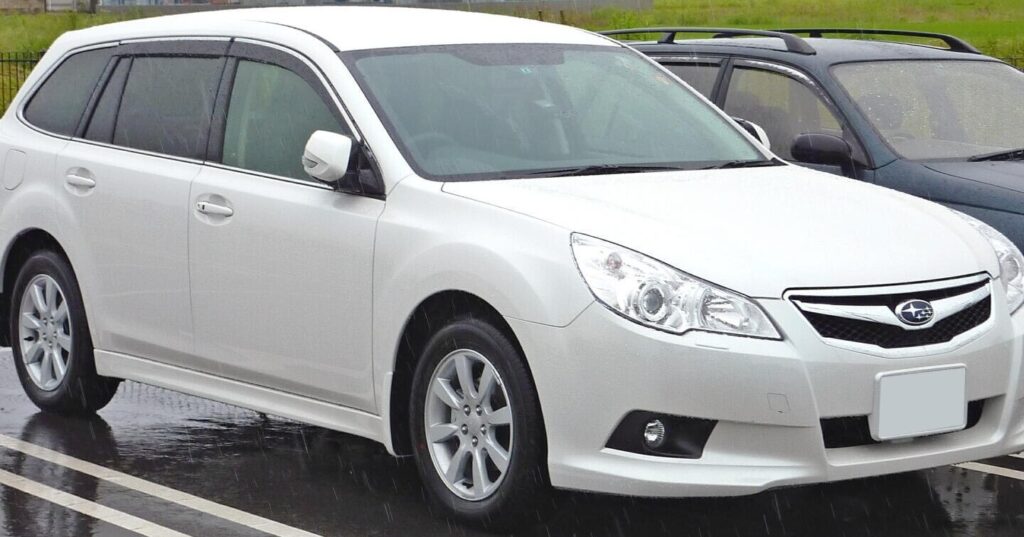
The Subaru Legacy V Station Wagon 2.5i Sport, produced between 2009 and 2012, represented a key iteration of Subaru’s popular mid-size wagon. Part of the fifth generation Legacy (BP/BR chassis), this variant aimed to blend practicality, all-weather capability, and a degree of sporty styling within the Legacy lineup. Positioned as a mid-range offering, the 2.5i Sport with the Lineartronic continuously variable transmission (CVT) provided a balance between fuel efficiency and performance, appealing to families and individuals seeking a versatile vehicle. It was primarily sold in markets like North America, Australia, and select European countries where station wagons retained significant popularity.
Technical Specifications
| Brand | Subaru |
| Model | Legacy |
| Generation | Legacy V Station Wagon |
| Type | 2.5i sport (170 Hp) AWD Lineartronic |
| Start of production | 2009 |
| End of production | 2012 |
| Powertrain Architecture | Internal Combustion engine |
| Body type | Station wagon (estate) |
| Seats | 5 |
| Doors | 5 |
| Fuel consumption (urban) | 11.3 l/100 km (20.8 US mpg) |
| Fuel consumption (extra urban) | 6.8 l/100 km (34.6 US mpg) |
| Fuel consumption (combined) | 8.4 l/100 km (28 US mpg) |
| CO2 emissions | 196 g/km |
| Fuel Type | Petrol (Gasoline) |
| Acceleration 0 – 100 km/h | 10.3 sec |
| Acceleration 0 – 62 mph | 10.3 sec |
| Acceleration 0 – 60 mph | 9.8 sec |
| Maximum speed | 205 km/h (127.38 mph) |
| Emission standard | Euro 5 |
| Weight-to-power ratio | 9.4 kg/Hp |
| Weight-to-torque ratio | 7 kg/Nm |
| Power | 170 Hp @ 5600 rpm |
| Torque | 230 Nm @ 4000 rpm (169.64 lb.-ft. @ 4000 rpm) |
| Engine layout | Front, Longitudinal |
| Engine Model/Code | EJ253 |
| Engine displacement | 2457 cm3 (149.94 cu. in.) |
| Number of cylinders | 4 |
| Engine configuration | Boxer |
| Cylinder Bore | 99.5 mm (3.92 in.) |
| Piston Stroke | 79 mm (3.11 in.) |
| Compression ratio | 10:1 |
| Number of valves per cylinder | 4 |
| Fuel injection system | Multi-port manifold injection |
| Engine aspiration | Naturally aspirated engine |
| Valvetrain | DOHC |
| Engine oil capacity | 4.2 l (4.44 US qt | 3.7 UK qt) |
| Coolant capacity | 6.4 l (6.76 US qt | 5.63 UK qt) |
| Kerb Weight | 1600 kg (3527.4 lbs.) |
| Max. weight | 2030 kg (4475.38 lbs.) |
| Max load | 430 kg (947.99 lbs.) |
| Trunk (boot) space – minimum | 526 l (18.58 cu. ft.) |
| Trunk (boot) space – maximum | 1660 l (58.62 cu. ft.) |
| Fuel tank capacity | 65 l (17.17 US gal | 14.3 UK gal) |
| Max. roof load | 80 kg (176.37 lbs.) |
| Permitted trailer load with brakes (12%) | 1800 kg (3968.32 lbs.) |
| Permitted trailer load without brakes | 720 kg (1587.33 lbs.) |
| Length | 4775 mm (187.99 in.) |
| Width | 1780 mm (70.08 in.) |
| Height | 1535 mm (60.43 in.) |
| Wheelbase | 2750 mm (108.27 in.) |
| Front track | 1565 mm (61.61 in.) |
| Rear track | 1570 mm (61.81 in.) |
| Minimum turning circle | 11.4 m (37.4 ft.) |
| Drive wheel | All wheel drive (4×4) |
| Number of gears and type of gearbox | automatic transmission Lineartronic |
| Front suspension | Independent type McPherson |
| Rear suspension | Double wishbone |
| Front brakes | Ventilated discs |
| Rear brakes | Disc |
| Assisting systems | ABS (Anti-lock braking system) |
| Steering type | Steering rack and pinion |
| Tires size | 225/45 R18W |
| Wheel rims size | 7.5J x 18 |
Powertrain & Engine Architecture
The heart of the 2.5i Sport was the EJ253 2.5-liter naturally aspirated boxer-four engine. This engine, a hallmark of Subaru, featured horizontally opposed pistons, contributing to a low center of gravity and improved balance. The EJ253 utilized a single overhead camshaft (SOHC) design per cylinder bank, operating 16 valves in total. Fuel delivery was managed by a multi-point fuel injection system. The engine produced 170 horsepower at 5600 rpm and 230 Nm (169.64 lb-ft) of torque at 4000 rpm. Paired with this engine was Subaru’s Lineartronic CVT, a continuously variable transmission designed to optimize fuel efficiency and provide smooth acceleration. The Lineartronic featured simulated gear ratios to mimic a traditional automatic transmission, offering a more familiar driving experience. All-wheel drive was standard, utilizing Subaru’s symmetrical AWD system for enhanced traction and stability in various conditions.
Driving Characteristics
The 2.5i Sport with the Lineartronic CVT offered a comfortable and predictable driving experience. While not overtly sporty, the engine provided adequate power for everyday driving and highway cruising. The CVT, while efficient, lacked the direct feel and responsiveness of a traditional automatic or manual transmission. Acceleration from 0-60 mph took approximately 9.8 seconds. The Lineartronic’s programming included simulated shift points, but the absence of fixed gears meant that engine speed could remain relatively constant during acceleration, sometimes resulting in a “rubber band” feel. The all-wheel-drive system provided confident handling in inclement weather and on slippery surfaces. Compared to the six-speed manual transmission available on some Legacy models, the CVT prioritized fuel economy over outright performance.
Equipment & Trim Levels
The 2.5i Sport trim typically included standard features such as air conditioning, power windows and locks, a CD player with auxiliary input, and keyless entry. Upholstery was generally cloth, with optional leather available. The Sport trim often added features like alloy wheels, a sport-tuned suspension (though subtle), and unique exterior styling cues. Optional extras could include a sunroof, a premium audio system, and navigation. Safety features were a strong point, with standard inclusion of anti-lock brakes (ABS), electronic brake-force distribution (EBD), and multiple airbags.
Chassis & Braking
The Legacy V Station Wagon utilized a McPherson strut front suspension and a double-wishbone rear suspension. This setup aimed to balance ride comfort with handling stability. The 2.5i Sport typically featured a slightly firmer suspension tuning compared to base models. Braking duties were handled by ventilated discs at the front and solid discs at the rear. ABS was standard, providing enhanced braking control in emergency situations. The vehicle’s weight of approximately 1600 kg (3527.4 lbs) influenced its braking performance and handling characteristics.
Market Reception & Comparison
The 2.5i Sport with the Lineartronic CVT was generally well-received by critics as a practical and efficient family wagon. However, some reviewers noted the CVT’s lack of engagement compared to traditional transmissions. Fuel economy was a strong point, with combined figures around 28 US mpg. Compared to other trims in the Legacy lineup, such as the 2.5i Limited (which offered more luxury features) or the turbocharged 2.5GT (which prioritized performance), the 2.5i Sport occupied a middle ground, appealing to buyers seeking a balance of features and affordability. Reliability was generally good, though like all vehicles, regular maintenance was crucial.
Legacy
The EJ253 engine, while generally reliable, is known to be susceptible to head gasket issues if not properly maintained, particularly regarding cooling system upkeep. The Lineartronic CVT, while offering smooth operation, requires regular fluid changes to ensure longevity. Today, the 2009-2012 Subaru Legacy V Station Wagon 2.5i Sport represents a relatively affordable and practical used car option. Its all-wheel-drive system and spacious interior continue to appeal to buyers seeking a versatile vehicle for family transportation and all-weather driving. Well-maintained examples can still provide many years of reliable service, but prospective buyers should be aware of the potential for head gasket issues and the importance of CVT fluid maintenance.