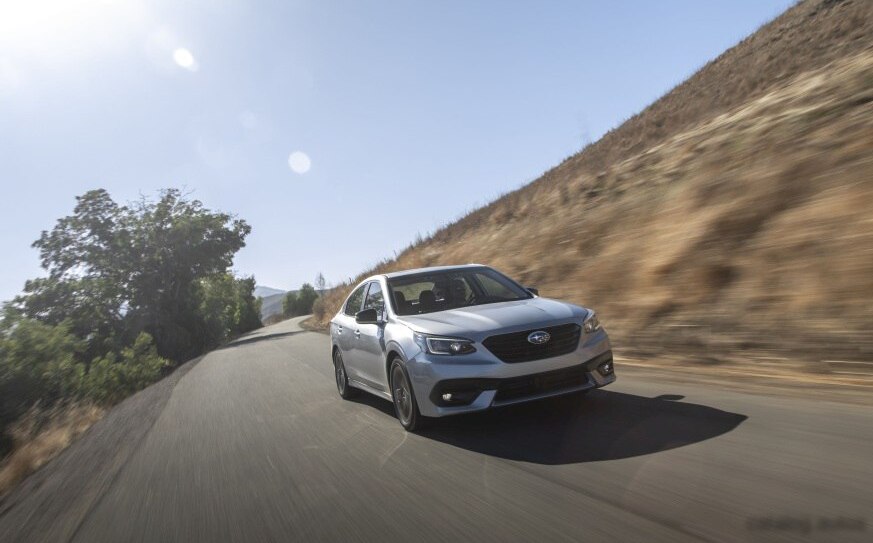
The Subaru Legacy VII 2.5, equipped with a 182 horsepower engine and Lineartronic continuously variable transmission (CVT) paired with all-wheel drive, was a key offering in Subaru’s mid-size sedan lineup from July 2019 to May 2022. Positioned as a comfortable and capable all-weather vehicle, this variant represented a balance between performance and efficiency within the seventh generation Legacy (produced from 2019-2024). It aimed to appeal to buyers seeking a practical, reliable, and safe family sedan with standard all-wheel drive, a hallmark of the Subaru brand. This model was primarily sold in North America, Europe, and select Asian markets.
Technical Specifications
| Brand | Subaru |
| Model | Legacy |
| Generation | Legacy VII |
| Type (Engine) | 2.5 (182 Hp) AWD Lineartronic |
| Start of production | July, 2019 |
| End of production | May, 2022 |
| Powertrain Architecture | Internal Combustion engine |
| Body type | Sedan |
| Seats | 5 |
| Doors | 4 |
| Fuel consumption (urban) | 8.7 l/100 km (27 US mpg, 32.5 UK mpg, 11.5 km/l) |
| Fuel consumption (extra urban) | 6.7 l/100 km (35.1 US mpg, 42.2 UK mpg, 14.9 km/l) |
| Fuel consumption (combined) | 7.8 l/100 km (30.2 US mpg, 36.2 UK mpg, 12.8 km/l) |
| Fuel Type | Petrol (Gasoline) |
| Weight-to-power ratio | 8.7 kg/Hp, 115 Hp/tonne |
| Weight-to-torque ratio | 6.6 kg/Nm, 151 Nm/tonne |
| Power | 182 Hp @ 5800 rpm |
| Power per litre | 72.9 Hp/l |
| Torque | 239 Nm @ 4400 rpm (176.28 lb.-ft. @ 4400 rpm) |
| Engine layout | Front, Longitudinal |
| Engine Model/Code | FB25D |
| Engine displacement | 2498 cm3 (152.44 cu. in.) |
| Number of cylinders | 4 |
| Engine configuration | Boxer |
| Cylinder Bore | 94 mm (3.7 in.) |
| Piston Stroke | 90 mm (3.54 in.) |
| Compression ratio | 12:1 |
| Number of valves per cylinder | 4 |
| Fuel injection system | Direct injection |
| Engine aspiration | Naturally aspirated engine |
| Valvetrain | DOHC |
| Engine oil capacity | 4.2 l (4.44 US qt | 3.7 UK qt) |
| Coolant capacity | 9 l (9.51 US qt | 7.92 UK qt) |
| Kerb Weight | 1583-1624 kg (3489.92 – 3580.31 lbs.) |
| Trunk (boot) space | 428 l (15.11 cu. ft.) |
| Fuel tank capacity | 70 l (18.49 US gal | 15.4 UK gal) |
| Length | 4840 mm (190.55 in.) |
| Width | 1840 mm (72.44 in.) |
| Height | 1500 mm (59.06 in.) |
| Wheelbase | 2750 mm (108.27 in.) |
| Front track | 1580 mm (62.2 in.) |
| Rear track | 1610 mm (63.39 in.) |
| Front overhang | 1010 mm (39.76 in.) |
| Rear overhang | 1080 mm (42.52 in.) |
| Ride height (ground clearance) | 150 mm (5.91 in.) |
| Minimum turning circle | 11.2 m (36.75 ft.) |
| Drivetrain | All wheel drive (4×4) |
| Gearbox | Lineartronic CVT |
| Front suspension | Independent, McPherson with coil spring and anti-roll bar |
| Rear suspension | Double wishbone, Transverse stabilizer, Coil spring |
| Front brakes | Ventilated discs, 315 mm |
| Rear brakes | Ventilated discs, 300 mm |
| Tires size | 225/55 R17; 225/50 R18 |
| Wheel rims size | 7J x 17; 7.5J x 17; 7.5J x 18 |
INTRODUCTION
The Subaru Legacy VII 2.5 AWD Lineartronic, introduced in 2019, represented a significant evolution of Subaru’s popular mid-size sedan. Built on the Subaru Global Platform (SGP), this generation prioritized safety, comfort, and all-weather capability. The 2.5-liter engine and Lineartronic CVT combination was a mainstay of the lineup, offering a balance between fuel efficiency and adequate performance for everyday driving. It served as a step up from the base 2.0-liter engine option, targeting buyers who desired more power without the higher cost of potential turbocharged variants available in some markets.
Powertrain & Engine Architecture
At the heart of the Legacy 2.5 was the FB25D 2.5-liter naturally aspirated boxer-four engine. This engine, a hallmark of Subaru’s engineering, features horizontally opposed pistons, which contribute to a lower center of gravity and reduced vibration. The FB25D utilizes direct fuel injection, optimizing fuel delivery and combustion efficiency. The engine’s DOHC (Dual Overhead Camshaft) valvetrain, with four valves per cylinder, further enhances breathing and power output. The Lineartronic CVT, a key component of this variant, is a continuously variable transmission that offers seamless gear changes and contributes to improved fuel economy. Unlike traditional automatic transmissions with fixed gear ratios, the Lineartronic CVT uses a belt and pulley system to provide an infinite number of gear ratios within its operating range. This allows the engine to operate at its most efficient RPM for any given driving condition. The engine’s Start & Stop System further aids in fuel conservation by automatically shutting off the engine when the vehicle is stationary.
Driving Characteristics
The 2.5-liter engine and Lineartronic CVT pairing in the Legacy VII delivered a smooth and predictable driving experience. While not overtly sporty, the combination provided sufficient power for merging onto highways and passing maneuvers. The CVT, while efficient, sometimes exhibited a “rubber band” feel, where engine RPMs would rise before corresponding acceleration. Subaru addressed this with programmed “shift points” within the CVT to mimic the feel of a traditional automatic transmission. Compared to the base 2.0-liter engine, the 2.5-liter offered noticeably more responsive acceleration. However, it lacked the punch of the optional turbocharged engines available in some markets. The all-wheel-drive system provided excellent traction in various weather conditions, enhancing stability and confidence, particularly on slippery surfaces. The CVT’s ratios were tuned for fuel efficiency, prioritizing economy over outright performance.
Equipment & Trim Levels
The Legacy 2.5 AWD Lineartronic typically came standard with a comprehensive suite of features. These included automatic climate control, a touchscreen infotainment system with Apple CarPlay and Android Auto compatibility, and Subaru’s EyeSight driver-assist technology, which incorporates features like adaptive cruise control, lane departure warning, and automatic emergency braking. Interior upholstery was typically cloth, with available upgrades to leather in higher trim levels. Optional extras included a premium sound system, a power sunroof, and heated front seats. Trim levels varied by market, but generally offered increasing levels of luxury and convenience features as you moved up the range.
Chassis & Braking
The Legacy VII utilized a MacPherson strut front suspension and a double-wishbone rear suspension, providing a comfortable and controlled ride. Stabilizer bars were standard front and rear, minimizing body roll during cornering. Braking duties were handled by ventilated disc brakes on all four wheels, providing ample stopping power. The braking system was augmented by ABS (Anti-lock Braking System) and electronic brake-force distribution. The suspension tuning was geared towards comfort and everyday usability, rather than aggressive handling. The all-wheel-drive system contributed to enhanced stability and braking performance, particularly in adverse conditions.
Market Reception & Comparison
The Subaru Legacy VII 2.5 AWD Lineartronic was generally well-received by automotive critics. It was praised for its standard all-wheel drive, spacious interior, comfortable ride, and comprehensive safety features. However, some reviewers noted the CVT’s occasionally uninspiring driving experience and the engine’s lack of outright power compared to some competitors. Fuel economy was considered competitive for its class. Compared to other trims in the Legacy lineup, the 2.5-liter offered a sweet spot between affordability and performance. The base 2.0-liter was more economical but lacked power, while the turbocharged options were more expensive and focused on performance enthusiasts. Against competitors like the Toyota Camry, Honda Accord, and Mazda 6, the Legacy distinguished itself with its standard all-wheel drive and unique boxer engine configuration.
Legacy
The FB25D engine, used in the Legacy 2.5, has proven to be a relatively reliable powertrain. Common maintenance items include regular oil changes and timing belt replacements (though some later versions used a timing chain). The Lineartronic CVT, while generally durable, requires proper fluid maintenance to ensure longevity. On the used car market, the Legacy VII 2.5 AWD Lineartronic represents a good value proposition for buyers seeking a safe, reliable, and capable all-weather sedan. Its reputation for dependability and the inherent advantages of Subaru’s all-wheel-drive system continue to make it a popular choice among used car shoppers.