Technical Specifications
| Brand | Subaru |
| Model | Outback |
| Generation | Outback I (BD, BG, BK) |
| Type | 2.5i 4WD (165 Hp) Automatic |
| Start of production | 1994 |
| End of production | 1999 |
| Powertrain Architecture | Internal Combustion engine |
| Body type | Station wagon (estate) |
| Seats | 5 |
| Doors | 5 |
| Fuel consumption (urban) | 14 l/100 km (16.8 US mpg, 20.2 UK mpg, 7.1 km/l) |
| Fuel consumption (extra urban) | 9 l/100 km (26.1 US mpg, 31.4 UK mpg, 11.1 km/l) |
| Fuel consumption (combined) | 11 l/100 km (21.4 US mpg, 25.7 UK mpg, 9.1 km/l) |
| Fuel Type | Petrol (Gasoline) |
| Emission standard | EURO 1 |
| Weight-to-power ratio | 9 kg/Hp, 111.5 Hp/tonne |
| Weight-to-torque ratio | 6.5 kg/Nm, 152.7 Nm/tonne |
| Power | 165 Hp @ 5600 rpm |
| Power per litre | 67.2 Hp/l |
| Torque | 226 Nm @ 4400 rpm (166.69 lb.-ft. @ 4400 rpm) |
| Engine layout | Front, Longitudinal |
| Engine Model/Code | EJ25 |
| Engine displacement | 2457 cm3 (149.94 cu. in.) |
| Number of cylinders | 4 |
| Engine configuration | Boxer |
| Cylinder Bore | 99.5 mm (3.92 in.) |
| Piston Stroke | 79 mm (3.11 in.) |
| Compression ratio | 10:1 |
| Number of valves per cylinder | 4 |
| Fuel injection system | Multi-port manifold injection |
| Engine aspiration | Naturally aspirated engine |
| Valvetrain | OHC |
| Engine oil capacity | 4.5 l (4.76 US qt | 3.96 UK qt) |
| Kerb Weight | 1480 kg (3262.84 lbs.) |
| Fuel tank capacity | 60 l (15.85 US gal | 13.2 UK gal) |
| Length | 4719 mm (185.79 in.) |
| Width | 1715 mm (67.52 in.) |
| Height | 1600 mm (62.99 in.) |
| Wheelbase | 2629 mm (103.5 in.) |
| Drive wheel | All wheel drive (4×4) |
| Number of gears and type of gearbox | 4 gears, automatic transmission |
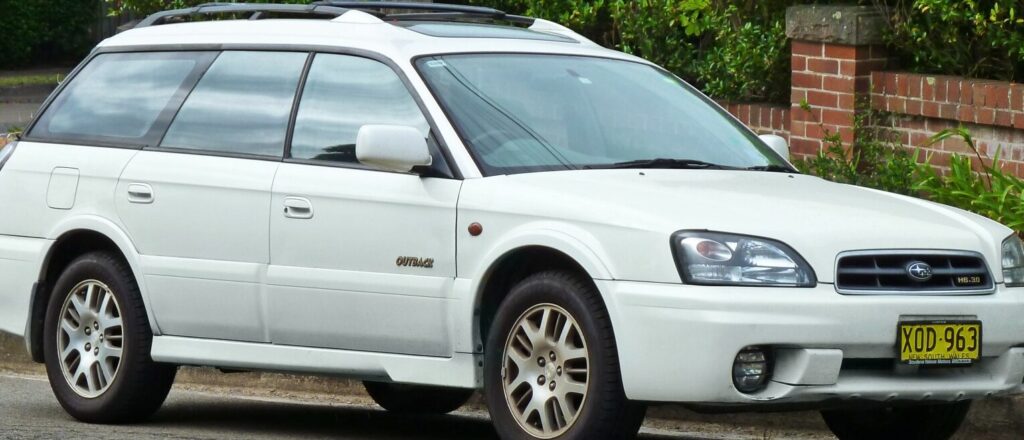
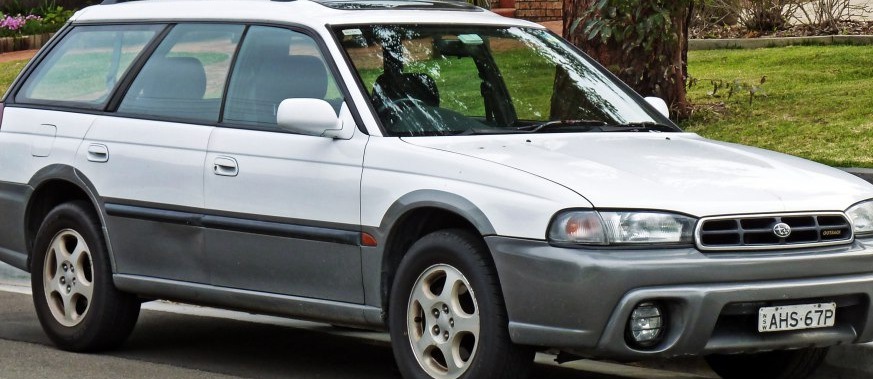
The Subaru Outback I, specifically the 2.5i 4WD variant with an automatic transmission, marked Subaru’s initial step into the growing sport utility wagon segment. Produced from 1994 to 1999, depending on the specific market, this model – identified by chassis codes BD, BG, and BK – was essentially an enhanced Subaru Legacy wagon. It featured increased ground clearance, more rugged styling elements, and standard all-wheel drive. This 2.5i Automatic configuration proved to be a popular mid-range option, attracting buyers who desired a practical, capable vehicle with a comfortable and convenient driving experience. It was instrumental in establishing the Outback as a distinct model line, separate from the Legacy wagon, and helped define a segment that would later be largely populated by crossovers.
Powertrain & Engine Architecture
At the core of the 2.5i Outback is the EJ25 2.5-liter naturally aspirated boxer-four engine. This engine, a signature of Subaru’s engineering prowess, employs horizontally opposed pistons, contributing to a lower center of gravity and reduced engine vibration. The EJ25 utilizes a single overhead camshaft (OHC) design with four valves per cylinder, coupled with a multi-port fuel injection system. The engine generates 165 horsepower at 5600 rpm and 226 Nm (166.69 lb-ft) of torque at 4400 rpm. Paired with this engine is a four-speed automatic transmission, engineered for smooth operation and ease of use. While not focused on sporty performance, it delivered sufficient power for everyday driving and light off-road adventures. The engine code, EJ25, is essential for identifying specific parts and understanding maintenance requirements.
Driving Characteristics
The 2.5i Automatic Outback provided a comfortable and predictable driving experience. The automatic transmission, while lacking the responsiveness of a manual gearbox, offered smooth gear changes and eliminated the need for constant shifting. Acceleration was adequate for merging onto highways and overtaking slower vehicles, but it wasn’t a particularly quick vehicle. The standard all-wheel drive system provided excellent traction in various weather conditions, making it a reliable choice for those living in areas prone to snow or rain. Compared to the five-speed manual version, the automatic prioritized convenience over performance. The higher-output turbocharged models, though more expensive, offered significantly more power and a sportier driving feel. The four-speed automatic’s gear ratios were optimized for fuel efficiency and comfortable cruising rather than rapid acceleration.
Equipment & Trim Levels
The 2.5i Automatic Outback typically came equipped with standard features such as air conditioning, power windows and locks, and an AM/FM stereo. Interior upholstery was generally cloth, with leather options available as an upgrade. The dashboard layout was functional and straightforward, emphasizing usability over elaborate aesthetics. Optional extras included a sunroof, upgraded audio systems, and alloy wheels. This trim level struck a good balance between features and affordability, making it a popular choice for families and individuals seeking a versatile vehicle.
Chassis & Braking
The Outback I featured a MacPherson strut front suspension and a double-wishbone rear suspension, providing a comfortable ride and predictable handling characteristics. The 2.5i models generally included front disc brakes and rear drum brakes. Stabilizer bars were incorporated at both the front and rear to minimize body roll during cornering. The suspension was tuned to balance on-road comfort with off-road capability, allowing the Outback to navigate both paved roads and unpaved trails with relative ease. The chassis was reinforced compared to the standard Legacy wagon to accommodate the increased ground clearance and more rugged styling.
Market Reception & Comparison
The Subaru Outback I was generally well-received by automotive critics, who lauded its practicality, all-wheel drive system, and comfortable ride quality. The 2.5i Automatic variant was considered a sensible option for buyers who valued convenience and ease of use over outright performance. Fuel economy was considered average for its class, and reliability was generally good, although some owners reported potential issues with the automatic transmission over the long term. Compared to other wagons and early crossovers available at the time, the Outback offered a unique combination of features and capabilities, establishing itself as a leader in the emerging sport utility wagon segment.
Legacy
The Subaru Outback I, and specifically the 2.5i Automatic variant, established the foundation for the successful Outback models that followed. The EJ25 engine, while eventually replaced by more modern designs, proved to be a durable and reliable powerplant. The four-speed automatic transmission, while not known for its sporty nature, provided years of dependable service for many owners. Today, well-maintained examples of the Outback I are sought after by enthusiasts and collectors, representing a significant chapter in Subaru’s history and a testament to the brand’s commitment to all-wheel drive and practicality. In the used car market, these vehicles are often seen as affordable and capable options, although potential buyers should be prepared for age-related maintenance that may be required.