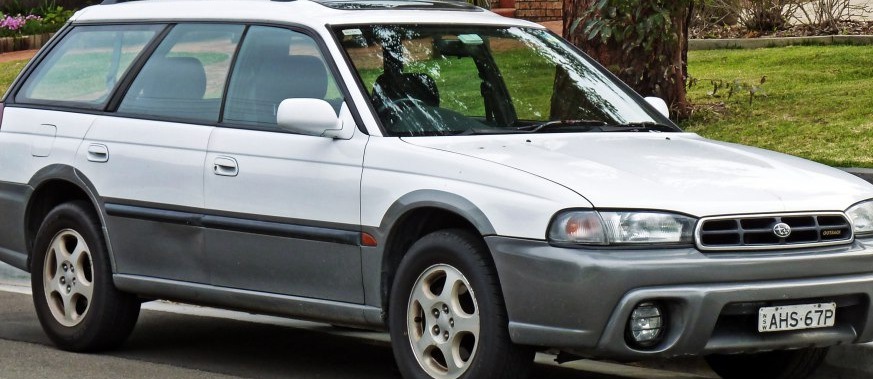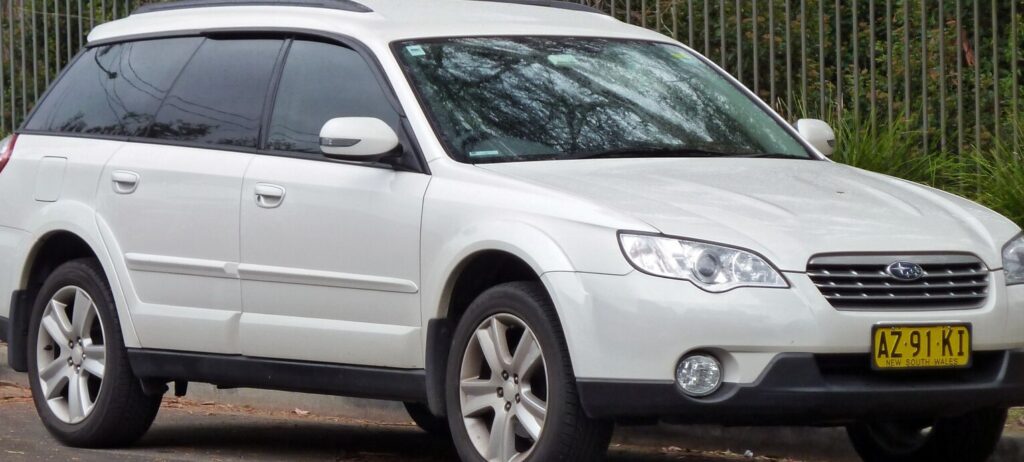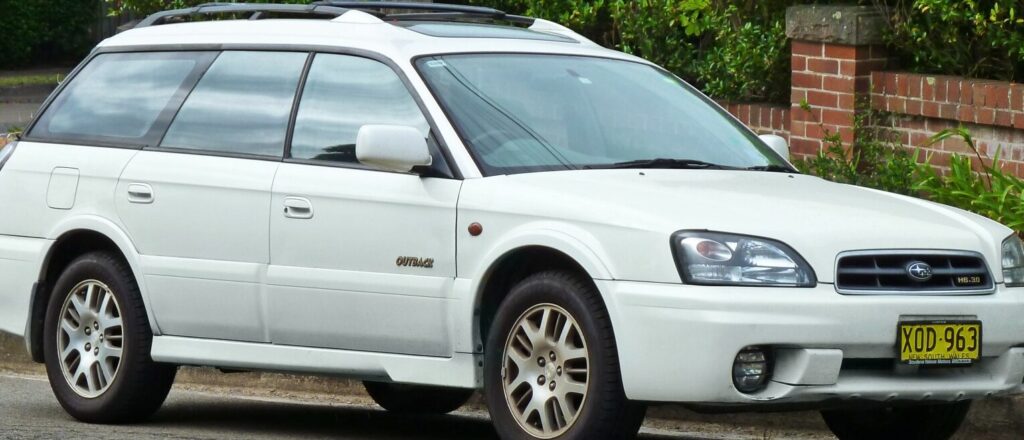
The Subaru Outback II (BE/BH) 2.5i 4WD, produced between 1999 and 2003, represented a significant evolution of Subaru’s popular all-wheel-drive wagon. Building upon the success of the original Outback, the BE/BH generation aimed to blend the practicality of a station wagon with the capability of a sport utility vehicle. This particular 2.5i variant, equipped with a 2.5-liter naturally aspirated boxer engine producing 156 horsepower, served as a core model within the Outback lineup, offering a balance of performance, fuel efficiency, and affordability. It was positioned as a step up from the base 2.0L models, appealing to buyers seeking more power for highway driving and light off-road adventures.
Technical Specifications
| Brand | Subaru |
| Model | Outback |
| Generation | Outback II (BE, BH) |
| Type (Engine) | 2.5 i 4WD (156 Hp) |
| Start of production | 1999 |
| End of production | 2003 |
| Powertrain Architecture | Internal Combustion engine |
| Body type | Station wagon (estate) |
| Seats | 5 |
| Doors | 5 |
| Fuel consumption (urban) | 12.3 l/100 km (19.1 US mpg, 23 UK mpg, 8.1 km/l) |
| Fuel consumption (extra urban) | 7.2 l/100 km (32.7 US mpg, 39.2 UK mpg, 13.9 km/l) |
| Fuel consumption (combined) | 9 l/100 km (26.1 US mpg, 31.4 UK mpg, 11.1 km/l) |
| Fuel Type | Petrol (Gasoline) |
| Acceleration 0 – 100 km/h | 9.5 sec |
| Acceleration 0 – 62 mph | 9.5 sec |
| Acceleration 0 – 60 mph | 9 sec |
| Maximum speed | 197 km/h (122.41 mph) |
| Emission standard | Euro 3 |
| Weight-to-power ratio | 9.5 kg/Hp, 105.4 Hp/tonne |
| Weight-to-torque ratio | 6.6 kg/Nm, 150.7 Nm/tonne |
| Power | 156 Hp @ 5600 rpm |
| Power per litre | 63.5 Hp/l |
| Torque | 223 Nm @ 3600 rpm (164.48 lb.-ft. @ 3600 rpm) |
| Engine layout | Front, Longitudinal |
| Engine Model/Code | EJ25 |
| Engine displacement | 2457 cm3 (149.94 cu. in.) |
| Number of cylinders | 4 |
| Engine configuration | Boxer |
| Cylinder Bore | 99.5 mm (3.92 in.) |
| Piston Stroke | 79 mm (3.11 in.) |
| Compression ratio | 10:1 |
| Number of valves per cylinder | 4 |
| Fuel injection system | Multi-port manifold injection |
| Engine aspiration | Naturally aspirated engine |
| Valvetrain | DOHC |
| Engine oil capacity | 4.5 l (4.76 US qt | 3.96 UK qt) |
| Coolant | 5.9 l (6.23 US qt | 5.19 UK qt) |
| Kerb Weight | 1480 kg (3262.84 lbs.) |
| Max. weight | 2015 kg (4442.31 lbs.) |
| Max load | 535 kg (1179.47 lbs.) |
| Trunk (boot) space – minimum | 459 l (16.21 cu. ft.) |
| Trunk (boot) space – maximum | 1649 l (58.23 cu. ft.) |
| Fuel tank capacity | 64 l (16.91 US gal | 14.08 UK gal) |
| Length | 4730 mm (186.22 in.) |
| Width | 1770 mm (69.69 in.) |
| Height | 1545 mm (60.83 in.) |
| Wheelbase | 2670 mm (105.12 in.) |
| Front track | 1495 mm (58.86 in.) |
| Rear (Back) track | 1485 mm (58.46 in.) |
| Drive wheel | All wheel drive (4×4) |
| Number of gears and type of gearbox | 5 gears, manual transmission |
| Front suspension | Spring Strut |
| Rear suspension | Coil spring |
| Front brakes | Ventilated discs |
| Rear brakes | Disc |
| Assisting systems | ABS (Anti-lock braking system) |
| Steering type | Steering rack and pinion |
| Power steering | Hydraulic Steering |
| Tires size | 215/60 R16 |
Powertrain & Engine Architecture
The heart of the 2.5i Outback was the EJ25 engine, a 2.5-liter horizontally opposed (boxer) four-cylinder. This engine design, a Subaru hallmark, offered a low center of gravity, contributing to the vehicle’s balanced handling. The EJ25 featured a single overhead camshaft (SOHC) design per cylinder bank, operating four valves per cylinder. Fuel delivery was handled by a multi-point fuel injection system. The engine produced 156 horsepower at 5600 rpm and 164 lb-ft of torque at 3600 rpm. This power was delivered to all four wheels through a standard five-speed manual transmission. A four-speed automatic transmission was also available, and it’s this combination that represents a significant portion of the 2.5i Outback sales. The automatic transmission, while providing convenience, was not known for its sportiness or fuel efficiency compared to the manual.
Driving Characteristics
The 2.5i 4WD Outback with the automatic transmission offered a comfortable and capable driving experience. Acceleration from 0-60 mph took around 9 seconds, which was adequate for everyday driving but noticeably slower than the manual transmission or the more powerful 2.5 XT turbo models. The automatic transmission’s gear ratios were geared towards fuel economy and smooth cruising rather than aggressive acceleration. In real-world conditions, the Outback 2.5i felt most at home on highway journeys, where the engine provided sufficient power for passing maneuvers. The all-wheel-drive system provided excellent traction in various weather conditions, making it a reliable choice for drivers in regions with snow or rain. The suspension was tuned for comfort, absorbing bumps and providing a stable ride.
Equipment & Trim Levels
The 2.5i Outback typically came standard with features such as air conditioning, power windows and locks, and an AM/FM stereo. Higher trim levels, often denoted by “Limited” or “L.L. Bean” editions, added features like leather upholstery, a sunroof, upgraded audio systems, and alloy wheels. The L.L. Bean editions, a collaboration between Subaru and the outdoor retailer, often included unique exterior and interior styling cues, as well as specialized equipment like all-weather floor mats and cargo area protectors. Optional extras included a CD changer, cruise control, and a rear cargo net.
Chassis & Braking
The Outback II utilized a MacPherson strut front suspension and a double-wishbone rear suspension. The suspension was tuned to provide a comfortable ride while maintaining good handling characteristics. The braking system consisted of ventilated disc brakes on the front wheels and solid disc brakes on the rear. Anti-lock brakes (ABS) were standard equipment. The Outback’s chassis was designed to provide a stable platform for both on-road and off-road driving. The all-wheel-drive system, coupled with a relatively high ground clearance, allowed the Outback to tackle moderate off-road terrain.
Market Reception & Comparison
The Subaru Outback II 2.5i 4WD was generally well-received by automotive critics. It was praised for its practicality, safety, and all-weather capability. However, the automatic transmission was sometimes criticized for its lack of responsiveness and its impact on fuel economy. Compared to the 2.0L Outback models, the 2.5i offered a noticeable improvement in performance. Compared to the turbocharged 2.5 XT models, the 2.5i was less powerful but more affordable and offered better fuel economy. The Outback competed with other compact SUVs and wagons, such as the Honda CR-V and the Toyota RAV4.
Legacy
The Subaru Outback II 2.5i 4WD remains a popular choice in the used car market today. The EJ25 engine, while known for potential head gasket issues in some applications, is generally considered reliable when properly maintained. Regular oil changes and coolant flushes are crucial for preventing engine problems. The Outback’s all-wheel-drive system and durable construction contribute to its longevity. These vehicles are often sought after by buyers looking for a practical, reliable, and capable all-weather vehicle. The BE/BH generation Outback solidified Subaru’s reputation as a manufacturer of rugged and dependable vehicles, paving the way for the continued success of the Outback model line.