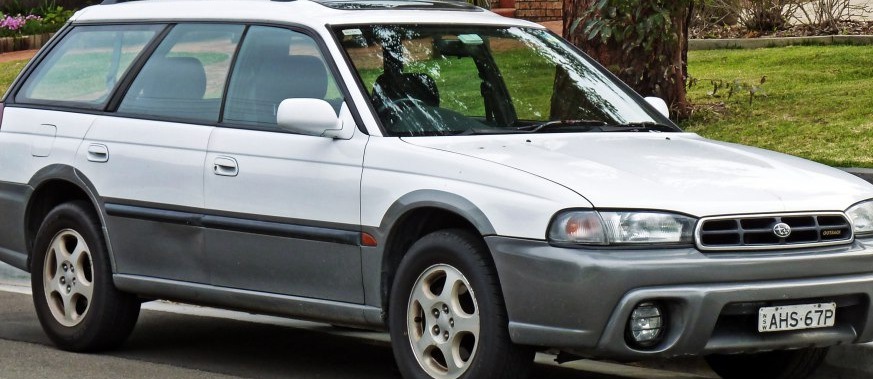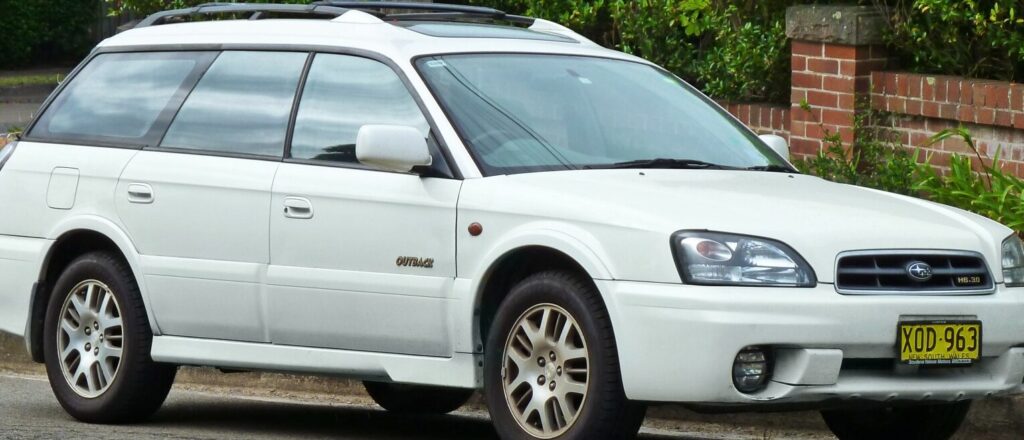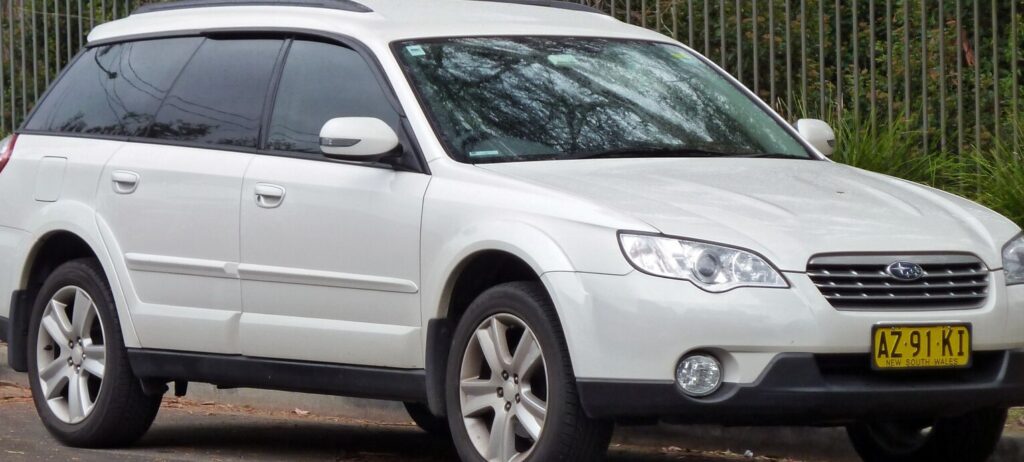
The Subaru Outback III (BL, BP) 2.5 T, produced between 2003 and 2007, represented a significant evolution of Subaru’s popular crossover wagon. Positioned as the performance-oriented trim within the third-generation Outback lineup, the 2.5 T distinguished itself with a turbocharged engine and standard all-wheel drive. This variant aimed to appeal to buyers seeking a blend of practicality, capability, and spirited driving dynamics. It occupied the upper echelon of the Outback range, sitting above the naturally aspirated 2.5i models and offering a more premium experience. The BL/BP generation Outback was built on Subaru’s platform, offering a spacious interior and a focus on all-weather capability.
Technical Specifications
| Brand | Subaru |
| Model | Outback |
| Generation | Outback III (BL, BP) |
| Type (Engine) | 2.5 T (250 Hp) AWD Automatic |
| Start of production | 2003 |
| End of production | 2007 |
| Powertrain Architecture | Internal Combustion engine |
| Body type | Station wagon (estate) |
| Seats | 5 |
| Doors | 5 |
| Fuel consumption (urban) | 12.4 l/100 km (19 US mpg, 22.8 UK mpg) |
| Fuel consumption (extra urban) | 9.4 l/100 km (25 US mpg, 30.1 UK mpg) |
| Fuel Type | Petrol (Gasoline) |
| Emission standard | Euro 4 |
| Weight-to-power ratio | 6.2 kg/Hp, 161.3 Hp/tonne |
| Weight-to-torque ratio | 4.6 kg/Nm, 218.7 Nm/tonne |
| Power | 250 Hp @ 6000 rpm |
| Power per litre | 101.8 Hp/l |
| Torque | 339 Nm @ 3600 rpm (250.03 lb.-ft. @ 3600 rpm) |
| Engine layout | Front, Longitudinal |
| Engine Model/Code | EJ255 |
| Engine displacement | 2457 cm3 (149.94 cu. in.) |
| Number of cylinders | 4 |
| Engine configuration | Boxer |
| Number of valves per cylinder | 4 |
| Fuel injection system | Multi-port manifold injection |
| Engine aspiration | Turbocharger, Intercooler |
| Engine oil capacity | 4.2 l (4.44 US qt | 3.7 UK qt) |
| Coolant capacity | 7.3 l (7.71 US qt | 6.42 UK qt) |
| Kerb Weight | 1550 kg (3417.17 lbs) |
| Max. weight | 2060 kg (4541.52 lbs) |
| Max load | 510 kg (1124.36 lbs) |
| Trunk (boot) space – minimum | 459 l (16.21 cu. ft.) |
| Trunk (boot) space – maximum | 1649 l (58.23 cu. ft.) |
| Fuel tank capacity | 64 l (16.91 US gal | 14.08 UK gal) |
| Length | 4795 mm (188.78 in) |
| Width | 1770 mm (69.69 in) |
| Height | 1605 mm (63.19 in) |
| Wheelbase | 2670 mm (105.12 in) |
| Front track | 1495 mm (58.86 in) |
| Rear track | 1490 mm (58.66 in) |
| Minimum turning circle | 10.8 m (35.43 ft) |
| Drive wheel | All wheel drive (4×4) |
| Number of gears | 5 |
| Gearbox type | Automatic transmission |
| Front suspension | Spring Strut |
| Rear suspension | Wishbone |
| Front brakes | Ventilated discs |
| Rear brakes | Disc |
| Assisting systems | ABS (Anti-lock braking system) |
| Steering type | Steering rack and pinion |
| Power steering | Hydraulic Steering |
| Tires size | 225/55R17 |
Powertrain & Engine Architecture
The heart of the Outback 2.5 T was the EJ255, a 2.5-liter horizontally opposed (Boxer) four-cylinder engine. This engine was a key component of Subaru’s identity, known for its smooth operation and low center of gravity. The EJ255 featured a single turbocharger with an intercooler, boosting power output to 250 horsepower at 6000 rpm and 339 Nm (250 lb-ft) of torque at 3600 rpm. Fuel delivery was managed by a multi-port fuel injection system. The engine’s Boxer configuration contributed to reduced vibrations and improved balance. The automatic transmission was a five-speed unit, designed to handle the engine’s torque output and provide smooth shifts. While not known for being the most fuel-efficient transmission, it offered convenience for everyday driving.
Driving Characteristics
The 2.5 T offered a noticeable performance upgrade over the naturally aspirated Outback models. Acceleration was brisk, and the turbocharger provided a readily available boost of power for overtaking and merging. The automatic transmission, while smooth, wasn’t particularly sporty. It prioritized comfort over aggressive shifting. Compared to the five-speed manual transmission available on some models, the automatic felt less engaging. The all-wheel-drive system provided excellent traction in various conditions, making the Outback 2.5 T a capable vehicle for inclement weather and light off-road adventures. The gear ratios were tuned for a balance of acceleration and fuel economy, but the added weight of the turbo engine and automatic transmission did impact overall efficiency.
Equipment & Trim Levels
The Outback 2.5 T typically came well-equipped, reflecting its position as the premium trim level. Standard features often included automatic climate control, power windows and locks, a CD player with multiple speakers, and alloy wheels. Leather upholstery was frequently standard or available as an option. Higher-end trims could also include features like a sunroof, premium audio system, and heated front seats. The interior design was functional and comfortable, with a focus on practicality. The dashboard layout was straightforward, with easy-to-use controls. Optional extras included a navigation system and upgraded interior trim materials.
Chassis & Braking
The Outback 2.5 T utilized a MacPherson strut front suspension and a double-wishbone rear suspension. This setup provided a comfortable ride while maintaining reasonable handling characteristics. The suspension was tuned to prioritize comfort over sporty handling. The braking system consisted of ventilated discs at the front and solid discs at the rear. Anti-lock brakes (ABS) were standard, enhancing safety and control during hard braking. The steering was rack-and-pinion with hydraulic power assist, providing a responsive and predictable feel. The vehicle’s weight distribution, aided by the Boxer engine, contributed to balanced handling.
Market Reception & Comparison
The Outback 2.5 T was generally well-received by automotive critics. It was praised for its powerful engine, all-wheel-drive capability, and spacious interior. However, some reviewers noted that the automatic transmission could feel sluggish at times. Compared to the base 2.5i models, the 2.5 T offered a significant performance advantage, but at a higher price point. Fuel economy was also slightly lower with the turbocharged engine. Against competitors like the Honda CR-V and Toyota RAV4, the Outback 2.5 T stood out with its unique Boxer engine and standard all-wheel drive. Reliability was generally good, although turbocharger maintenance should be considered.
Legacy
The Subaru Outback III 2.5 T remains a popular choice in the used car market. The EJ255 engine, while capable, requires regular maintenance, particularly regarding the turbocharger and oil changes. The automatic transmission is generally reliable, but it’s essential to check for smooth shifting and proper operation. Overall, the Outback 2.5 T offers a compelling combination of practicality, performance, and all-weather capability. Its Boxer engine and standard all-wheel drive continue to appeal to buyers seeking a unique and capable crossover wagon. Finding well-maintained examples is key, as preventative maintenance is crucial for long-term reliability.