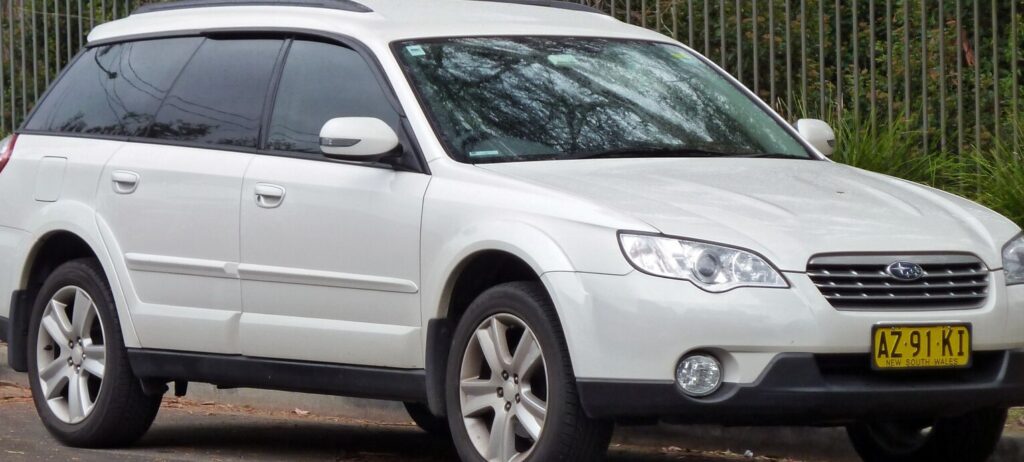
The Subaru Outback III (BL, BP) 2.5i, produced between 2003 and 2007, represented a significant evolution of Subaru’s popular crossover wagon. Positioned as a mid-range offering within the third-generation Outback lineup – which also included a 2.5X model and later turbocharged variants – the 2.5i aimed to balance affordability with Subaru’s renowned symmetrical all-wheel drive system and a comfortable, practical interior. Built on the BL/BP platform, it served as a key model for Subaru in North America, appealing to buyers seeking a versatile vehicle capable of handling diverse weather conditions and light off-road adventures. This variant was particularly popular for its blend of fuel efficiency and adequate power for everyday driving.
Technical Specifications
| Brand | Subaru |
| Model | Outback |
| Generation | Outback III (BL, BP) |
| Type (Engine) | 2.5i (165 Hp) AWD |
| Start of production | 2003 |
| End of production | 2007 |
| Powertrain Architecture | Internal Combustion engine |
| Body type | Station wagon (estate) |
| Seats | 5 |
| Doors | 5 |
| Fuel Type | Petrol (Gasoline) |
| Acceleration 0 – 100 km/h | 9.8 sec |
| Acceleration 0 – 62 mph | 9.8 sec |
| Acceleration 0 – 60 mph | 9.3 sec |
| Maximum speed | 198 km/h (123.03 mph) |
| Weight-to-power ratio | 8.7 kg/Hp, 115.4 Hp/tonne |
| Weight-to-torque ratio | 6.4 kg/Nm, 157.3 Nm/tonne |
| Power | 165 Hp @ 5600 rpm |
| Power per litre | 67.2 Hp/l |
| Torque | 225 Nm @ 4000 rpm (165.95 lb.-ft. @ 4000 rpm) |
| Engine layout | Front, Longitudinal |
| Engine Model/Code | EJ253 |
| Engine displacement | 2457 cm3 (149.94 cu. in.) |
| Number of cylinders | 4 |
| Engine configuration | Boxer |
| Cylinder Bore | 99.5 mm (3.92 in.) |
| Piston Stroke | 79 mm (3.11 in.) |
| Compression ratio | 10:1 |
| Number of valves per cylinder | 4 |
| Fuel injection system | Multi-port manifold injection |
| Engine aspiration | Naturally aspirated engine |
| Valvetrain | DOHC |
| Engine oil capacity | 4.2 l (4.44 US qt | 3.7 UK qt) |
| Coolant | 6.5 l (6.87 US qt | 5.72 UK qt) |
| Kerb Weight | 1430 kg (3152.61 lbs) |
| Trunk (boot) space – minimum | 459 l (16.21 cu. ft.) |
| Trunk (boot) space – maximum | 1649 l (58.23 cu. ft.) |
| Fuel tank capacity | 64 l (16.91 US gal | 14.08 UK gal) |
| Length | 4730 mm (186.22 in.) |
| Width | 1770 mm (69.69 in.) |
| Height | 1545 mm (60.83 in.) |
| Wheelbase | 2670 mm (105.12 in.) |
| Front track | 1495 mm (58.86 in.) |
| Rear (Back) track | 1485 mm (58.46 in.) |
| Drive wheel | All wheel drive (4×4) |
| Number of gears and type of gearbox | 5 gears, manual transmission |
| Front suspension | Spring Strut |
| Rear suspension | Coil spring |
| Front brakes | Ventilated discs |
| Rear brakes | Disc |
| Assisting systems | ABS (Anti-lock braking system) |
| Steering type | Steering rack and pinion |
| Power steering | Hydraulic Steering |
| Tires size | 215/60 R16 |
Powertrain & Engine Architecture
The heart of the 2.5i Outback was the EJ253 engine, a 2.5-liter naturally aspirated, horizontally-opposed (boxer) four-cylinder. This engine was a staple of Subaru’s lineup during this period, known for its relatively smooth operation and inherent balance due to the opposing piston design. The EJ253 featured a single overhead camshaft (SOHC) per cylinder bank, operating four valves per cylinder. Fuel delivery was handled by a multi-point fuel injection system, providing adequate atomization for efficient combustion. The engine produced 165 horsepower at 5600 rpm and 166 lb-ft of torque at 4000 rpm. The engine’s longitudinal mounting allowed for a more balanced weight distribution, contributing to the Outback’s handling characteristics. The standard transmission for this variant was a five-speed manual, though a four-speed automatic transmission was also available, and often preferred by buyers seeking ease of use.
Driving Characteristics
The 2.5i Outback with the five-speed manual offered reasonably brisk acceleration, achieving 0-60 mph in around 9.3 seconds. The automatic transmission, while providing smoother shifts, did slightly diminish performance. The engine’s torque curve was relatively flat, providing usable power across a wide range of engine speeds. However, it wasn’t a particularly powerful engine, and passing maneuvers at highway speeds required careful planning. The symmetrical all-wheel drive system provided excellent traction in various conditions, making the Outback a confident performer in rain, snow, and on gravel roads. The suspension was tuned for comfort, absorbing bumps and irregularities well, but it wasn’t particularly sporty. The steering was precise, but lacked significant feedback.
Equipment & Trim Levels
The 2.5i Outback typically came standard with features such as air conditioning, power windows and locks, a CD player, and a tilt-adjustable steering wheel. Higher trim levels, often denoted by the addition of “Limited” to the name, added features like leather upholstery, a power driver’s seat, alloy wheels, and a premium audio system. Optional extras included a sunroof, heated front seats, and a navigation system. The interior design was functional and durable, prioritizing practicality over luxury. The rear seats offered ample legroom, and the cargo area was generously sized, especially with the rear seats folded down.
Chassis & Braking
The Outback III utilized a MacPherson strut front suspension and a double-wishbone rear suspension. This setup provided a good balance of ride comfort and handling. The chassis was reinforced to handle the demands of all-wheel drive and occasional off-road use. Braking duties were handled by ventilated disc brakes at the front and solid disc brakes at the rear. Anti-lock brakes (ABS) were standard, enhancing safety and control during emergency braking situations. The Outback’s relatively high ground clearance (8.7 inches) allowed it to navigate moderate obstacles and unpaved roads with ease.
Market Reception & Comparison
The 2.5i Outback was generally well-received by automotive critics. It was praised for its practicality, safety, and all-weather capability. However, some reviewers noted that the engine lacked the power of the turbocharged variants. Compared to the 2.5X, the 2.5i offered a more affordable entry point into the Outback lineup. Compared to the turbocharged models, the 2.5i delivered better fuel economy, averaging around 20 mpg city and 27 mpg highway. Reliability was generally good, although some owners reported issues with the head gaskets, a common problem with Subaru engines of this era.
Legacy
The Subaru Outback III 2.5i remains a popular choice in the used car market today. Its reputation for reliability, practicality, and all-weather capability continues to attract buyers. While the EJ253 engine is known for potential head gasket issues, proper maintenance and timely repairs can mitigate this risk. The 2.5i Outback represents a sweet spot in the model’s history, offering a good balance of affordability, capability, and fuel efficiency. It solidified the Outback’s position as a leading crossover wagon and a favorite among outdoor enthusiasts and families alike. Parts availability remains good, making it a relatively easy vehicle to maintain and repair.