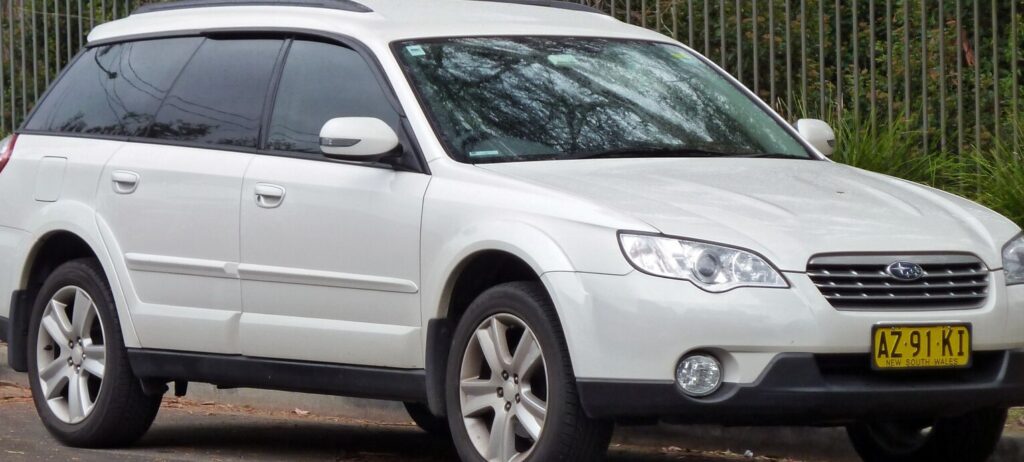
The Subaru Outback III (BL, BP) 2.5i, produced between 2007 and 2009, represented a significant evolution of Subaru’s popular crossover wagon. Positioned as a mid-range offering within the third-generation Outback lineup – which spanned from 2004 to 2009 – the 2.5i model aimed to balance affordability with the capability and practicality that defined the Outback nameplate. It slotted above the base 2.5X trim and below the more powerful XT models, appealing to buyers seeking a comfortable, all-weather vehicle with respectable performance. The BL/BP generation Outback was a key model for Subaru in the North American market, building on the success of previous generations and solidifying the brand’s reputation for reliability and all-wheel drive technology.
Technical Specifications
| Brand | Subaru |
| Model | Outback |
| Generation | Outback III (BL, BP) |
| Type (Engine) | 2.5i (173 Hp) AWD |
| Start of production | 2007 |
| End of production | 2009 |
| Powertrain Architecture | Internal Combustion engine |
| Body type | Station wagon (estate) |
| Seats | 5 |
| Doors | 5 |
| Fuel consumption (urban) | 11.6 l/100 km (20.3 US mpg) |
| Fuel consumption (extra urban) | 6.9 l/100 km (34.1 US mpg) |
| Fuel consumption (combined) | 8.6 l/100 km (27.4 US mpg) |
| Fuel Type | Petrol (Gasoline) |
| Acceleration 0 – 100 km/h | 9.8 sec |
| Acceleration 0 – 62 mph | 9.8 sec |
| Acceleration 0 – 60 mph | 9.3 sec |
| Maximum speed | 199 km/h (123.65 mph) |
| Emission standard | Euro 4 |
| Weight-to-power ratio | 8.5 kg/Hp |
| Weight-to-torque ratio | 6.4 kg/Nm |
| Power | 173 Hp @ 6000 rpm |
| Torque | 229 Nm @ 4400 rpm (168.9 lb.-ft. @ 4400 rpm) |
| Engine layout | Front, Longitudinal |
| Engine Model/Code | EJ253 |
| Engine displacement | 2457 cm3 (149.94 cu. in.) |
| Number of cylinders | 4 |
| Engine configuration | Boxer |
| Cylinder Bore | 99.5 mm (3.92 in.) |
| Piston Stroke | 79 mm (3.11 in.) |
| Compression ratio | 10:1 |
| Number of valves per cylinder | 4 |
| Fuel injection system | Multi-port manifold injection |
| Engine aspiration | Naturally aspirated engine |
| Valvetrain | DOHC |
| Engine oil capacity | 4.2 l (4.44 US qt | 3.7 UK qt) |
| Coolant capacity | 6.5 l (6.87 US qt | 5.72 UK qt) |
| Kerb Weight | 1475 kg (3251.82 lbs.) |
| Trunk (boot) space – minimum | 459 l (16.21 cu. ft.) |
| Trunk (boot) space – maximum | 1649 l (58.23 cu. ft.) |
| Fuel tank capacity | 64 l (16.91 US gal | 14.08 UK gal) |
| Length | 4730 mm (186.22 in.) |
| Width | 1770 mm (69.69 in.) |
| Height | 1545 mm (60.83 in.) |
| Wheelbase | 2670 mm (105.12 in.) |
| Front track | 1495 mm (58.86 in.) |
| Rear track | 1485 mm (58.46 in.) |
| Minimum turning circle | 10.8 m (35.43 ft.) |
| Drive wheel | All wheel drive (4×4) |
| Number of gears | 5 |
| Gearbox type | Manual transmission |
| Front suspension | Spring Strut |
| Rear suspension | Coil spring |
| Front brakes | Ventilated discs |
| Rear brakes | Disc |
| Assisting systems | ABS (Anti-lock braking system) |
| Steering type | Steering rack and pinion |
| Power steering | Hydraulic Steering |
| Tires size | 215/55 R17 |
Powertrain & Engine Architecture
The heart of the 2007-2009 Subaru Outback 2.5i was the EJ253 engine, a 2.5-liter naturally aspirated, horizontally-opposed (boxer) four-cylinder. This engine was a staple of Subaru’s lineup during this period, known for its relatively smooth operation and durability. The EJ253 featured a single overhead camshaft (SOHC) design per cylinder bank, operating 16 valves. Fuel delivery was handled by a multi-point fuel injection system. The engine produced 173 horsepower at 6000 rpm and 168.9 lb-ft of torque at 4400 rpm. The engine’s longitudinal mounting and symmetrical all-wheel drive system were hallmarks of Subaru engineering. The standard transmission for this variant was a 5-speed manual, though a 4-speed automatic transmission was also available, and often preferred by buyers seeking ease of use. The automatic transmission, while providing convenience, did impact acceleration slightly compared to the manual version.
Driving Characteristics
The 2.5i Outback offered a comfortable and composed driving experience. Acceleration from 0-60 mph took approximately 9.3 seconds, which was adequate for everyday driving but not particularly sporty. The automatic transmission, while smooth, had relatively wide gear ratios, which could sometimes result in the engine feeling strained during quick acceleration or when climbing hills. The symmetrical all-wheel drive system provided excellent traction in various weather conditions, making the Outback a capable vehicle for those living in areas with snow or rain. The suspension was tuned for comfort, absorbing bumps and imperfections in the road well, but this came at the expense of some handling precision. Compared to the turbocharged XT models, the 2.5i lacked the outright power and responsiveness, but it offered better fuel economy and a more relaxed driving experience.
Equipment & Trim Levels
The 2.5i trim level of the Outback III typically included standard features such as air conditioning, power windows and locks, a CD player with auxiliary input, and keyless entry. Upholstery was typically cloth, though leather options were available. Higher-spec 2.5i models could be equipped with features like a sunroof, upgraded audio system, and automatic climate control. Optional extras included alloy wheels, fog lights, and a navigation system. The interior design was functional and straightforward, prioritizing practicality over luxury. The Outback’s spacious interior and large cargo area were key selling points, making it a versatile vehicle for families and those with active lifestyles.
Chassis & Braking
The Outback III utilized a MacPherson strut front suspension and a double-wishbone rear suspension, providing a comfortable ride and predictable handling. The chassis was reinforced to provide increased rigidity and improve crash safety. Braking duties were handled by ventilated discs at the front and solid discs at the rear. Anti-lock brakes (ABS) were standard, enhancing braking performance and stability. The steering system was a rack-and-pinion setup with hydraulic power assist, providing responsive and precise steering feel. The 2.5i model typically rode on 17-inch alloy wheels with 215/55 R17 tires.
Market Reception & Comparison
The Subaru Outback 2.5i was generally well-received by automotive critics and consumers alike. It was praised for its practicality, safety, and all-weather capability. However, some reviewers noted that the engine lacked the power of its turbocharged counterparts and that the automatic transmission could feel sluggish at times. Compared to competitors like the Honda CR-V and Toyota RAV4, the Outback offered a unique combination of features, including standard all-wheel drive and a spacious interior. Fuel economy was competitive for its class, averaging around 27.4 US mpg in combined driving. Reliability was generally good, though some owners reported issues with the head gaskets, a common problem with Subaru engines of this era.
Legacy
The Subaru Outback III 2.5i remains a popular choice in the used car market today. Its reputation for reliability, practicality, and all-weather capability continues to attract buyers. While the EJ253 engine is known for its potential head gasket issues, proper maintenance and timely repairs can mitigate these problems. The Outback’s spacious interior and versatile cargo area make it a suitable vehicle for families and those with active lifestyles. The BL/BP generation Outback helped solidify Subaru’s position as a leader in the crossover wagon segment, and its legacy continues to influence the design and engineering of subsequent Outback models.