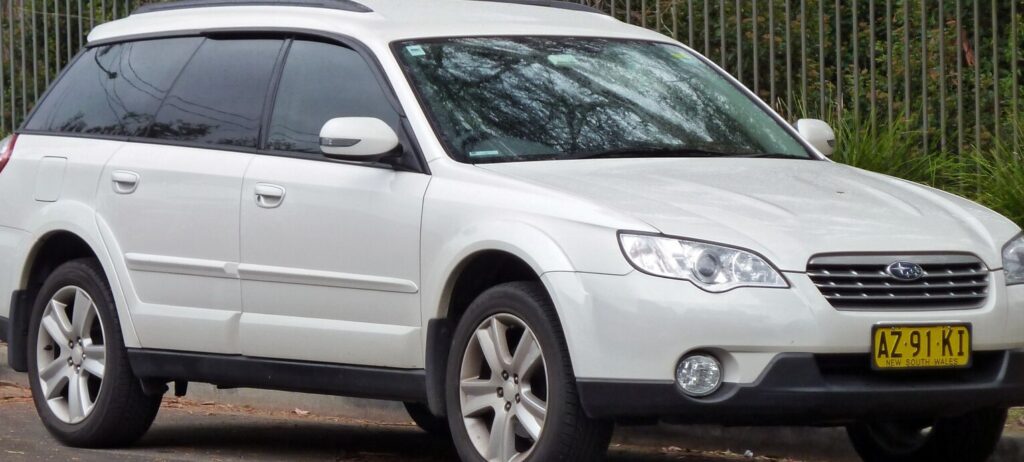
The Subaru Outback III (BL, BP) 3.0R, produced between 2003 and 2009, marked a significant step forward for Subaru’s all-wheel-drive wagon. Serving as the premium engine option within the third-generation Outback lineup – alongside the 2.5i models – the 3.0R delivered a substantial performance increase and a more refined driving experience. This model played a crucial role in cementing the Outback’s reputation as a versatile vehicle capable of handling both on-road comfort and moderate off-road adventures, especially in North America, a key market for the vehicle. It was built on the Subaru B platform, shared with other models like the Legacy and Baja.
Technical Specifications
| Brand | Subaru |
| Model | Outback |
| Generation | Outback III (BL, BP) |
| Type (Engine) | 3.0R (245 Hp) AWD |
| Start of production | 2003 |
| End of production | 2009 |
| Powertrain Architecture | Internal Combustion engine |
| Body type | Station wagon (estate) |
| Seats | 5 |
| Doors | 5 |
| Fuel consumption (economy) – urban | 13.4 l/100 km (17.6 US mpg, 21.1 UK mpg, 7.5 km/l) |
| Fuel consumption (economy) – extra urban | 7.6 l/100 km (30.9 US mpg, 37.2 UK mpg, 13.2 km/l) |
| Fuel consumption (economy) – combined | 9.8 l/100 km (24 US mpg, 28.8 UK mpg, 10.2 km/l) |
| Fuel Type | Petrol (Gasoline) |
| Acceleration 0 – 100 km/h | 8.5 sec |
| Acceleration 0 – 62 mph | 8.5 sec |
| Acceleration 0 – 60 mph | 8.1 sec |
| Maximum speed | 224 km/h (139.19 mph) |
| Emission standard | Euro 4 |
| Weight-to-power ratio | 6.3 kg/Hp, 158.6 Hp/tonne |
| Weight-to-torque ratio | 5.2 kg/Nm, 192.2 Nm/tonne |
| Power | 245 Hp @ 6600 rpm |
| Power per litre | 81.7 Hp/l |
| Torque | 297 Nm @ 4200 rpm (219.06 lb.-ft. @ 4200 rpm) |
| Engine layout | Front, Longitudinal |
| Engine Model/Code | EZ30D |
| Engine displacement | 3000 cm3 (183.07 cu. in.) |
| Number of cylinders | 6 |
| Engine configuration | Boxer |
| Cylinder Bore | 89.2 mm (3.51 in.) |
| Piston Stroke | 80 mm (3.15 in.) |
| Compression ratio | 10.7:1 |
| Number of valves per cylinder | 4 |
| Fuel injection system | Multi-port manifold injection |
| Engine aspiration | Naturally aspirated engine |
| Valvetrain | DOHC |
| Engine oil capacity | 5.5 l (5.81 US qt | 4.84 UK qt) |
| Coolant | 7.2 l (7.61 US qt | 6.34 UK qt) |
| Kerb Weight | 1545 kg (3406.14 lbs.) |
| Max. weight | 2060 kg (4541.52 lbs.) |
| Max load | 515 kg (1135.38 lbs.) |
| Trunk (boot) space – minimum | 429 l (15.15 cu. ft.) |
| Trunk (boot) space – maximum | 1628 l (57.49 cu. ft.) |
| Fuel tank capacity | 64 l (16.91 US gal | 14.08 UK gal) |
| Length | 4730 mm (186.22 in.) |
| Width | 1770 mm (69.69 in.) |
| Height | 1545 mm (60.83 in.) |
| Wheelbase | 2670 mm (105.12 in.) |
| Front track | 1495 mm (58.86 in.) |
| Rear (Back) track | 1485 mm (58.46 in.) |
| Minimum turning circle | 10.8 m (35.43 ft.) |
| Drive wheel | All wheel drive (4×4) |
| Number of gears and type of gearbox | 5 gears, automatic transmission |
| Front suspension | Coil spring |
| Rear suspension | Coil spring |
| Front brakes | Ventilated discs |
| Rear brakes | Disc |
| Assisting systems | ABS (Anti-lock braking system) |
| Steering type | Steering rack and pinion |
| Tires size | 215/60 R17 |
Powertrain & Engine Architecture
The core of the Outback 3.0R is the EZ30D 3.0-liter horizontally-opposed (boxer) six-cylinder engine. This engine, a signature of Subaru’s engineering prowess, was selected for its inherent balance and smooth power delivery. The EZ30D incorporated multi-port fuel injection and a dual overhead camshaft (DOHC) valvetrain with four valves per cylinder. It generated 245 horsepower at 6,600 rpm and 297 Nm (219 lb-ft) of torque at 4,200 rpm. The five-speed automatic transmission paired with the 3.0R was engineered for smooth shifts and efficient power transfer to the symmetrical all-wheel-drive system. This transmission was calibrated for comfort and ease of use, prioritizing smooth acceleration over aggressive downshifts.
Driving Characteristics
The 3.0R automatic Outback offered a demonstrably more relaxed and capable driving experience compared to the base 2.5i models. While not a performance vehicle, the 3.0R provided sufficient power for highway merging, passing, and even light towing. The automatic transmission, lacking manual control in earlier model years, was well-suited to the engine’s torque curve, delivering adequate response in most driving scenarios. The standard all-wheel-drive system, a hallmark of Subaru, inspired confidence in diverse weather conditions and on unpaved surfaces. In comparison to a manual transmission 3.0R, the automatic conceded some responsiveness and fuel efficiency, but gained in user-friendliness, particularly in city driving.
Equipment & Trim Levels
The 3.0R generally came equipped with a higher standard of features than the 2.5i trims. Common standard features included leather upholstery, heated front seats, a premium audio system, automatic climate control, and alloy wheels. Optional extras often included a power sunroof, a navigation system, and upgraded sound systems. The interior design was functional and comfortable, emphasizing practicality over luxury. Trim levels varied slightly depending on the year and market, but typically offered incremental upgrades in features and aesthetics.
Chassis & Braking
The Outback 3.0R utilized a MacPherson strut front suspension and a double-wishbone rear suspension, providing a comfortable ride and predictable handling. The chassis was reinforced compared to the Legacy sedan, reflecting the Outback’s intended use as a more robust vehicle. Braking was managed by ventilated disc brakes at the front and solid disc brakes at the rear. An anti-lock braking system (ABS) was standard, enhancing safety and control during emergency braking. The suspension tuning prioritized comfort and stability over sporty handling.
Market Reception & Comparison
The Outback 3.0R was generally well-received by automotive reviewers, who lauded its smooth engine, comfortable ride, and all-weather capability. However, some critics pointed out that the automatic transmission could feel somewhat sluggish, and fuel economy wasn’t a strong suit. Compared to the 2.5i models, the 3.0R offered a significant performance improvement, but at a higher price. When compared to competitors like the Honda CR-V and Toyota RAV4, the Outback 3.0R distinguished itself with its standard all-wheel drive and unique boxer engine configuration.
Legacy
The EZ30D engine, while generally reliable, is known to require consistent maintenance, particularly concerning head gasket integrity. Proper cooling system maintenance is vital to prevent overheating and potential engine damage. Today, the Outback III 3.0R remains a popular choice in the used car market, particularly for buyers seeking a capable and comfortable all-weather vehicle. Its blend of practicality, reliability (when properly maintained), and available features continues to appeal to a broad range of drivers. Parts availability is generally good, and the Outback’s relatively straightforward mechanical design makes it a feasible option for mechanically inclined owners.