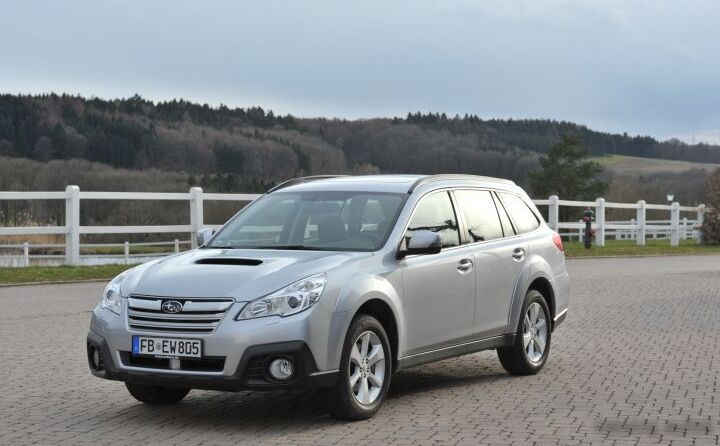
The Subaru Outback IV, specifically the 2.0d variant with 150 horsepower and all-wheel drive (AWD), represents a significant iteration in Subaru’s popular crossover wagon lineage. Produced from 2013 to 2014 as part of the BR/BM facelift, this model aimed to balance fuel efficiency with the Outback’s renowned all-weather capability and practicality. It occupied a mid-range position within the fourth-generation Outback lineup, slotting below the more powerful 2.5i models and offering a diesel alternative to the gasoline engines available in other markets. This version was primarily targeted towards European and Asian markets where diesel engines were favored for their fuel economy and torque characteristics.
Technical Specifications
| Brand | Subaru |
| Model | Outback |
| Generation | Outback IV (BR, BM, facelift 2013) |
| Type (Engine) | 2.0d (150 Hp) AWD |
| Start of production | 2013 |
| End of production | 2014 |
| Powertrain Architecture | Internal Combustion engine |
| Body type | Station wagon (estate) |
| Seats | 5 |
| Doors | 5 |
| Fuel consumption (urban) | 7.1 l/100 km (33.1 US mpg, 39.8 UK mpg, 14.1 km/l) |
| Fuel consumption (extra urban) | 5.2 l/100 km (45.2 US mpg, 54.3 UK mpg, 19.2 km/l) |
| Fuel consumption (combined) | 5.9 l/100 km (39.9 US mpg, 47.9 UK mpg, 16.9 km/l) |
| CO2 emissions | 155 g/km |
| Fuel Type | Diesel |
| Acceleration 0 – 100 km/h | 9.7 sec |
| Acceleration 0 – 62 mph | 9.7 sec |
| Acceleration 0 – 60 mph | 9.2 sec |
| Maximum speed | 195 km/h (121.17 mph) |
| Emission standard | Euro 5 |
| Weight-to-power ratio | 10.5 kg/Hp, 95.5 Hp/tonne |
| Weight-to-torque ratio | 4.5 kg/Nm, 222.8 Nm/tonne |
| Power | 150 Hp @ 3600 rpm |
| Torque | 350 Nm @ 1600-2400 rpm (258.15 lb.-ft. @ 1600-2400 rpm) |
| Engine layout | Front, Longitudinal |
| Engine Model/Code | EE20 |
| Engine displacement | 1998 cm3 (121.93 cu. in.) |
| Number of cylinders | 4 |
| Engine configuration | Boxer |
| Cylinder Bore | 86 mm (3.39 in.) |
| Piston Stroke | 86 mm (3.39 in.) |
| Compression ratio | 16.3:1 |
| Number of valves per cylinder | 4 |
| Fuel injection system | Diesel Commonrail |
| Engine aspiration | Turbocharger, Intercooler |
| Valvetrain | DOHC |
| Engine oil capacity | 5.9 l (6.23 US qt | 5.19 UK qt) |
| Coolant | 9 l (9.51 US qt | 7.92 UK qt) |
| Kerb Weight | 1571 kg (3463.46 lbs.) |
| Trunk (boot) space – minimum | 1726 l (60.95 cu. ft.) |
| Fuel tank capacity | 65 l (17.17 US gal | 14.3 UK gal) |
| Permitted trailer load with brakes (12%) | 1700 kg (3747.86 lbs.) |
| Length | 4790 mm (188.58 in.) |
| Width | 1820 mm (71.65 in.) |
| Height | 1605 mm (63.19 in.) |
| Wheelbase | 2745 mm (108.07 in.) |
| Front track | 1540 mm (60.63 in.) |
| Rear (Back) track | 1540 mm (60.63 in.) |
| Ride height (ground clearance) | 200 mm (7.87 in.) |
| Minimum turning circle (turning diameter) | 11 m (36.09 ft.) |
| Drive wheel | All wheel drive (4×4) |
| Number of gears and type of gearbox | 6 gears, manual transmission |
| Front suspension | Independent type McPherson |
| Rear suspension | Double wishbone |
| Front brakes | Ventilated discs |
| Rear brakes | Disc |
| Assisting systems | ABS (Anti-lock braking system) |
| Steering type | Steering rack and pinion |
| Tires size | 225/60 R17 |
| Wheel rims size | 7J x 17 |
Powertrain & Engine Architecture
The heart of the 2.0d Outback is the EE20 diesel engine, a 2.0-liter horizontally-opposed (Boxer) four-cylinder. This engine is a key component of Subaru’s engineering philosophy, providing a low center of gravity for improved handling. The EE20 utilizes a turbocharger with an intercooler to boost power output to 150 horsepower and 350 Nm (258 lb-ft) of torque. The engine employs a common rail direct injection system, delivering fuel directly into the combustion chamber at extremely high pressure for efficient combustion. The DOHC (Double Overhead Camshaft) valvetrain, with four valves per cylinder, further enhances breathing and performance. The 2.0d Outback was exclusively offered with a 6-speed manual transmission, prioritizing driver engagement and fuel efficiency over the convenience of an automatic.
Driving Characteristics
The 2.0d Outback with the manual transmission delivers a balanced driving experience. While not as quick as the 2.5i gasoline models, the diesel engine’s substantial torque provides ample pulling power for everyday driving and hauling. The 6-speed manual gearbox is well-matched to the engine’s characteristics, offering precise shifts and allowing the driver to keep the engine in its optimal power band. Acceleration from 0-60 mph takes approximately 9.2 seconds, and top speed is around 121 mph. The symmetrical all-wheel drive system provides excellent traction in various weather conditions, a hallmark of the Outback. The manual transmission, while engaging, requires more driver involvement than an automatic, and may not be preferred by all drivers.
Equipment & Trim Levels
The 2.0d Outback typically came equipped with a respectable level of standard features. These included automatic climate control, a touchscreen infotainment system (though often basic by modern standards), power windows and locks, and alloy wheels. Safety features such as ABS, traction control, and multiple airbags were standard. Optional extras could include a sunroof, leather upholstery, and a more advanced navigation system. Interior trim levels varied, but generally featured durable cloth upholstery and a functional, if not luxurious, dashboard layout. The focus was on practicality and durability rather than outright luxury.
Chassis & Braking
The Outback IV utilizes a McPherson strut front suspension and a double-wishbone rear suspension, providing a comfortable ride and predictable handling. The suspension is tuned to prioritize comfort over sporty handling, making it well-suited for long journeys. Braking duties are handled by ventilated discs at the front and solid discs at the rear. ABS (Anti-lock Braking System) is standard, enhancing braking performance and stability. The Outback’s relatively high ground clearance (200mm / 7.87 inches) contributes to its off-road capability, allowing it to tackle moderate terrain with ease.
Market Reception & Comparison
The 2.0d Outback was generally well-received by automotive critics, particularly in Europe and Asia. It was praised for its fuel efficiency, all-weather capability, and spacious interior. However, some reviewers noted that the engine could be somewhat noisy and that the manual transmission might not appeal to all buyers. Compared to the 2.5i gasoline models, the 2.0d offered better fuel economy but less outright performance. The 2.0d also provided a more affordable entry point into the Outback range, making it an attractive option for budget-conscious buyers. Reliability was generally good, though diesel engines can be more complex and potentially more expensive to repair than gasoline engines.
Legacy
The EE20 diesel engine, while eventually superseded by newer designs, proved to be a relatively robust and reliable powerplant. The 2.0d Outback IV remains a popular choice in the used car market, particularly for those seeking a practical, fuel-efficient, and capable crossover wagon. Maintenance costs for the diesel engine can be higher than for gasoline engines, and it’s important to ensure that the vehicle has been properly maintained, including regular servicing of the diesel particulate filter (DPF). Overall, the 2.0d Outback IV represents a well-rounded and capable vehicle that continues to offer good value for money.