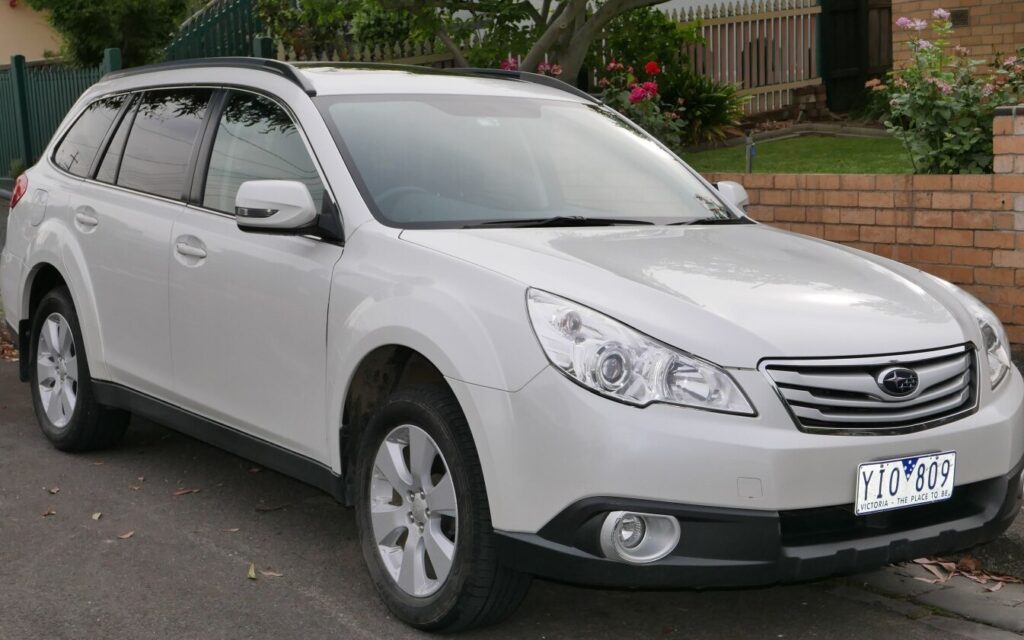
The Subaru Outback IV (BR, BM) Limited 2.5i, produced from 2010 to 2011, represented a significant iteration of Subaru’s popular all-wheel-drive wagon. Positioned as a mid-range trim within the fourth-generation Outback lineup (which spanned from 2009-2012), the 2.5i Limited offered a balance of comfort, capability, and fuel efficiency. It built upon the foundation of the 1HX0/A3 platform shared with other Subaru models, and aimed to appeal to buyers seeking a versatile vehicle for both daily commuting and outdoor adventures. This variant was primarily sold in North America, where the Outback had established a strong following as a practical and reliable alternative to traditional SUVs.
Technical Specifications
| Brand | Subaru |
| Model | Outback |
| Generation | Outback IV (BR, BM) |
| Type | Limited 2.5i (170 Hp) |
| Start of production | 2010 |
| End of production | 2011 |
| Powertrain Architecture | Internal Combustion engine |
| Body type | Station wagon (estate) |
| Seats | 5 |
| Doors | 5 |
| Fuel consumption (urban) | 10.6 l/100 km (22.2 US mpg) |
| Fuel consumption (extra urban) | 8.1 l/100 km (29 US mpg) |
| Fuel consumption (combined) | 9.3 l/100 km (25.3 US mpg) |
| Fuel Type | Petrol (Gasoline) |
| Acceleration 0 – 100 km/h | 9.8 sec |
| Acceleration 0 – 62 mph | 9.8 sec |
| Acceleration 0 – 60 mph | 9.3 sec |
| Maximum speed | 240 km/h (149.13 mph) |
| Emission standard | EURO4 |
| Weight-to-power ratio | 9.5 kg/Hp |
| Weight-to-torque ratio | 7 kg/Nm |
| Power | 170 Hp @ 5600 rpm |
| Torque | 229 Nm @ 4000 rpm (168.9 lb.-ft. @ 4000 rpm) |
| Engine layout | Front, Transverse |
| Engine Model/Code | EJ253 |
| Engine displacement | 2457 cm3 (149.94 cu. in.) |
| Number of cylinders | 4 |
| Engine configuration | Boxer |
| Cylinder Bore | 99.5 mm (3.92 in.) |
| Piston Stroke | 79 mm (3.11 in.) |
| Compression ratio | 9.5:1 |
| Number of valves per cylinder | 4 |
| Fuel injection system | Multi-port manifold injection |
| Engine aspiration | Naturally aspirated engine |
| Valvetrain | SOHC |
| Engine oil capacity | 4 l (4.23 US qt | 3.52 UK qt) |
| Coolant capacity | 6.4 l (6.76 US qt | 5.63 UK qt) |
| Kerb Weight | 1608 kg (3545.03 lbs.) |
| Max. weight | 2034 kg (4484.2 lbs.) |
| Max load | 426 kg (939.17 lbs.) |
| Trunk (boot) space – minimum | 971 l (34.29 cu. ft.) |
| Trunk (boot) space – maximum | 2019 l (71.3 cu. ft.) |
| Fuel tank capacity | 70 l (18.49 US gal | 15.4 UK gal) |
| Length | 4775 mm (187.99 in.) |
| Width | 1820 mm (71.65 in.) |
| Height | 1605 mm (63.19 in.) |
| Wheelbase | 2740 mm (107.87 in.) |
| Front track | 1549 mm (60.98 in.) |
| Rear track | 1549 mm (60.98 in.) |
| Minimum turning circle | 11 m (36.09 ft.) |
| Drive wheel | All wheel drive (4×4) |
| Number of gears | 5 |
| Gearbox type | Manual transmission |
| Front suspension | Independent, McPherson with coil spring and anti-roll bar |
| Rear suspension | Independent multi-link spring suspension with stabilizer |
| Front brakes | Ventilated discs |
| Rear brakes | Disc |
| Assisting systems | ABS (Anti-lock braking system) |
| Steering type | Cone worm with recirculation balls |
| Power steering | Hydraulic |
| Tires size | 225/60 R17 |
| Wheel rims size | 17 |
Powertrain & Engine Architecture
The heart of the 2010-2011 Outback 2.5i Limited was the EJ253 engine, a 2.5-liter naturally aspirated horizontally-opposed (boxer) four-cylinder. This engine was a staple of Subaru’s lineup for many years, known for its relatively smooth operation and durability. The EJ253 featured a single overhead camshaft (SOHC) design, two valves per cylinder, and multi-point fuel injection. The boxer configuration, with pistons moving horizontally, contributed to a lower center of gravity, enhancing handling. The engine produced 170 horsepower at 5600 rpm and 168.9 lb-ft of torque at 4000 rpm. This power was delivered to all four wheels through a 5-speed manual transmission. The transmission was chosen for its simplicity and reliability, though it lacked the fuel efficiency of more modern automatic options.
Driving Characteristics
The 2.5i Limited with the 5-speed manual offered adequate, though not exhilarating, performance. Acceleration from 0-60 mph took around 9.3 seconds. The engine’s torque curve was relatively flat, providing usable power across a wide range of engine speeds. However, it did require downshifting for quicker acceleration, especially when passing or climbing hills. Compared to the more powerful 3.6R models with their six-cylinder engines, the 2.5i felt noticeably slower. The manual transmission provided a more engaging driving experience than the available automatic, giving the driver greater control over the engine’s power band. The symmetrical all-wheel-drive system provided excellent traction in various weather conditions, a hallmark of Subaru vehicles.
Equipment & Trim Levels
The Limited trim level placed the 2.5i above the base Outback in terms of features. Standard equipment included alloy wheels, a power driver’s seat, keyless entry, cruise control, and a premium audio system. The interior featured cloth upholstery, though leather was available as an option. Other optional extras included a power moonroof, heated front seats, and a navigation system. The dashboard layout was functional and straightforward, prioritizing ease of use over flashy design. The Outback’s spacious interior and large cargo area were key selling points, making it a practical choice for families and those with active lifestyles.
Chassis & Braking
The Outback IV utilized a MacPherson strut front suspension and an independent multi-link rear suspension. This setup provided a comfortable ride while maintaining reasonable handling characteristics. Stabilizer bars were fitted to both the front and rear axles to reduce body roll during cornering. The braking system consisted of ventilated discs at the front and solid discs at the rear. Anti-lock brakes (ABS) were standard, enhancing safety and control during emergency braking situations. The Outback’s relatively high ground clearance (8.7 inches) allowed it to tackle moderate off-road terrain with ease.
Market Reception & Comparison
The 2010-2011 Subaru Outback 2.5i Limited received generally positive reviews from automotive critics. It was praised for its practicality, reliability, and all-weather capability. However, some reviewers noted that the 2.5-liter engine felt underpowered compared to competitors and the more potent 3.6R Outback. Fuel economy was considered average for its class, with combined mileage around 25.3 mpg. Compared to the 3.6R, the 2.5i offered a lower price point and better fuel efficiency, making it an attractive option for budget-conscious buyers. The manual transmission version was favored by driving enthusiasts who appreciated its greater control and engagement.
Legacy
The EJ253 engine, while not without its quirks (such as potential for head gasket issues in earlier iterations), proved to be a durable and reliable powerplant when properly maintained. The fourth-generation Outback, including the 2.5i Limited, established the model as a leading contender in the crossover wagon segment. Today, well-maintained examples of this generation Outback are still relatively common on the used car market, offering a compelling combination of practicality, reliability, and affordability. The 2.5i Limited, with its manual transmission, remains a popular choice among Subaru enthusiasts who appreciate its simple, robust design and engaging driving experience.