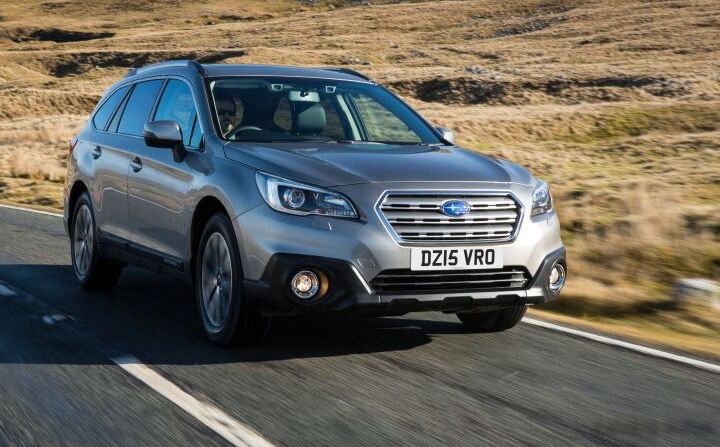
The Subaru Outback V (BS) 2.0d, produced between 2014 and 2018, represents a significant iteration of Subaru’s popular all-wheel-drive wagon. Positioned as a practical and capable vehicle, the 2.0d variant offered a diesel engine option within the fifth-generation Outback (BS) lineup, appealing to buyers prioritizing fuel efficiency and torque for towing or navigating varied terrain. This model played a key role in Subaru’s European and Asian markets, where diesel engines were more prevalent, while also finding a niche audience in North America. It sat in the mid-range of the Outback offerings, providing a balance between the base 2.5i gasoline engine and the more powerful 3.6R.
Technical Specifications
| Brand | Subaru |
| Model | Outback |
| Generation | Outback V (BS) |
| Type (Engine) | 2.0d (150 Hp) AWD |
| Start of production | 2014 |
| End of production | 2018 |
| Powertrain Architecture | Internal Combustion engine |
| Body type | Station wagon (estate) |
| Seats | 5 |
| Doors | 5 |
| Fuel consumption (urban) | 6.9 l/100 km (34.1 US mpg) |
| Fuel consumption (extra urban) | 4.8 l/100 km (49 US mpg) |
| Fuel consumption (combined) | 5.6 l/100 km (42 US mpg) |
| CO2 emissions | 145 g/km |
| Fuel Type | Diesel |
| Acceleration 0 – 100 km/h | 9.7 sec |
| Acceleration 0 – 62 mph | 9.7 sec |
| Acceleration 0 – 60 mph | 9.2 sec |
| Maximum speed | 200 km/h (124.27 mph) |
| Emission standard | Euro 6 |
| Power | 150 Hp @ 3600 rpm |
| Torque | 350 Nm @ 1600-2800 rpm (258.15 lb.-ft.) |
| Engine layout | Front, Longitudinal |
| Engine Model/Code | EE20 |
| Engine displacement | 1998 cm3 (121.93 cu. in.) |
| Number of cylinders | 4 |
| Engine configuration | Boxer |
| Cylinder Bore | 86 mm (3.39 in.) |
| Piston Stroke | 86 mm (3.39 in.) |
| Compression ratio | 15.2:1 |
| Number of valves per cylinder | 4 |
| Fuel injection system | Diesel Commonrail |
| Engine aspiration | Turbocharger, Intercooler |
| Engine oil capacity | 5.9 l (6.23 US qt | 5.19 UK qt) |
| Coolant | 9 l (9.51 US qt | 7.92 UK qt) |
| Max. weight | 2130 kg (4695.85 lbs.) |
| Trunk (boot) space – minimum | 559 l (19.74 cu. ft.) |
| Trunk (boot) space – maximum | 1848 l (65.26 cu. ft.) |
| Fuel tank capacity | 60 l (15.85 US gal | 13.2 UK gal) |
| Max. roof load | 80 kg (176.37 lbs.) |
| Permitted trailer load with brakes (8%) | 2000 kg (4409.25 lbs.) |
| Permitted trailer load with brakes (12%) | 1800 kg (3968.32 lbs.) |
| Permitted trailer load without brakes | 750 kg (1653.47 lbs.) |
| Length | 4815 mm (189.57 in.) |
| Width | 1840 mm (72.44 in.) |
| Height | 1605 mm (63.19 in.) |
| Wheelbase | 2745 mm (108.07 in.) |
| Front track | 1575 mm (62.01 in.) |
| Rear (Back) track | 1590 mm (62.6 in.) |
| Ride height (ground clearance) | 200 mm (7.87 in.) |
| Minimum turning circle (turning diameter) | 11.8 m (38.71 ft.) |
| Drive wheel | All wheel drive (4×4) |
| Number of gears and type of gearbox | 6 gears, manual transmission |
| Front suspension | Independent, type McPherson with coil spring and anti-roll bar |
| Rear suspension | Double wishbone |
| Assisting systems | ABS (Anti-lock braking system) |
| Steering type | Steering rack and pinion |
| Power steering | Electric Steering |
| Tires size | 225/65R17 |
| Wheel rims size | 7Jx17 |
INTRODUCTION
The Subaru Outback V (BS) 2.0d, launched in 2014, built upon the success of previous Outback generations, continuing Subaru’s reputation for building rugged, reliable, and capable wagons. The BS generation represented a significant redesign, featuring a more refined interior, improved ride quality, and updated technology. The 2.0d variant, powered by the EE20 diesel engine, was primarily aimed at markets where diesel fuel was readily available and economically advantageous. It offered a compelling alternative to gasoline-powered Outbacks, particularly for drivers covering long distances or frequently towing. This model was sold alongside the 2.5i (gasoline) and 3.6R (larger gasoline engine) trims.
Powertrain & Engine Architecture
The heart of the Outback 2.0d is the EE20 2.0-liter horizontally-opposed (Boxer) four-cylinder diesel engine. This engine is a direct-injection diesel, utilizing a common rail fuel injection system to deliver fuel at extremely high pressures for efficient combustion. The EE20 features a single turbocharger with an intercooler to increase air density and boost power output. The engine’s flat-four configuration contributes to a lower center of gravity, enhancing handling and stability. The 2.0d was typically paired with a six-speed manual transmission, although a Lineartronic CVT (Continuously Variable Transmission) was also offered in some markets. The engine produces 150 horsepower at 3600 rpm and 350 Nm (258 lb-ft) of torque between 1600 and 2800 rpm. This torque curve provides strong low-end and mid-range acceleration, making it well-suited for everyday driving and towing.
Driving Characteristics
The 2.0d Outback offers a distinctly different driving experience compared to its gasoline counterparts. While the gasoline engines prioritize outright acceleration, the diesel focuses on torque and fuel efficiency. The 2.0d provides ample power for merging onto highways and overtaking, but its acceleration isn’t as brisk as the 2.5i or 3.6R. The six-speed manual transmission allows for precise control, while the CVT offers smooth, seamless acceleration. The Outback’s symmetrical all-wheel-drive system provides excellent traction in all weather conditions, making it a confident performer on slippery surfaces. The suspension is tuned for comfort, absorbing bumps and providing a stable ride, even when fully loaded. The gear ratios in the manual transmission are well-chosen to maximize fuel economy and provide adequate power in most driving situations.
Equipment & Trim Levels
The 2.0d Outback typically came with a generous level of standard equipment. Base models included features such as automatic climate control, a touchscreen infotainment system with Bluetooth connectivity, alloy wheels, and a comprehensive suite of safety features, including ABS, stability control, and multiple airbags. Higher trim levels added features like leather upholstery, a sunroof, premium audio system, and advanced driver-assistance systems such as adaptive cruise control and lane departure warning. Interior upholstery was typically cloth on base models, with leather options available on higher trims. Dashboard configurations were consistent across the range, featuring a user-friendly layout with intuitive controls.
Chassis & Braking
The Outback 2.0d utilizes a robust chassis designed to handle the demands of all-terrain driving. The front suspension features McPherson struts with coil springs and an anti-roll bar, while the rear suspension employs a double-wishbone setup. This configuration provides a comfortable ride and good handling characteristics. Braking systems varied depending on the trim level and market. Most models were equipped with ventilated front disc brakes and solid rear disc brakes. ABS (Anti-lock Braking System) was standard, providing enhanced stopping power and control in emergency situations. The Outback’s generous ground clearance of 200mm (7.87 inches) allows it to navigate rough terrain with ease.
Market Reception & Comparison
The Subaru Outback 2.0d was generally well-received by automotive critics, who praised its fuel efficiency, torque, and all-weather capability. However, some reviewers noted that the diesel engine was slightly noisier than the gasoline engines. Compared to the 2.5i, the 2.0d offered better fuel economy and more torque, but slightly less overall power. Compared to the 3.6R, the 2.0d was more economical but lacked the 3.6R’s effortless acceleration. The 2.0d appealed to buyers who prioritized fuel efficiency and practicality over outright performance. Reliability was generally good, with the EE20 engine proving to be a durable and long-lasting unit.
Legacy
The Subaru Outback V (BS) 2.0d remains a popular choice in the used car market, particularly for buyers seeking a reliable and fuel-efficient all-wheel-drive wagon. The EE20 diesel engine has a reputation for longevity, provided it has been properly maintained. Regular servicing, including oil changes and filter replacements, is crucial for ensuring the engine’s continued reliability. While diesel engines may face increasing scrutiny regarding emissions, the Outback 2.0d offers a compelling combination of practicality, capability, and fuel economy that continues to appeal to a wide range of buyers.