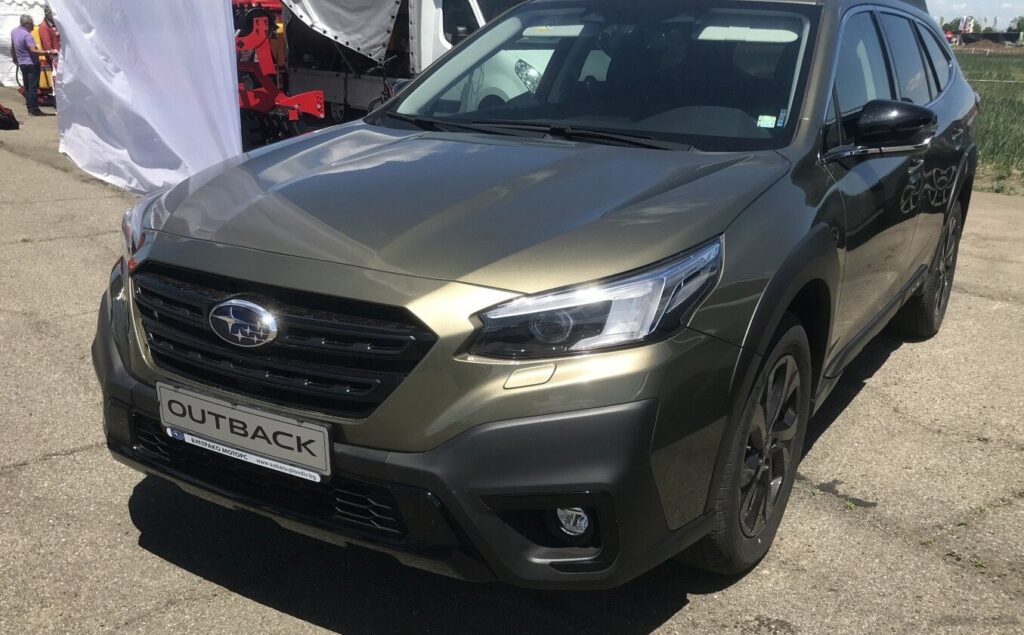
The Subaru Outback VI (BT) 2.5i, equipped with a 169 horsepower engine and Lineartronic continuously variable transmission (CVT), represents a significant iteration in Subaru’s long-running Outback series. Introduced in May 2021, this variant occupies a central position within the BT generation, offering a balance between performance, fuel efficiency, and standard features. The BT generation Outback, built on the Subaru Global Platform, aimed to enhance safety, comfort, and driving dynamics compared to its predecessor. This specific 2.5i AWD Lineartronic model is primarily targeted towards buyers seeking a versatile, all-weather capable wagon with a focus on practicality and a comfortable driving experience.
Technical Specifications
| Brand | Subaru |
| Model | Outback |
| Generation | Outback VI (BT) |
| Type (Engine) | 2.5i (169 Hp) AWD Lineartronic |
| Start of production | May, 2021 |
| Powertrain Architecture | Internal Combustion engine |
| Body type | Station wagon (estate) |
| Seats | 5 |
| Doors | 5 |
| Fuel consumption at Low speed (WLTP) | 12.2 l/100 km (19.3 US mpg, 23.2 UK mpg, 8.2 km/l) |
| Fuel consumption at Medium speed (WLTP) | 8.1 l/100 km (29 US mpg, 34.9 UK mpg, 12.3 km/l) |
| Fuel consumption at high speed (WLTP) | 7.1 l/100 km (33.1 US mpg, 39.8 UK mpg, 14.1 km/l) |
| Fuel consumption at very high speed (WLTP) | 8.7 l/100 km (27 US mpg, 32.5 UK mpg, 11.5 km/l) |
| Combined fuel consumption (WLTP) | 8.6 l/100 km (27.4 US mpg, 32.8 UK mpg, 11.6 km/l) |
| CO2 emissions (WLTP) | 193 g/km |
| Fuel consumption (economy) – urban (NEDC, WLTP equivalent) | 9.1 l/100 km (25.8 US mpg, 31 UK mpg, 11 km/l) |
| Fuel consumption (economy) – extra urban (NEDC, WLTP equivalent) | 6.5 l/100 km (36.2 US mpg, 43.5 UK mpg, 15.4 km/l) |
| Fuel consumption (economy) – combined (NEDC, WLTP equivalent) | 7.4 l/100 km (31.8 US mpg, 38.2 UK mpg, 13.5 km/l) |
| CO2 emissions (NEDC, WLTP equivalent) | 169 g/km |
| Fuel Type | Petrol (Gasoline) |
| Acceleration 0 – 100 km/h | 10.2 sec |
| Acceleration 0 – 62 mph | 10.2 sec |
| Acceleration 0 – 60 mph | 9.7 sec |
| Maximum speed | 193 km/h (119.92 mph) |
| Emission standard | Euro 6d-ISC-FCM |
| Weight-to-power ratio | 9.3 kg/Hp, 107.9 Hp/tonne |
| Weight-to-torque ratio | 6.2 kg/Nm, 160.9 Nm/tonne |
| Power | 169 Hp @ 5000-5800 rpm |
| Power per litre | 67.7 Hp/l |
| Torque | 252 Nm @ 3800 rpm (185.87 lb.-ft. @ 3800 rpm) |
| Engine layout | Front, Longitudinal |
| Engine Model/Code | FB25 |
| Engine displacement | 2498 cm3 (152.44 cu. in.) |
| Number of cylinders | 4 |
| Engine configuration | Boxer |
| Cylinder Bore | 94 mm (3.7 in.) |
| Piston Stroke | 90 mm (3.54 in.) |
| Compression ratio | 12:1 |
| Number of valves per cylinder | 4 |
| Fuel injection system | Direct injection |
| Engine oil capacity | 4.2 l (4.44 US qt | 3.7 UK qt) |
| Coolant | 9 l (9.51 US qt | 7.92 UK qt) |
| Kerb Weight | 1566-1599 kg (3452.44 – 3525.19 lbs.) |
| Max. weight | 2200 kg (4850.17 lbs.) |
| Max load | 601-634 kg (1324.98 – 1397.73 lbs.) |
| Trunk (boot) space – minimum | 561 l (19.81 cu. ft.) |
| Trunk (boot) space – maximum | 1822 l (64.34 cu. ft.) |
| Fuel tank capacity | 63 l (16.64 US gal | 13.86 UK gal) |
| Permitted trailer load with brakes (12%) | 2000 kg (4409.25 lbs.) |
| Permitted trailer load without brakes | 750 kg (1653.47 lbs.) |
| Permitted towbar download | 90 kg (198.42 lbs.) |
| Length | 4870 mm (191.73 in.) |
| Width | 1875 mm (73.82 in.) |
| Width including mirrors | 2067 mm (81.38 in.) |
| Height | 1670-1675 mm (65.75 – 65.94 in.) |
| Wheelbase | 2745 mm (108.07 in.) |
| Front track | 1570 mm (61.81 in.) |
| Rear (Back) track | 1600 mm (62.99 in.) |
| Ride height (ground clearance) | 213 mm (8.39 in.) |
| Minimum turning circle (turning diameter) | 12.2 m (40.03 ft.) |
| Front suspension | Independent, type McPherson with coil spring and anti-roll bar |
| Rear suspension | Double wishbone |
| Front brakes | Ventilated discs |
| Rear brakes | Ventilated discs |
| Gearbox | automatic transmission Lineartronic |
INTRODUCTION
The Subaru Outback VI (BT) 2.5i Lineartronic, launched in 2021, builds upon the Outback’s reputation as a rugged, capable, and family-friendly wagon. Positioned as a mainstream offering within the BT lineup, it slots in below the more powerful turbocharged variants (like the 2.4XT) and above any potential base models offered in certain markets. The BT generation represented a complete redesign, moving to the Subaru Global Platform for improved rigidity, safety, and ride quality. This 2.5i model is particularly significant as it represents the volume seller for Subaru, appealing to a broad range of customers prioritizing practicality and all-weather capability over outright performance.
Powertrain & Engine Architecture
At the heart of the 2.5i Lineartronic is the FB25 2.5-liter naturally aspirated four-cylinder Boxer engine. This engine is a hallmark of Subaru’s engineering, known for its low center of gravity and smooth operation. The FB25 utilizes direct fuel injection, contributing to improved fuel efficiency and power delivery. The engine produces 169 horsepower at 5000-5800 rpm and 252 Nm (185.87 lb.-ft.) of torque at 3800 rpm. Paired with the FB25 is Subaru’s Lineartronic CVT, a continuously variable transmission designed to provide smooth, seamless acceleration and optimized fuel economy. Unlike traditional stepped automatic transmissions, the Lineartronic uses a belt and pulley system to offer an infinite number of gear ratios. The Lineartronic in the Outback BT is programmed with simulated “shift points” to mimic the feel of a conventional automatic, addressing a common criticism of CVTs. The engine also incorporates Subaru’s Start & Stop system for further fuel savings.
Driving Characteristics
The 2.5i Lineartronic delivers a comfortable and predictable driving experience. While not particularly sporty, the engine provides adequate power for everyday driving situations. Acceleration from 0-60 mph takes approximately 9.7 seconds, and 0-100 km/h in 10.2 seconds. The Lineartronic CVT contributes to smooth acceleration, but can sometimes feel less responsive than a traditional automatic, especially during quick overtaking maneuvers. The CVT’s programming attempts to mitigate this by simulating gear changes, but a noticeable “rubber band” effect can still be present. The symmetrical all-wheel-drive system, standard on all Outbacks, provides excellent traction in various weather conditions. The Outback’s suspension is tuned for comfort, absorbing bumps and imperfections in the road effectively. The overall driving experience is geared towards practicality and ease of use rather than outright performance.
Equipment & Trim Levels
The 2.5i Lineartronic typically comes well-equipped with standard features including Subaru’s EyeSight driver-assist technology (including adaptive cruise control, lane departure warning, and automatic emergency braking), a touchscreen infotainment system with Apple CarPlay and Android Auto compatibility, automatic climate control, and power-adjustable driver’s seat. Interior upholstery is typically cloth, with available upgrades to leather in higher trim levels. Optional extras often include a premium audio system, a power sunroof, and heated front seats. The dashboard layout is functional and user-friendly, with a focus on providing clear and accessible controls.
Chassis & Braking
The Outback VI utilizes a robust chassis designed for all-weather capability and durability. The front suspension features McPherson struts with a coil spring and anti-roll bar, while the rear suspension employs a double-wishbone setup. Braking duties are handled by ventilated discs on all four wheels, providing ample stopping power. The Outback’s all-wheel-drive system is a symmetrical design, distributing power evenly to all four wheels for optimal traction. Ground clearance is a generous 213 mm (8.39 inches), allowing the Outback to tackle moderate off-road terrain with confidence.
Market Reception & Comparison
The Subaru Outback VI 2.5i Lineartronic has been generally well-received by automotive critics and consumers alike. It’s praised for its spacious interior, comfortable ride, standard safety features, and all-weather capability. Compared to the turbocharged 2.4XT variant, the 2.5i offers a more affordable price point and better fuel economy, but sacrifices some performance. The 2.5i also provides a more relaxed driving experience compared to the more aggressively tuned 2.4XT. Fuel economy figures are competitive within the segment, averaging around 27.4 US mpg combined. Reliability has been generally good, with the FB25 engine proving to be a durable and dependable powerplant.
Legacy
The FB25 engine, paired with the Lineartronic CVT, has become a mainstay in Subaru’s lineup, known for its longevity and relatively low maintenance costs. While the CVT has faced some scrutiny over the years, Subaru has continuously refined the technology, improving its reliability and responsiveness. The Outback VI 2.5i Lineartronic remains a popular choice in the used car market, offering a compelling combination of practicality, safety, and value. Its reputation for reliability and all-weather capability ensures continued demand for this versatile wagon for years to come.