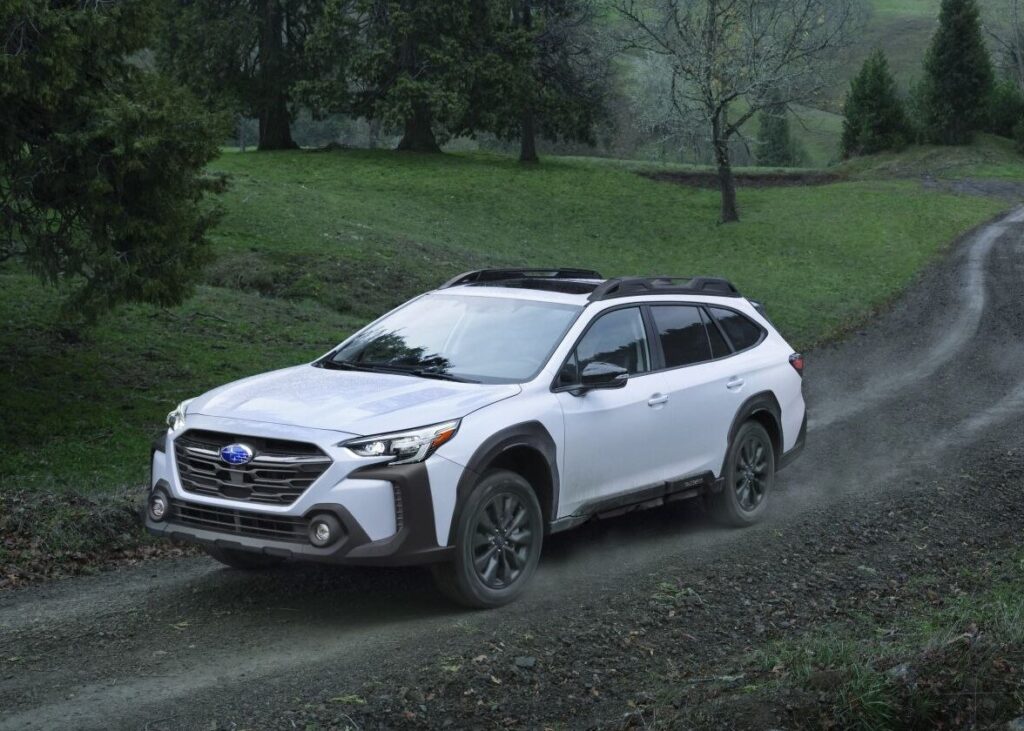
The Subaru Outback VI (BT), particularly the facelifted model introduced in April 2022 and produced through August 2025, represents the sixth generation of Subaru’s popular all-wheel-drive wagon. Positioned as a versatile family vehicle, the Outback blends the practicality of an SUV with the driving dynamics of a car. The 2.4i variant, equipped with a 260 horsepower turbocharged boxer engine and a Lineartronic CVT (Continuously Variable Transmission), served as a key offering in the North American market, representing a significant step up in performance from the base engine options available in other regions. This model year saw a refresh to the already successful BT platform, incorporating styling updates and enhanced technology.
Technical Specifications
| Brand | Subaru |
| Model | Outback |
| Generation | Outback VI (BT, facelift 2022) |
| Type (Engine) | 2.4i (260 Hp) AWD Lineartronic CVT |
| Start of production | April, 2022 |
| End of production | August, 2025 |
| Powertrain Architecture | Internal Combustion engine |
| Body type | Station wagon (estate) |
| Seats | 5 |
| Doors | 5 |
| Fuel consumption (economy) – urban | 10.2 l/100 km (23.1 US mpg, 27.7 UK mpg, 9.8 km/l) |
| Fuel consumption (economy) – extra urban | 7.8 l/100 km (30.2 US mpg, 36.2 UK mpg, 12.8 km/l) |
| Fuel consumption (economy) – combined | 9 l/100 km (26.1 US mpg, 31.4 UK mpg, 11.1 km/l) |
| Fuel Type | Petrol (Gasoline) |
| Weight-to-power ratio | 6.8 kg/Hp, 146.1 Hp/tonne |
| Weight-to-torque ratio | 4.7 kg/Nm, 211.4 Nm/tonne |
| Power | 260 Hp @ 5600 rpm |
| Power per litre | 108.9 Hp/l |
| Torque | 376 Nm @ 2000-4800 rpm (277.32 lb.-ft. @ 2000-4800 rpm) |
| Engine layout | Front, Longitudinal |
| Engine Model/Code | FA24 |
| Engine displacement | 2387 cm3 (145.66 cu. in.) |
| Number of cylinders | 4 |
| Engine configuration | Boxer |
| Cylinder Bore | 94 mm (3.7 in.) |
| Piston Stroke | 86 mm (3.39 in.) |
| Compression ratio | 10.6:1 |
| Number of valves per cylinder | 4 |
| Fuel injection system | Direct injection |
| Engine aspiration | Twin-scroll turbo, Intercooler |
| Valvetrain | DOHC |
| Engine oil capacity | 4.5 l (4.76 US qt | 3.96 UK qt) |
| Coolant | 8.7 l (9.19 US qt | 7.65 UK qt) |
| Kerb Weight | 1779-1790 kg (3922.02 – 3946.27 lbs.) |
| Trunk (boot) space – minimum | 923 l (32.6 cu. ft.) |
| Trunk (boot) space – maximum | 2141 l (75.61 cu. ft.) |
| Fuel tank capacity | 70 l (18.49 US gal | 15.4 UK gal) |
| Permitted trailer load with brakes (12%) | 1588 kg (3500.94 lbs.) |
| Permitted towbar download | 159 kg (350.53 lbs.) |
| Length | 4854 mm (191.1 in.) |
| Width | 1854 mm (72.99 in.) |
| Width including mirrors | 2083 mm (82.01 in.) |
| Height | 1687 mm (66.42 in.) |
| Wheelbase | 2746 mm (108.11 in.) |
| Front track | 1570 mm (61.81 in.) |
| Rear (Back) track | 1595 mm (62.8 in.) |
| Ride height (ground clearance) | 221 mm (8.7 in.) |
| Minimum turning circle (turning diameter) | 11 m (36.09 ft.) |
| Approach angle | 18.6° |
| Departure angle | 21.7° |
| Ramp-over (brakeover) angle | 19.4° |
| Drivetrain Architecture | The Internal combustion engine (ICE) drives permanently the four wheels of the vehicle. |
| Drive wheel | All wheel drive (4×4) |
| Number of gears and type of gearbox | 8 gears, automatic transmission Lineartronic CVT |
| Front suspension | Independent, type McPherson with coil spring and anti-roll bar |
| Rear suspension | Double wishbone, Transverse stabilizer |
| Front brakes | Ventilated discs, 314.96 mm |
| Rear brakes | Ventilated discs, 299.72 mm |
| Assisting systems | ABS (Anti-lock braking system) |
| Steering type | Steering rack and pinion |
| Power steering | Electric Steering |
| Tires size | 225/60 R18 100H |
| Wheel rims size | 7J x 18 |
INTRODUCTION
The 2022-2025 Subaru Outback VI 2.4i, powered by the FA24 engine and utilizing a Lineartronic CVT, represents a significant evolution of Subaru’s popular wagon. Building upon the foundation of the BT platform, this variant aimed to deliver a compelling blend of performance, fuel efficiency, and all-weather capability. It occupied a mid-range position within the Outback lineup, offering a substantial power upgrade over the base 2.5-liter engine while remaining more accessible than the higher-performance turbocharged options available in some markets. The facelift introduced in 2022 brought revised styling cues, updated infotainment systems, and enhancements to the EyeSight driver-assist technology.
Powertrain & Engine Architecture
At the heart of the 2.4i Outback lies the FA24 2.4-liter turbocharged four-cylinder boxer engine. This engine, a key component of Subaru’s next-generation powertrain strategy, utilizes direct fuel injection and a twin-scroll turbocharger to deliver 260 horsepower and 277 lb-ft of torque. The boxer configuration, with its horizontally opposed pistons, contributes to a low center of gravity, enhancing stability and handling. The Lineartronic CVT, Subaru’s implementation of a continuously variable transmission, is designed to provide smooth, efficient power delivery. Unlike traditional stepped automatic transmissions, the CVT utilizes a belt and pulley system to offer an infinite number of gear ratios within its operating range. This allows the engine to operate at its most efficient point, maximizing fuel economy and responsiveness. The FA24 engine benefits from active valve control system (AVCS) on both intake and exhaust camshafts, optimizing engine performance across the rev range.
Driving Characteristics
The 2.4i Outback with the Lineartronic CVT offers a distinctly different driving experience compared to models equipped with the standard 2.5-liter engine or manual transmissions. The turbocharged engine provides ample power for everyday driving and confident passing maneuvers. While the CVT lacks the traditional gear shifts of a conventional automatic, it simulates gear changes through stepped ratios, providing a more familiar feel. The CVT is programmed to hold lower “gear” ratios during aggressive acceleration, maximizing engine power. Compared to the base engine, the 2.4i delivers noticeably quicker acceleration and a more relaxed driving experience, particularly when fully loaded or traveling uphill. The all-wheel-drive system provides excellent traction in various weather conditions, making it a capable vehicle for year-round use.
Equipment & Trim Levels
The 2.4i Outback typically came standard with a comprehensive suite of features, including Subaru’s EyeSight driver-assist technology (adaptive cruise control, lane departure warning, automatic emergency braking), a touchscreen infotainment system with Apple CarPlay and Android Auto compatibility, automatic climate control, and power-adjustable front seats. Higher trim levels added features such as leather upholstery, a premium audio system, a power liftgate, and heated rear seats. Optional extras included a sunroof, navigation system, and advanced safety features like blind-spot monitoring and rear cross-traffic alert.
Chassis & Braking
The Outback VI utilizes a unibody construction with independent suspension at all four corners. The front suspension employs a McPherson strut design with coil springs and a stabilizer bar, while the rear suspension features a double-wishbone setup with a transverse stabilizer bar. This configuration provides a comfortable ride and predictable handling. Braking duties are handled by ventilated disc brakes on all four wheels, providing ample stopping power. The ABS (Anti-lock Braking System) helps maintain steering control during emergency braking situations. The suspension tuning is geared towards comfort and stability, prioritizing ride quality over outright sportiness.
Market Reception & Comparison
The 2.4i Outback was generally well-received by automotive critics, who praised its powerful engine, comfortable ride, and spacious interior. The Lineartronic CVT was a point of contention for some, with some reviewers preferring the engagement of a traditional automatic transmission. However, the CVT’s fuel efficiency and smooth operation were also noted as strengths. Compared to the base 2.5-liter Outback, the 2.4i offered a significant performance advantage, making it a more appealing option for drivers who prioritize power and responsiveness. Fuel economy was comparable to other mid-size SUVs and wagons in its class.
Legacy
The FA24 engine and Lineartronic CVT combination has proven to be a reliable powertrain in the Subaru Outback. While long-term durability data is still emerging, early reports suggest that the engine is robust and capable of handling sustained use. The CVT, while requiring proper maintenance (fluid changes), has also demonstrated good reliability. On the used car market, the 2022-2025 Outback 2.4i holds its value well, reflecting its desirable combination of performance, features, and all-wheel-drive capability. Its blend of practicality and capability ensures its continued appeal to buyers seeking a versatile and reliable family vehicle.