Technical Specifications
| Brand | Subaru |
| Model | Outback |
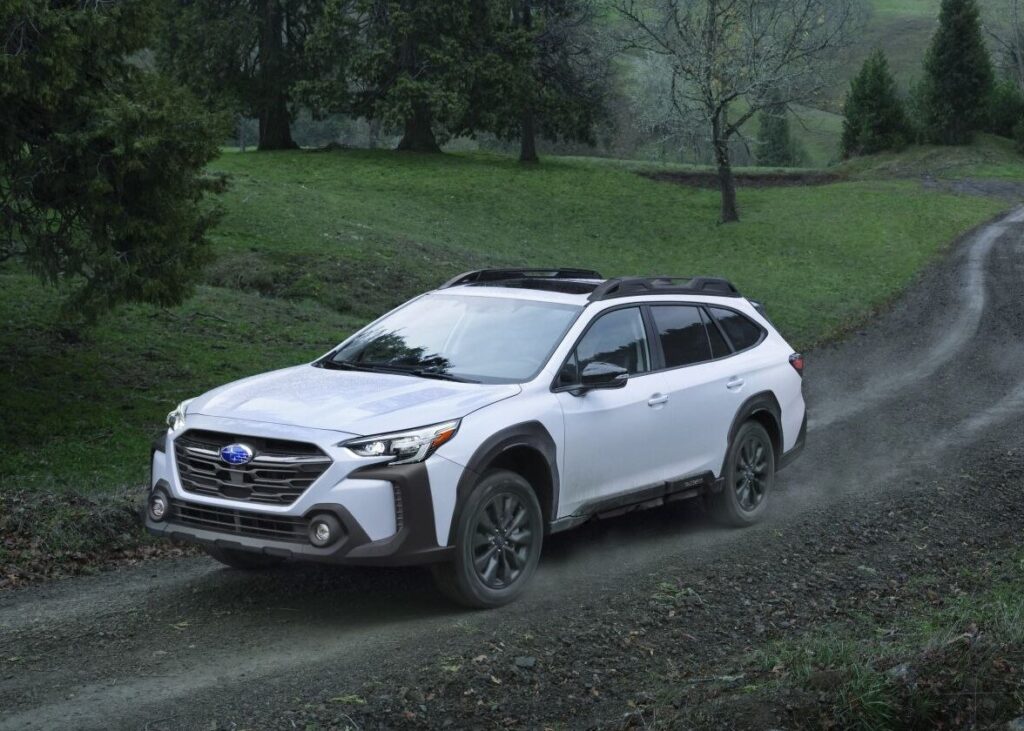
| Generation | Outback VI (BT, facelift 2022) |
| Type (Engine) | 2.5i (182 Hp) AWD Lineartronic CVT |
| Start of production | April, 2022 |
| End of production | August, 2025 |
| Powertrain Architecture | Internal Combustion engine |
| Body type | Station wagon (estate) |
| Seats | 5 |
| Doors | 5 |
| Fuel consumption (urban) | 9 l/100 km (26.1 US mpg, 31.4 UK mpg, 11.1 km/l) |
| Fuel consumption (extra urban) | 7.1 l/100 km (33.1 US mpg, 39.8 UK mpg, 14.1 km/l) |
| Fuel consumption (combined) | 8.1 l/100 km (29 US mpg, 34.9 UK mpg, 12.3 km/l) |
| Fuel Type | Petrol (Gasoline) |
| Weight-to-power ratio | 9.1 kg/Hp, 110.2 Hp/tonne |
| Weight-to-torque ratio | 6.9 kg/Nm, 144.7 Nm/tonne |
| Power | 182 Hp @ 5800 rpm |
| Power per litre | 72.9 Hp/l |
| Torque | 239 Nm @ 4400 rpm (176.28 lb.-ft. @ 4400 rpm) |
| Engine layout | Front, Longitudinal |
| Engine Model/Code | FB25 |
| Engine displacement | 2498 cm3 (152.44 cu. in.) |
| Number of cylinders | 4 |
| Engine configuration | Boxer |
| Cylinder Bore | 94 mm (3.7 in.) |
| Piston Stroke | 90 mm (3.54 in.) |
| Compression ratio | 12:1 |
| Number of valves per cylinder | 4 |
| Fuel injection system | Direct injection |
| Engine aspiration | Naturally aspirated engine |
| Valvetrain | DOHC |
| Engine oil capacity | 4.2 l (4.44 US qt | 3.7 UK qt) |
| Coolant | 9 l (9.51 US qt | 7.92 UK qt) |
| Kerb Weight | 1652-1715 kg (3642.04 – 3780.93 lbs.) |
| Trunk (boot) space – minimum | 923 l (32.6 cu. ft.) |
| Trunk (boot) space – maximum | 2141 l (75.61 cu. ft.) |
| Fuel tank capacity | 70 l (18.49 US gal | 15.4 UK gal) |
| Permitted trailer load with brakes (12%) | 1225 kg (2700.66 lbs.) |
| Permitted towbar download | 122 kg (268.96 lbs.) |
| Length | 4854 mm (191.1 in.) |
| Width | 1854 mm (72.99 in.) |
| Width including mirrors | 2083 mm (82.01 in.) |
| Height | 1687 mm (66.42 in.) |
| Wheelbase | 2746 mm (108.11 in.) |
| Front track | 1570 mm (61.81 in.) |
| Rear (Back) track | 1595 mm (62.8 in.) |
| Ride height (ground clearance) | 221 mm (8.7 in.) |
| Minimum turning circle (turning diameter) | 11 m (36.09 ft.) |
| Approach angle | 18.6° |
| Departure angle | 21.7° |
| Ramp-over (brakeover) angle | 19.4° |
| Drivetrain Architecture | The Internal combustion engine (ICE) drives permanently the four wheels of the vehicle. |
| Drive wheel | All wheel drive (4×4) |
| Number of gears and type of gearbox | 8 gears, automatic transmission Lineartronic CVT |
| Front suspension | Independent, type McPherson with coil spring and anti-roll bar |
| Rear suspension | Double wishbone, Transverse stabilizer |
| Front brakes | Ventilated discs, 314.96 mm |
| Rear brakes | Ventilated discs, 299.72 mm |
| Assisting systems | ABS (Anti-lock braking system) |
| Steering type | Steering rack and pinion |
| Power steering | Electric Steering |
| Tires size | 225/65 R17 102H; 225/60 R18 100H |
| Wheel rims size | 7J x 17; 7J x 18 |
The Subaru Outback VI (BT), particularly the 2.5i variant with the Lineartronic CVT introduced with the 2022 facelift, represents Subaru’s continued commitment to the all-weather, all-road station wagon segment. Production spanned from April 2022 to August 2025, positioning this model as a mid-cycle refresh of the sixth-generation Outback (BT) which initially debuted in 2019. This specific configuration – the 2.5-liter naturally aspirated engine paired with the continuously variable transmission and symmetrical all-wheel drive – became a cornerstone of the Outback lineup in North America, offering a balance of capability, fuel efficiency, and affordability. It aimed to appeal to buyers seeking a practical and versatile vehicle for both daily commuting and outdoor adventures.
Powertrain & Engine Architecture
At the heart of the 2022-2025 Subaru Outback 2.5i lies the FB25 2.5-liter naturally aspirated boxer-four engine. This engine, a staple in Subaru’s lineup for years, is renowned for its smoothness and durability. The boxer configuration, with its horizontally opposed pistons, contributes to a low center of gravity, enhancing handling. The FB25 utilizes direct fuel injection, optimizing combustion efficiency and power delivery. The engine produces 182 horsepower at 5800 rpm and 176 lb-ft of torque at 4400 rpm. Paired with this engine is Subaru’s Lineartronic CVT (Continuously Variable Transmission). This transmission simulates gear changes, offering smooth acceleration and improved fuel economy compared to traditional automatic transmissions. The CVT is programmed with eight simulated “steps” to provide a more familiar driving experience. The engine also incorporates Subaru’s Start & Stop system, further enhancing fuel efficiency by automatically shutting off the engine when the vehicle is stationary.
Driving Characteristics
The 2.5i with the Lineartronic CVT delivers a comfortable and predictable driving experience. While not overtly sporty, the engine provides adequate power for everyday driving and highway merging. The CVT effectively manages the engine’s powerband, offering smooth and linear acceleration. Compared to the turbocharged 2.4-liter engine option available on higher trims, the 2.5i feels less powerful, particularly during quick overtaking maneuvers. However, the CVT’s ability to keep the engine in its optimal power range mitigates some of this difference. The symmetrical all-wheel drive system provides excellent traction in various weather conditions, a hallmark of Subaru vehicles. The gear ratios are tuned for efficiency, prioritizing fuel economy over outright performance. The simulated gear steps in the CVT are generally well-executed, minimizing the “rubber band” feel often associated with CVTs.
Equipment & Trim Levels
The 2.5i trim served as the entry point to the Outback lineup. Standard features typically included automatic climate control, a touchscreen infotainment system with Apple CarPlay and Android Auto compatibility, Subaru’s EyeSight driver-assist technology (including adaptive cruise control, lane departure warning, and automatic emergency braking), and a suite of safety features. Interior upholstery was typically cloth, with options for leather upgrades on higher sub-trims. Optional extras included a power sunroof, premium audio system, and various convenience packages. The 2.5i aimed to provide a well-equipped vehicle at a competitive price point, appealing to buyers who prioritized practicality and safety over luxury features.
Chassis & Braking
The Outback VI utilizes a unibody construction with independent suspension all around. The front suspension employs McPherson struts with a coil spring and anti-roll bar, while the rear features a double-wishbone setup with a transverse stabilizer. This suspension configuration provides a comfortable ride and predictable handling. Braking duties are handled by ventilated discs on all four wheels, providing ample stopping power. The 2.5i typically featured slightly smaller brake rotors compared to the turbocharged models. The standard all-wheel drive system utilizes a variable torque distribution, automatically adjusting power delivery to the front or rear wheels based on driving conditions.
Market Reception & Comparison
The 2022-2025 Subaru Outback 2.5i received generally positive reviews. Critics praised its spacious interior, standard safety features, and all-weather capability. The CVT was often cited as a strength, providing smooth and efficient operation. Compared to other trims in the Outback lineup, the 2.5i offered the best value for money, making it an attractive option for budget-conscious buyers. Fuel economy was competitive, averaging around 29 mpg combined. Reliability was generally good, with the FB25 engine having a proven track record. However, some reviewers noted that the engine could feel underpowered when fully loaded or driving uphill.
Legacy
The FB25 engine, paired with the Lineartronic CVT, has proven to be a reliable and durable powertrain combination. The 2022-2025 Outback 2.5i continues to hold its value well in the used car market, thanks to Subaru’s reputation for reliability and the vehicle’s all-weather capability. These models represent a sweet spot in the Outback lineup, offering a balance of affordability, practicality, and capability. The continued demand for these vehicles suggests that they will remain a popular choice for buyers seeking a versatile and dependable station wagon for years to come.