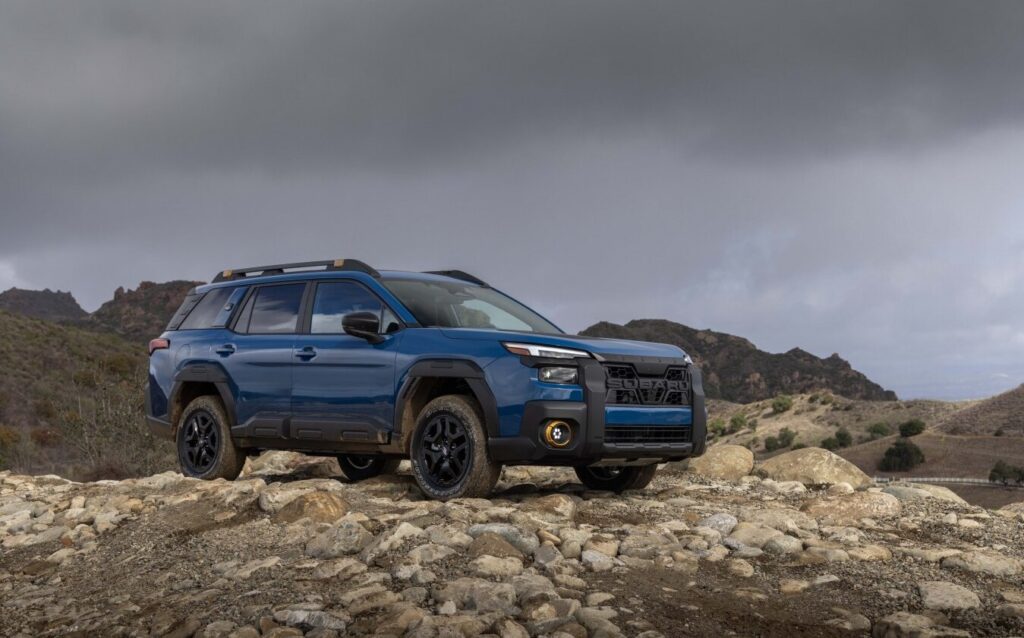
The Subaru Outback VII (BU) Wilderness 2.4 Turbo, introduced in August 2025, represents the top-tier performance variant of the seventh-generation Outback. Positioned as the flagship trim, it builds upon the Outback’s established reputation for all-weather capability and practicality, adding a significant boost in power and a more rugged aesthetic. This model is primarily targeted towards buyers seeking a versatile SUV with enhanced off-road credentials and a more engaging driving experience than the standard Outback trims. It slots above the base and Limited trims, offering a premium experience focused on performance and capability.
Technical Specifications
| Brand | Subaru |
| Model | Outback |
| Generation | Outback VII (BU) |
| Type (Engine) | Wilderness 2.4 Turbo (260 Hp) AWD Lineartronic CVT |
| Start of production | August, 2025 |
| Powertrain Architecture | Internal Combustion engine |
| Body type | SUV |
| Seats | 5 |
| Doors | 5 |
| Fuel Type | Petrol (Gasoline) |
| Weight-to-power ratio | 6.9 kg/Hp, 144.3 Hp/tonne |
| Weight-to-torque ratio | 4.8 kg/Nm, 208.7 Nm/tonne |
| Power | 260 Hp @ 5600 rpm |
| Power per litre | 108.9 Hp/l |
| Torque | 376 Nm @ 2000-4800 rpm, 277.32 lb.-ft. @ 2000-4800 rpm |
| Engine layout | Front, Longitudinal |
| Engine displacement | 2387 cm3, 145.66 cu. in. |
| Number of cylinders | 4 |
| Engine configuration | Boxer |
| Cylinder Bore | 94 mm, 3.7 in. |
| Piston Stroke | 86 mm, 3.39 in. |
| Compression ratio | 10.6:1 |
| Number of valves per cylinder | 4 |
| Fuel injection system | Direct injection |
| Engine aspiration | Twin-scroll turbo, Intercooler |
| Valvetrain | DOHC, DAVCS |
| Engine systems | Start & Stop System |
| Kerb Weight | 1802 kg, 3972.73 lbs |
| Trunk (boot) space – minimum | 980 l, 34.61 cu. ft. |
| Trunk (boot) space – maximum | 2280 l, 80.52 cu. ft. |
| Fuel tank capacity | 68 l, 17.96 US gal | 14.96 UK gal |
| Length | 4869 mm, 191.69 in. |
| Width | 1880 mm, 74.02 in. |
| Width including mirrors | 2106 mm, 82.91 in. |
| Height | 1735 mm, 68.31 in. |
| Wheelbase | 2746 mm, 108.11 in. |
| Front track | 1575 mm, 62.01 in. |
| Rear (Back) track | 1600 mm, 62.99 in. |
| Ride height (ground clearance) | 241 mm, 9.49 in. |
| Minimum turning circle (turning diameter) | 11.1 m, 36.42 ft. |
| Approach angle | 20° |
| Departure angle | 23.6° |
| Ramp-over (brakeover) angle | 21.2° |
| Drivetrain Architecture | The Internal combustion engine (ICE) drives permanently the four wheels of the vehicle. |
| Drive wheel | All wheel drive (4×4) |
| Number of gears and type of gearbox | automatic transmission Lineartronic CVT |
| Front suspension | Independent, type McPherson with coil spring and anti-roll bar |
| Rear suspension | Double wishbone, Transverse stabilizer, Coil spring |
| Front brakes | Ventilated discs, 315 mm |
| Rear brakes | Ventilated discs, 300 mm |
| Assisting systems | ABS (Anti-lock braking system) |
| Steering type | Steering rack and pinion |
| Power steering | Electric Steering |
| Tires size | 225/65 R17 |
| Wheel rims size | 7J x 17 |
Powertrain & Engine Architecture
At the heart of the Outback Wilderness 2.4 Turbo lies the FB24F engine, a 2.4-liter turbocharged horizontally-opposed (Boxer) four-cylinder. This engine utilizes direct fuel injection and a twin-scroll turbocharger with an intercooler to deliver 260 horsepower at 5600 rpm and 376 Nm (277.32 lb.-ft.) of torque between 2000 and 4800 rpm. The engine features Subaru’s Dual Active Valve Control System (DAVCS) for optimized valve timing and improved efficiency. The Lineartronic CVT (Continuously Variable Transmission) is the sole transmission offering, optimized for smooth power delivery and fuel efficiency. Subaru has tuned the CVT with simulated shift points to mimic a traditional automatic transmission, providing a more familiar driving experience. The engine is longitudinally mounted, contributing to the Outback’s balanced handling characteristics.
Driving Characteristics
The 2.4-liter turbo engine paired with the Lineartronic CVT provides a noticeable performance upgrade over the naturally aspirated engines available in lower Outback trims. While the CVT doesn’t offer the immediate response of a traditional automatic or dual-clutch transmission, it delivers smooth and consistent acceleration. The wide torque band allows for effortless passing maneuvers and confident climbing on inclines. The Wilderness trim’s increased ground clearance and revised suspension tuning enhance its off-road capability, making it a capable performer on gravel roads and moderate trails. Compared to the standard Outback, the Wilderness feels more responsive and planted, particularly during spirited driving. The CVT is programmed to hold lower “gear” ratios for longer under hard acceleration, maximizing engine power.
Equipment & Trim Levels
The Wilderness trim comes standard with a comprehensive suite of features, including StarTex water-repellent upholstery, all-weather floor liners, and unique exterior styling cues like the matte black finish on the wheels and trim. Inside, the Wilderness features a large 11.6-inch touchscreen infotainment system with Apple CarPlay and Android Auto compatibility. Standard safety features include Subaru’s EyeSight driver-assist technology, which encompasses adaptive cruise control, lane departure warning, and automatic emergency braking. Optional extras include a premium Harman Kardon audio system, a power moonroof, and heated rear seats. The interior trim is designed to be durable and functional, reflecting the Wilderness’s focus on outdoor adventure.
Chassis & Braking
The Outback Wilderness benefits from a revised suspension system designed to improve both on-road comfort and off-road capability. The front suspension utilizes McPherson struts with a coil spring and anti-roll bar, while the rear features a double-wishbone setup with a transverse stabilizer and coil spring. The increased ride height (241 mm / 9.49 inches) provides greater ground clearance for navigating rough terrain. The braking system consists of ventilated discs on all four wheels, with larger 315mm front rotors and 300mm rear rotors. The standard ABS (Anti-lock Braking System) enhances braking performance and stability in various conditions. The electric power steering provides precise and responsive steering feel.
Market Reception & Comparison
The Outback Wilderness has been generally well-received by automotive critics, who praise its enhanced performance, rugged styling, and improved off-road capability. Compared to the standard Outback trims, the Wilderness offers a more engaging driving experience and a more adventurous aesthetic. Fuel economy is slightly lower than the base models due to the turbocharged engine, but the performance gains are considered worthwhile by many buyers. Compared to competitors like the Jeep Cherokee Trailhawk, the Outback Wilderness offers a more refined interior and a more comfortable ride, while the Jeep provides more extreme off-road capability. The Outback Wilderness’s combination of practicality, capability, and value has made it a popular choice among buyers seeking a versatile and adventurous SUV.
Legacy
The FB24F engine and Lineartronic CVT combination in the Outback Wilderness is expected to be a reliable powertrain, building upon Subaru’s reputation for durability. While long-term reliability data is still emerging, early indications suggest that the engine and transmission are holding up well under normal driving conditions. The Outback Wilderness is likely to hold its value well in the used car market, due to its unique features and desirable combination of performance and capability. As Subaru continues to refine its technology, the Outback Wilderness represents a significant step forward in the evolution of the Outback model line, solidifying its position as a leader in the all-weather, all-terrain SUV segment.