
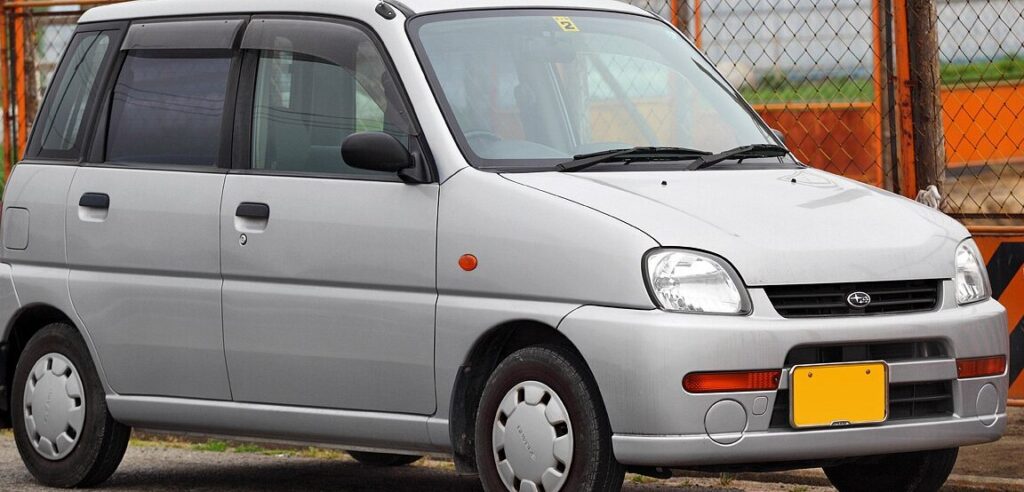
The Subaru Pleo is a lightweight, city-focused hatchback produced by Subaru between 1998 and 2009. Designed primarily for the Japanese domestic market (JDM), the Pleo occupied the “kei car” segment – a class of vehicles with strict regulations regarding size and engine displacement. The 0.66-liter variant, producing 45 horsepower, represented the entry-level offering in the Pleo lineup, prioritizing fuel efficiency and affordability over outright performance. This model was a direct response to the demand for compact, economical transportation in densely populated urban areas of Japan. While never officially sold in the United States, the Pleo exemplifies the unique engineering and design philosophies prevalent in the JDM market.
Technical Specifications
| Brand | Subaru |
| Model | Pleo |
| Generation | Pleo |
| Type (Engine) | 0.66 (45 Hp) |
| Start of production | October, 1998 |
| End of production | December, 2009 |
| Powertrain Architecture | Internal Combustion engine |
| Body type | Hatchback |
| Seats | 4 |
| Doors | 5 |
| Fuel consumption (urban) | 7 l/100 km (33.6 US mpg, 40.4 UK mpg, 14.3 km/l) |
| Fuel consumption (extra urban) | 5 l/100 km (47 US mpg, 56.5 UK mpg, 20 km/l) |
| Fuel Type | Petrol (Gasoline) |
| Maximum speed | 130 km/h (80.78 mph) |
| Weight-to-power ratio | 17.1 kg/Hp, 58.4 Hp/tonne |
| Weight-to-torque ratio | 13.8 kg/Nm, 72.7 Nm/tonne |
| Power | 45 Hp @ 6400 rpm |
| Power per litre | 68.4 Hp/l |
| Torque | 56 Nm @ 4000 rpm (41.3 lb.-ft. @ 4000 rpm) |
| Engine layout | Front, Transverse |
| Engine displacement | 658 cm3 (40.15 cu. in.) |
| Number of cylinders | 4 |
| Engine configuration | Inline |
| Cylinder Bore | 56 mm (2.2 in.) |
| Piston Stroke | 66.8 mm (2.63 in.) |
| Compression ratio | 10:1 |
| Number of valves per cylinder | 4 |
| Fuel injection system | Multi-port manifold injection |
| Engine aspiration | Naturally aspirated engine |
| Valvetrain | OHC |
| Kerb Weight | 770 kg (1697.56 lbs.) |
| Fuel tank capacity | 32 l (8.45 US gal | 7.04 UK gal) |
| Length | 3395 mm (133.66 in.) |
| Width | 1475 mm (58.07 in.) |
| Height | 1580 mm (62.2 in.) |
| Wheelbase | 2310 mm (90.94 in.) |
| Front track | 1285 mm (50.59 in.) |
| Rear track | 1260 mm (49.61 in.) |
| Minimum turning circle | 9.2 m (30.18 ft.) |
| Drivetrain Architecture | The Internal combustion engine (ICE) drives the front wheels of the vehicle. |
| Drive wheel | Front wheel drive |
| Number of gears and type of gearbox | 5 gears, manual transmission |
| Front suspension | Spring Strut |
| Rear suspension | Coil spring |
| Front brakes | Ventilated discs |
| Rear brakes | Drum |
| Assisting systems | ABS (Anti-lock braking system) |
| Steering type | Steering rack and pinion |
| Power steering | Hydraulic Steering |
| Tires size | 145/70 R12 |
Powertrain & Engine Architecture
The heart of the Pleo 0.66 is a 658cc inline-four cylinder engine, designated as part of Subaru’s EF series. This engine utilizes a single overhead camshaft (OHC) valvetrain and a multi-port fuel injection system. The relatively low compression ratio of 10:1 was a compromise to accommodate the lower octane fuel commonly available in Japan. The engine’s modest output of 45 horsepower at 6400 rpm and 56 Nm (41.3 lb-ft) of torque at 4000 rpm was typical for kei cars of the era. The engine was transversely mounted, driving the front wheels. The standard transmission was a five-speed manual, although a two-speed Continuously Variable Transmission (CVT) was also offered as an option, further prioritizing ease of use and fuel economy. The CVT version was aimed at drivers who preferred a smoother, less engaging driving experience.
Driving Characteristics
The Pleo 0.66, with its limited power output, was never intended to be a performance vehicle. Acceleration was leisurely, and highway merging required careful planning. However, within the confines of urban environments, the Pleo proved surprisingly nimble and easy to maneuver. The lightweight construction (770 kg or 1697.56 lbs) helped to mitigate the lack of horsepower. The five-speed manual transmission allowed drivers to keep the engine in its optimal power band, while the optional CVT provided a seamless and relaxed driving experience. Compared to higher-spec Pleo models with larger engines, the 0.66 version felt significantly slower, but it offered a noticeable advantage in fuel economy. The gear ratios in the manual transmission were closely spaced to maximize acceleration in city driving.
Equipment & Trim Levels
The Pleo 0.66 typically came with a basic level of equipment, reflecting its position as the entry-level model. Standard features included power steering, air conditioning (often optional), and a basic audio system. Interior upholstery was typically cloth, and the dashboard featured a simple, functional design. Optional extras included power windows, central locking, and upgraded audio systems. Higher trim levels, available with larger engines, offered more luxurious features such as alloy wheels, upgraded interior trim, and advanced audio systems. The focus of the 0.66 trim was on providing a practical and affordable mode of transportation, rather than luxury or advanced features.
Chassis & Braking
The Pleo’s chassis was designed for compactness and efficiency. It utilized a front strut suspension and a rear coil spring suspension. The front brakes were ventilated discs, providing adequate stopping power for the vehicle’s weight and performance. However, the rear brakes were drums, a cost-saving measure common in kei cars. Anti-lock Braking System (ABS) was available as an option, enhancing safety. The relatively narrow tires (145/70 R12) contributed to fuel efficiency and reduced rolling resistance. The suspension was tuned for comfort rather than sporty handling, prioritizing a smooth ride over sharp cornering.
Market Reception & Comparison
The Subaru Pleo 0.66 was well-received in Japan as an affordable and practical city car. Critics praised its fuel efficiency, compact size, and ease of maneuverability. However, the limited power output was a common criticism. Compared to other kei cars of the time, such as the Honda Beat or the Suzuki Cappuccino, the Pleo lacked the sporty appeal of those models. However, it offered a more practical and affordable alternative. The Pleo 0.66’s fuel economy was competitive with other kei cars, typically achieving around 5 liters per 100 kilometers (47 US mpg) on the highway. Reliability was generally good, although regular maintenance was essential to ensure the longevity of the engine.
Legacy
The Subaru Pleo, particularly the 0.66-liter variant, remains a popular choice in the used car market in Japan. Its affordability, fuel efficiency, and compact size continue to appeal to buyers seeking a practical city car. While the Pleo was never officially sold in the United States, it has gained a cult following among JDM enthusiasts. The engine, while not particularly powerful, is known for its reliability and relatively simple maintenance requirements. The Pleo represents a unique chapter in Subaru’s history, showcasing the company’s ability to engineer innovative and efficient vehicles for specific market segments. The 0.66 version, in particular, embodies the spirit of the kei car – a small, economical, and practical vehicle designed for the challenges of urban life.
