
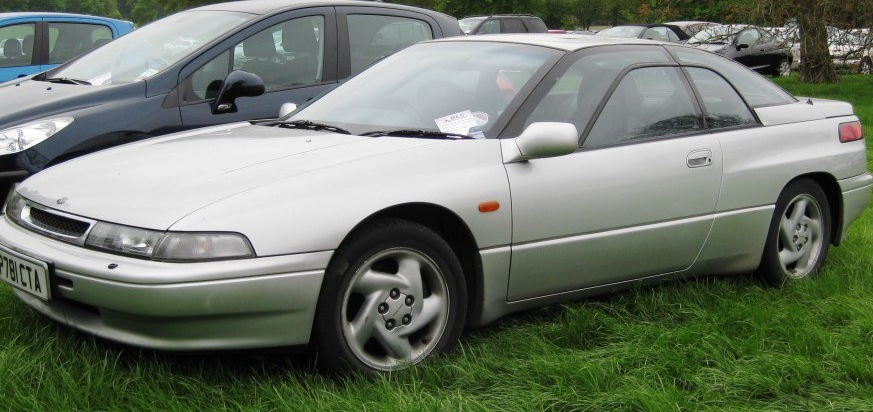
The Subaru SVX, internally designated as the CX, represented Subaru’s ambitious foray into the grand touring coupe market. Produced between 1991 and 1996, it was a distinctive vehicle characterized by its unique window-within-a-window design and a focus on blending sporty performance with luxury. The 3.3 24V variant, powered by a 250 horsepower engine, was the sole engine and transmission configuration offered throughout its production run in North America, and a key offering in other markets. It was positioned as Subaru’s flagship model, intended to compete with established European grand tourers.
Technical Specifications
| Brand | Subaru |
| Model | SVX |
| Generation | SVX (CX) |
| Type (Engine) | 3.3 24V (250 Hp) |
| Start of production | 1991 |
| End of production | 1994 |
| Powertrain Architecture | Internal Combustion engine |
| Body type | Coupe |
| Seats | 4 |
| Doors | 2 |
| Fuel consumption (urban) | 16 l/100 km (14.7 US mpg) |
| Fuel consumption (extra urban) | 9 l/100 km (26.1 US mpg) |
| Fuel Type | Petrol (Gasoline) |
| Acceleration 0 – 100 km/h | 7.6 sec |
| Acceleration 0 – 62 mph | 7.6 sec |
| Acceleration 0 – 60 mph | 7.2 sec |
| Maximum speed | 225 km/h (139.81 mph) |
| Weight-to-power ratio | 6.5 kg/Hp |
| Weight-to-torque ratio | 5.5 kg/Nm |
| Power | 250 Hp @ 6400 rpm |
| Torque | 294 Nm @ 4800 rpm (216.84 lb.-ft. @ 4800 rpm) |
| Engine layout | Front, Longitudinal |
| Engine Model/Code | EG33 |
| Engine displacement | 3318 cm3 (202.48 cu. in.) |
| Number of cylinders | 6 |
| Engine configuration | Boxer |
| Cylinder Bore | 97 mm (3.82 in.) |
| Piston Stroke | 75 mm (2.95 in.) |
| Compression ratio | 9.7:1 |
| Number of valves per cylinder | 4 |
| Fuel injection system | Multi-port manifold injection |
| Engine aspiration | Naturally aspirated |
| Valvetrain | DOHC |
| Engine oil capacity | 6 l (6.34 US qt | 5.28 UK qt) |
| Coolant capacity | 7.8 l (8.24 US qt | 6.86 UK qt) |
| Kerb Weight | 1625 kg (3582.51 lbs.) |
| Fuel tank capacity | 70 l (18.49 US gal | 15.4 UK gal) |
| Length | 4625 mm (182.09 in.) |
| Width | 1777 mm (69.96 in.) |
| Height | 1300 mm (51.18 in.) |
| Wheelbase | 2610 mm (102.76 in.) |
| Front track | 1500 mm (59.06 in.) |
| Rear track | 1480 mm (58.27 in.) |
| Drive wheel | All wheel drive (4×4) |
| Number of gears | 4 |
| Gearbox type | Automatic transmission |
| Front suspension | Coil spring |
| Rear suspension | Coil spring |
| Front brakes | Ventilated discs |
| Rear brakes | Ventilated discs |
| Assisting systems | ABS (Anti-lock braking system) |
| Steering type | Steering rack and pinion |
| Power steering | Hydraulic |
| Tires size | 225/50 R16 |
| Wheel rims size | 7.5 J |
Powertrain & Engine Architecture
The heart of the SVX was the EG33 3.3-liter flat-six (boxer) engine. This engine was a significant departure for Subaru, as it was their first foray into a six-cylinder configuration. The engine featured a 90-degree V-angle, contributing to a low center of gravity and improved balance. It utilized multi-port fuel injection and a dual overhead camshaft (DOHC) valvetrain, operating with four valves per cylinder. The engine produced 250 horsepower at 6400 rpm and 294 Nm (216.84 lb-ft) of torque at 4800 rpm. The sole transmission option was a four-speed automatic, designed to deliver smooth shifts and complement the engine’s torque curve. This automatic was specifically tuned for the SVX, prioritizing comfort and refinement over outright performance.
Driving Characteristics
The SVX 3.3 with the automatic transmission offered a comfortable and refined driving experience. While not a sports car in the traditional sense, the engine provided ample power for confident highway cruising and passing maneuvers. Acceleration from 0-60 mph was achieved in approximately 7.2 seconds. The automatic transmission, while smooth, did result in some power loss compared to a potential manual transmission variant (which was never offered in North America). The all-wheel-drive system provided excellent traction in various weather conditions, enhancing stability and control. The gear ratios were optimized for relaxed cruising, with a focus on maximizing fuel efficiency at highway speeds. However, aggressive driving revealed the transmission’s tendency to hunt for gears, particularly during uphill climbs.
Equipment & Trim Levels
The SVX was well-equipped for its time, reflecting its positioning as a luxury grand tourer. Standard features included leather upholstery, power-adjustable front seats, a premium sound system, automatic climate control, and power windows and locks. The distinctive window-within-a-window design contributed to a spacious and airy cabin. Optional extras included a sunroof, upgraded audio systems, and various cosmetic enhancements. The interior design was generally minimalist and functional, with a focus on ergonomics and ease of use. There wasn’t a significant trim level structure; the SVX was largely offered as a single, well-appointed package.
Chassis & Braking
The SVX featured a robust chassis designed to handle the power of the 3.3-liter engine and the demands of all-wheel drive. The suspension utilized coil springs and independent suspension on all four wheels. Front and rear brakes were ventilated discs, providing ample stopping power. An anti-lock braking system (ABS) was standard, enhancing safety and control during emergency braking situations. The steering was rack and pinion with hydraulic power assistance, offering precise and responsive handling. The SVX’s relatively heavy weight (1625 kg / 3582.51 lbs) did contribute to some body roll during cornering, but the all-wheel-drive system helped to mitigate understeer.
Market Reception & Comparison
The SVX received mixed reviews upon its release. Critics praised its unique styling, comfortable interior, and smooth ride. However, some criticized its performance, particularly the automatic transmission’s responsiveness and the car’s overall weight. Compared to other grand tourers of the era, such as the BMW 8 Series or the Mazda RX-7, the SVX offered a different proposition – a blend of practicality, all-weather capability, and distinctive styling. Fuel economy was reasonable for a vehicle of its size and performance, averaging around 14.7 US mpg in the city and 26.1 US mpg on the highway. Reliability was generally good, although some owners reported issues with the automatic transmission and the complex window mechanism.
Legacy
The Subaru SVX, despite its relatively short production run, has gained a cult following among enthusiasts. Its unique design and distinctive features have made it a sought-after classic. The EG33 engine is known for its durability and relatively simple maintenance requirements. While finding parts can be challenging, the SVX’s robust construction and readily available Subaru parts network contribute to its long-term reliability. Today, well-maintained SVX models command a premium in the used car market, appealing to collectors and those seeking a unique and stylish grand tourer.
