
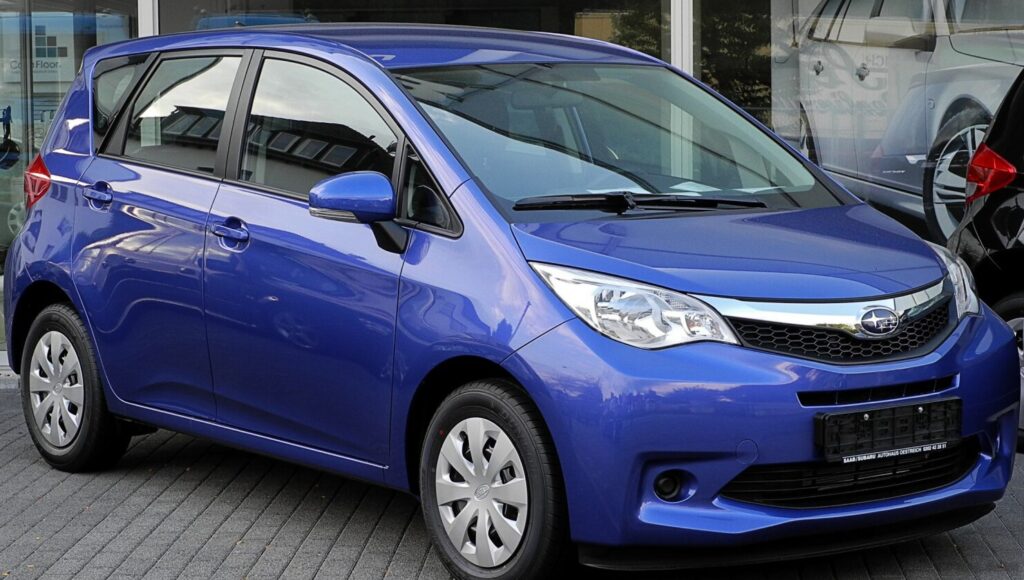
The Subaru Trezia 1.3i 16V, produced from November 2010 to 2014, was a compact hatchback designed as a collaborative effort between Subaru and Toyota (where it was sold as the Toyota Verso-S). Positioned as an entry-level offering within the Trezia range, this variant aimed to provide affordable and fuel-efficient transportation in the European market. The Trezia itself was based on the Toyota B90 platform, sharing many components with the Toyota Yaris. This model represented Subaru’s attempt to broaden its appeal beyond its traditional all-wheel-drive focused lineup, offering a more conventional front-wheel-drive option for urban drivers.
Technical Specifications
| Brand | Subaru |
| Model | Trezia |
| Generation | Trezia |
| Type (Engine) | 1.3i 16V (99 Hp) |
| Start of production | November, 2010 |
| End of production | 2014 |
| Powertrain Architecture | Internal Combustion engine |
| Body type | Hatchback |
| Seats | 5 |
| Doors | 5 |
| Fuel consumption (urban) | 6.8 l/100 km (34.6 US mpg, 41.5 UK mpg, 14.7 km/l) |
| Fuel consumption (extra urban) | 4.8 l/100 km (49 US mpg, 58.9 UK mpg, 20.8 km/l) |
| Fuel consumption (combined) | 5.5 l/100 km (42.8 US mpg, 51.4 UK mpg, 18.2 km/l) |
| Fuel Type | Petrol (Gasoline) |
| Maximum speed | 170 km/h (105.63 mph) |
| Weight-to-power ratio | 10.6 kg/Hp, 94.7 Hp/tonne |
| Weight-to-torque ratio | 8.4 kg/Nm, 119.6 Nm/tonne |
| Power | 99 Hp @ 6000 rpm |
| Power per litre | 74.5 Hp/l |
| Torque | 125 Nm @ 4000 rpm (92.2 lb.-ft. @ 4000 rpm) |
| Engine layout | Front, Transverse |
| Engine Model/Code | 1NR-FE |
| Engine displacement | 1329 cm3 (81.1 cu. in.) |
| Number of cylinders | 4 |
| Engine configuration | Inline |
| Cylinder Bore | 72.5 mm (2.85 in.) |
| Piston Stroke | 80.5 mm (3.17 in.) |
| Compression ratio | 11.5:1 |
| Number of valves per cylinder | 4 |
| Fuel injection system | Multi-port manifold injection |
| Engine aspiration | Naturally aspirated engine |
| Engine oil capacity | 3.4 l (3.59 US qt | 2.99 UK qt) |
| Coolant | 4.6 l (4.86 US qt | 4.05 UK qt) |
| Kerb Weight | 1045 kg (2303.83 lbs.) |
| Trunk (boot) space – minimum | 363 l (12.82 cu. ft.) |
| Fuel tank capacity | 42 l (11.1 US gal | 9.24 UK gal) |
| Length | 3995 mm (157.28 in.) |
| Width | 1695 mm (66.73 in.) |
| Height | 1595 mm (62.8 in.) |
| Wheelbase | 2550 mm (100.39 in.) |
| Front track | 1470 mm (57.87 in.) |
| Rear (Back) track | 1460 mm (57.48 in.) |
| Minimum turning circle | 10.6 m (34.78 ft.) |
| Drivetrain Architecture | The Internal combustion engine (ICE) drives the front wheels of the vehicle. |
| Drive wheel | Front wheel drive |
| Number of gears and type of gearbox | 6 gears, manual transmission |
| Assisting systems | ABS (Anti-lock braking system) |
| Steering type | Steering rack and pinion |
| Tires size | 185/65R15 |
| Wheel rims size | 15 |
Powertrain & Engine Architecture
The heart of the Trezia 1.3i 16V is the Toyota-sourced 1NR-FE engine, a 1.3-liter inline-four cylinder gasoline engine. This engine utilizes a multi-port fuel injection system and a dual overhead camshaft (DOHC) valvetrain with four valves per cylinder. The 1NR-FE is known for its relatively simple design, contributing to its reliability and ease of maintenance. It’s a naturally aspirated engine, meaning it doesn’t employ turbocharging or supercharging. The engine produces 99 horsepower at 6000 rpm and 125 Nm (92.2 lb-ft) of torque at 4000 rpm. This power is delivered to the front wheels through a six-speed manual transmission. The transmission was chosen to balance fuel efficiency with acceptable performance for city driving.
Driving Characteristics
The 1.3i 16V Trezia offers modest performance. Acceleration is adequate for urban environments, but it can feel strained when fully loaded or attempting highway overtaking maneuvers. The six-speed manual transmission helps to keep the engine in its optimal power band, but the relatively low torque output means frequent downshifts are often necessary. Compared to potential higher-spec Trezia variants (had they been offered in wider markets), this version prioritizes fuel economy over outright speed. The steering is light and precise, making it easy to maneuver in tight spaces. The suspension is tuned for comfort, providing a reasonably smooth ride, although it can feel somewhat soft during more spirited driving.
Equipment & Trim Levels
The Trezia 1.3i 16V typically came with a fairly basic level of equipment, reflecting its position as the entry-level model. Standard features generally included air conditioning, power steering, electric front windows, and a basic audio system with USB connectivity. Safety features included ABS brakes, front airbags, and seatbelt pretensioners. Optional extras could include alloy wheels, a rear parking sensor, and a more advanced audio system. Interior upholstery was typically cloth, and the dashboard featured a functional but somewhat utilitarian design. Trim levels varied slightly depending on the specific market, but the core features remained consistent.
Chassis & Braking
The Trezia utilizes a front-wheel-drive chassis with a MacPherson strut suspension in the front and a torsion beam suspension in the rear. The front brakes are ventilated discs, while the rear brakes are drum brakes. This configuration was chosen to keep costs down and maintain a reasonable weight balance. The steering is a rack and pinion system, providing responsive handling. The tires are typically 185/65R15, offering a good balance of grip and ride comfort. Stabilizer bars were included in the front suspension to reduce body roll during cornering.
Market Reception & Comparison
The Subaru Trezia 1.3i 16V was generally well-received as an affordable and practical city car. Critics praised its fuel efficiency and ease of driving, but noted its lack of outright performance. Compared to other small hatchbacks in the European market, such as the Volkswagen Polo or the Ford Fiesta, the Trezia offered a competitive price point but lacked the brand prestige and driving dynamics of its rivals. The Toyota Verso-S, its twin, received similar reviews. Fuel economy was a strong point, consistently achieving around 5.5 l/100km in combined driving, making it an attractive option for budget-conscious buyers. Reliability was also considered good, benefiting from Toyota’s reputation for building durable engines.
Legacy
The Subaru Trezia, and specifically the 1.3i 16V variant, has established a reputation for reliability and low running costs in the used car market. The 1NR-FE engine is known to be durable and relatively trouble-free, provided it receives regular maintenance. Parts availability is generally good, thanks to the shared components with Toyota models. While not a particularly exciting car to drive, the Trezia remains a practical and affordable option for those seeking a small, fuel-efficient hatchback. Its simple mechanical design makes it relatively easy and inexpensive to repair, further enhancing its appeal to budget-minded buyers. The Trezia represents a unique chapter in Subaru’s history, demonstrating the brand’s willingness to experiment with front-wheel-drive vehicles and cater to a broader range of customers.
