
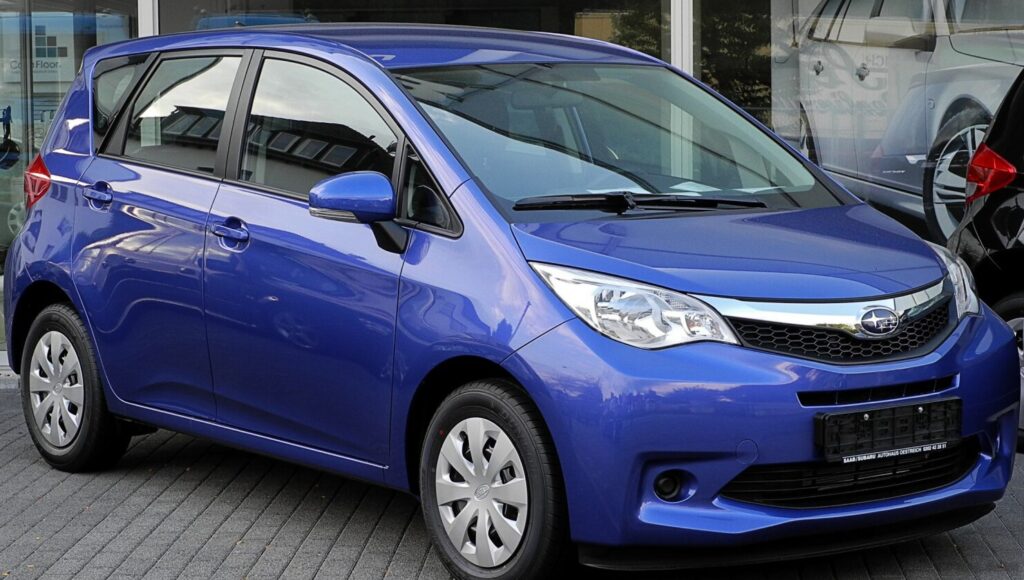
The Subaru Trezia 1.4D, produced between November 2010 and 2014, was a compact hatchback marketed primarily in Europe and Japan. It represented Subaru’s entry into the B-segment multi-purpose vehicle (MPV) market, achieved through a partnership with Toyota and based heavily on the Toyota Verso-S (also known as the Ractis in Japan). The 1.4D variant, equipped with a 90 horsepower diesel engine, occupied a middle ground in the Trezia lineup, offering a balance between fuel efficiency and acceptable performance for everyday driving. It was positioned as a practical and economical choice for small families or individuals seeking a versatile vehicle.
Technical Specifications
| Brand | Subaru |
| Model | Trezia |
| Generation | Trezia |
| Type (Engine) | 1.4D (90 Hp) |
| Start of production | November, 2010 |
| End of production | 2014 |
| Powertrain Architecture | Internal Combustion engine |
| Body type | Hatchback |
| Seats | 5 |
| Doors | 5 |
| Fuel consumption (urban) | 5 l/100 km (47 US mpg, 56.5 UK mpg, 20 km/l) |
| Fuel consumption (extra urban) | 3.9 l/100 km (60.3 US mpg, 72.4 UK mpg, 25.6 km/l) |
| Fuel consumption (combined) | 4.3 l/100 km (54.7 US mpg, 65.7 UK mpg, 23.3 km/l) |
| Fuel Type | Diesel |
| Maximum speed | 175 km/h (108.74 mph) |
| Weight-to-power ratio | 11.6 kg/Hp, 86.1 Hp/tonne |
| Weight-to-torque ratio | 4.2 kg/Nm, 239.2 Nm/tonne |
| Power | 90 Hp @ 3800 rpm |
| Power per litre | 66 Hp/l |
| Torque | 250 Nm @ 1800 rpm (184.39 lb.-ft. @ 1800 rpm) |
| Engine layout | Front, Transverse |
| Engine Model/Code | 1ND-TV |
| Engine displacement | 1364 cm3 (83.24 cu. in.) |
| Engine configuration | Inline |
| Cylinder Bore | 73 mm (2.87 in.) |
| Piston Stroke | 81.5 mm (3.21 in.) |
| Compression ratio | 16.5:1 |
| Fuel injection system | Diesel Commonrail |
| Engine aspiration | Turbocharger, Intercooler |
| Engine oil capacity | 4.1 l (4.33 US qt | 3.61 UK qt) |
| Coolant | 4.3 l (4.54 US qt | 3.78 UK qt) |
| Kerb Weight | 1045 kg (2303.83 lbs.) |
| Trunk (boot) space – minimum | 363 l (12.82 cu. ft.) |
| Fuel tank capacity | 42 l (11.1 US gal | 9.24 UK gal) |
| Length | 3995 mm (157.28 in.) |
| Width | 1695 mm (66.73 in.) |
| Height | 1595 mm (62.8 in.) |
| Wheelbase | 2550 mm (100.39 in.) |
| Front track | 1470 mm (57.87 in.) |
| Rear (Back) track | 1460 mm (57.48 in.) |
| Minimum turning circle | 10.6 m (34.78 ft.) |
| Drivetrain Architecture | The Internal combustion engine (ICE) drives the front wheels of the vehicle. |
| Drive wheel | Front wheel drive |
| Number of gears and type of gearbox | 6 gears, manual transmission |
| Assisting systems | ABS (Anti-lock braking system) |
| Steering type | Steering rack and pinion |
| Tires size | 185/65 R15 |
| Wheel rims size | 15 |
Powertrain & Engine Architecture
The heart of the Trezia 1.4D was the 1ND-TV diesel engine, a 1.4-liter inline-four cylinder unit developed by Toyota. This engine was a member of the Toyota ND engine family, known for its compact size and fuel efficiency. The 1ND-TV featured a common rail direct injection system, delivering fuel directly into the combustion chamber at extremely high pressure for optimized combustion. A turbocharger with an intercooler was employed to boost power output and improve torque across a wider rev range. The engine produced 90 horsepower at 3800 rpm and a respectable 250 Nm (184 lb-ft) of torque at just 1800 rpm. The engine’s relatively high compression ratio of 16.5:1 contributed to its efficiency, but also demanded high-quality diesel fuel. The Trezia 1.4D was exclusively offered with a six-speed manual transmission, prioritizing fuel economy over the convenience of an automatic.
Driving Characteristics
The 1.4D Trezia offered a practical, if not particularly exciting, driving experience. The engine’s torque peak at low rpm meant that it felt reasonably responsive in everyday driving situations, such as accelerating from a standstill or overtaking at moderate speeds. However, its 90 horsepower limited its overall acceleration capability. The six-speed manual transmission was well-matched to the engine, allowing drivers to keep the engine in its optimal power band. Compared to the petrol-powered Trezia variants, the 1.4D provided significantly better fuel economy, making it a more economical choice for those covering longer distances. It wasn’t a sporty vehicle; the focus was on comfort and efficiency rather than dynamic handling. The steering was light and precise, making it easy to maneuver in urban environments.
Equipment & Trim Levels
The Trezia 1.4D was typically equipped with a reasonable level of standard equipment. Base models included features such as air conditioning, power windows, central locking, and an audio system with USB connectivity. Safety features included ABS brakes, front and side airbags, and seatbelt pretensioners. Higher trim levels, often denoted by suffixes like ‘Active’ or ‘Limited’, added features such as alloy wheels, a multi-function steering wheel, and a more sophisticated audio system. Optional extras included a navigation system, parking sensors, and a panoramic sunroof. Interior upholstery was typically cloth, with a focus on durability and practicality. The dashboard layout was functional and straightforward, prioritizing ease of use.
Chassis & Braking
The Trezia’s chassis was a typical front-wheel-drive configuration, utilizing MacPherson strut suspension at the front and a torsion beam suspension at the rear. This setup provided a comfortable ride quality, although it wasn’t particularly sporty. The front brakes were ventilated discs, while the rear brakes were drums. This configuration was common for vehicles in this weight class and helped to keep production costs down. The steering was a rack and pinion system, providing precise and responsive steering feel. The Trezia’s relatively light weight (1045 kg / 2303 lbs) contributed to its decent handling characteristics.
Market Reception & Comparison
The Subaru Trezia 1.4D was generally well-received by critics as a practical and economical small MPV. Its fuel efficiency was a major selling point, and its spacious interior made it a good choice for small families. However, some reviewers criticized its lack of outright performance and its somewhat basic interior. Compared to other diesel-powered MPVs in the same segment, such as the Renault Modus or the Fiat Qubo, the Trezia offered a competitive level of equipment and fuel economy. The petrol-powered Trezia variants offered slightly more performance, but at the expense of fuel efficiency. The 1.4D was often seen as the sweet spot in the lineup, offering a good balance between economy and usability.
Legacy
The Subaru Trezia, while not a high-volume seller, established Subaru’s presence in the European B-segment MPV market. The 1.4D powertrain proved to be relatively reliable, with few widespread mechanical issues reported. On the used car market, Trezia 1.4D models are generally considered to be a good value for money, offering a practical and economical transportation solution. The engine’s durability and fuel efficiency continue to appeal to buyers looking for a reliable and affordable small MPV. However, potential buyers should be aware of the importance of using high-quality diesel fuel and maintaining the vehicle according to the manufacturer’s recommendations to ensure long-term reliability.
