
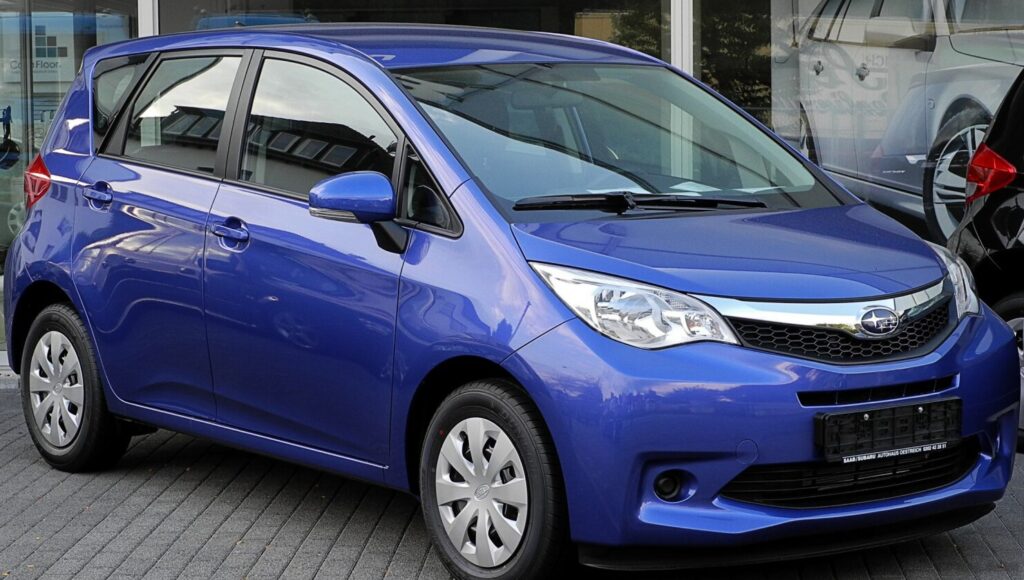
Technical Specifications
| Brand | Subaru |
| Model | Trezia |
| Generation | Trezia |
| Type (Engine) | 1.4D (90 Hp) Automatic |
| Start of production | November, 2010 |
| End of production | 2014 |
| Powertrain Architecture | Internal Combustion engine |
| Body type | Hatchback |
| Seats | 5 |
| Doors | 5 |
| Fuel consumption (urban) | 5 l/100 km (47 US mpg, 56.5 UK mpg, 20 km/l) |
| Fuel consumption (extra urban) | 4 l/100 km (58.8 US mpg, 70.6 UK mpg, 25 km/l) |
| Fuel consumption (combined) | 4.4 l/100 km (53.5 US mpg, 64.2 UK mpg, 22.7 km/l) |
| Fuel Type | Diesel |
| Maximum speed | 175 km/h (108.74 mph) |
| Weight-to-power ratio | 12.4 kg/Hp, 80.7 Hp/tonne |
| Weight-to-torque ratio | 5.4 kg/Nm, 183.9 Nm/tonne |
| Power | 90 Hp @ 3800 rpm |
| Power per litre | 66 Hp/l |
| Torque | 205 Nm @ 1800 rpm (151.2 lb.-ft. @ 1800 rpm) |
| Engine layout | Front, Transverse |
| Engine Model/Code | 1ND-TV |
| Engine displacement | 1364 cm3 (83.24 cu. in.) |
| Engine configuration | Inline |
| Cylinder Bore | 73 mm (2.87 in.) |
| Piston Stroke | 81.5 mm (3.21 in.) |
| Compression ratio | 16.5:1 |
| Fuel injection system | Diesel Commonrail |
| Engine aspiration | Turbocharger, Intercooler |
| Engine oil capacity | 4.1 l (4.33 US qt | 3.61 UK qt) |
| Coolant | 4.3 l (4.54 US qt | 3.78 UK qt) |
| Kerb Weight | 1115 kg (2458.15 lbs.) |
| Trunk (boot) space – minimum | 429 l (15.15 cu. ft.) |
| Fuel tank capacity | 42 l (11.1 US gal | 9.24 UK gal) |
| Length | 3995 mm (157.28 in.) |
| Width | 1695 mm (66.73 in.) |
| Height | 1595 mm (62.8 in.) |
| Wheelbase | 2550 mm (100.39 in.) |
| Front track | 1470 mm (57.87 in.) |
| Rear (Back) track | 1460 mm (57.48 in.) |
| Minimum turning circle | 10.6 m (34.78 ft.) |
| Drivetrain Architecture | Front wheel drive |
| Number of gears | 6 gears, automatic transmission |
| Assisting systems | ABS (Anti-lock braking system) |
| Steering type | Steering rack and pinion |
| Tires size | 185/60 R16 |
| Wheel rims size | 16 |
The Subaru Trezia 1.4D (90 hp) Automatic, produced between November 2010 and 2014, represents a unique offering in Subaru’s lineup during that period. Essentially a rebadged Toyota Verso-S (also known as the Ractis in Japan), the Trezia was Subaru’s entry into the European mini-MPV segment. It aimed to provide practicality and fuel efficiency in a compact package, appealing to urban drivers and small families. This particular variant, powered by a 1.4-liter diesel engine paired with a six-speed automatic transmission, occupied the lower-mid range of the Trezia model options, prioritizing economy and ease of use over outright performance. The Trezia was never officially sold in the United States, making it a relatively uncommon vehicle even within the global Subaru community.
Powertrain & Engine Architecture
The heart of the Trezia 1.4D Automatic is the 1ND-TV diesel engine, a 1.4-liter inline-four cylinder unit. This engine was sourced from Toyota and is part of the ND engine family. It features a turbocharger with an intercooler to boost power and efficiency. The engine utilizes a common-rail direct injection system, delivering fuel directly into the combustion chamber at extremely high pressure for improved combustion and reduced emissions. The 16.5:1 compression ratio is typical for a diesel engine, contributing to its thermal efficiency. The six-speed automatic transmission, while providing convenience, wasn’t known for particularly rapid shifts. It was geared towards smooth operation and fuel economy rather than sporty performance. The transmission’s programming prioritized comfort and ease of driving, making it well-suited for city traffic.
Driving Characteristics
The 90 horsepower output and 205 Nm (151 lb-ft) of torque of the 1.4D Automatic resulted in modest, but adequate, performance. Acceleration was not brisk, with a 0-60 mph time estimated around 12-13 seconds. The automatic transmission, while smooth, did contribute to a feeling of slight lethargy, especially when attempting quicker overtaking maneuvers. The gear ratios were optimized for fuel efficiency, meaning the engine often operated at lower RPMs during cruising. Compared to the 1.3-liter petrol version, the 1.4D offered significantly more torque, making it feel more capable when fully loaded or tackling inclines. However, it lacked the responsiveness of the manual transmission variants. The focus was clearly on providing a comfortable and economical driving experience.
Equipment & Trim Levels
The Trezia 1.4D Automatic typically came with a reasonable level of standard equipment. This included air conditioning, power windows, central locking, and an audio system with USB connectivity. Safety features such as ABS, front airbags, and side airbags were also standard. Higher trim levels, though not always readily available on this specific engine/transmission combination, could add features like alloy wheels, a multi-function steering wheel, and a more advanced audio system. Interior upholstery was generally cloth, with a functional, if somewhat basic, dashboard layout. Optional extras often included parking sensors and a navigation system.
Chassis & Braking
The Trezia utilized a front-wheel-drive platform with a MacPherson strut suspension in the front and a torsion beam suspension in the rear. The torsion beam setup was a cost-effective solution, prioritizing space efficiency over sophisticated handling. Braking was typically accomplished with disc brakes on the front wheels and drum brakes on the rear, a common configuration for vehicles in this weight class. The steering was a rack and pinion system, providing adequate precision for everyday driving. Stabilizer bars were fitted to both the front and rear axles to reduce body roll during cornering, but the Trezia was not designed for spirited driving.
Market Reception & Comparison
The Subaru Trezia, and by extension the Toyota Verso-S, received mixed reviews. Critics generally praised its practicality, fuel efficiency, and compact size, making it ideal for urban environments. However, the interior was often criticized for its somewhat low-rent materials and basic design. The 1.4D Automatic variant was seen as a sensible choice for those prioritizing economy and ease of use, but it was often overshadowed by the more engaging driving experience offered by the manual transmission models. Compared to other mini-MPVs of the time, such as the Renault Modus or the Fiat Idea, the Trezia offered a competitive level of space and fuel efficiency, but lacked the brand cachet of some of its rivals.
Legacy
The Subaru Trezia, while not a sales success in many markets, remains a relatively reliable and affordable used car option. The 1ND-TV diesel engine is known for its durability, provided it has been properly maintained. Common issues include turbocharger wear and potential problems with the diesel particulate filter (DPF) if the vehicle has been primarily used for short trips. The automatic transmission, while generally reliable, may exhibit some wear and tear over time. Today, the Trezia appeals to buyers seeking a practical, economical, and compact vehicle for city driving. Its unique positioning as a Subaru-branded Toyota makes it a somewhat niche vehicle, appreciated by those looking for something a little different.
