
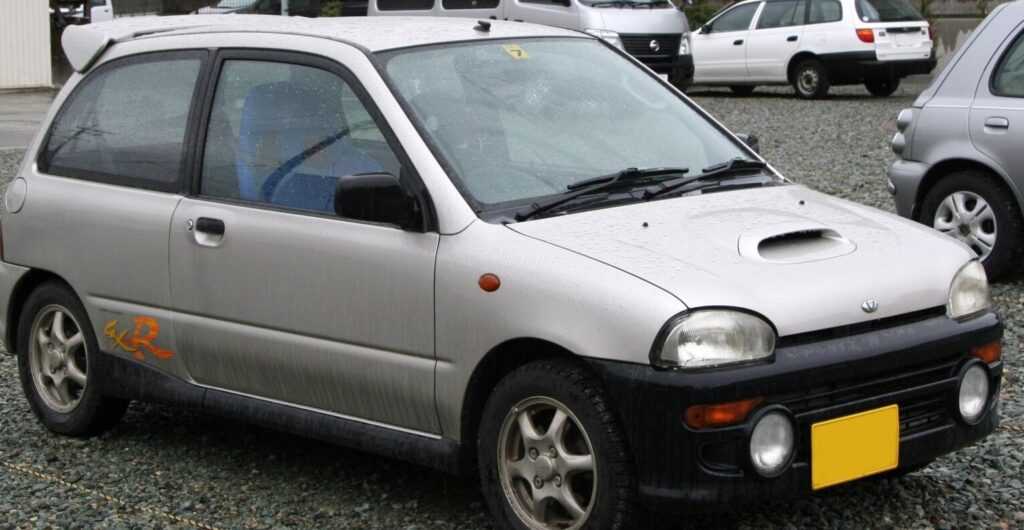
The Subaru Vivio T, produced between 1996 and 1998, represents a unique and often overlooked entry in Subaru’s history. This diminutive hatchback, primarily aimed at the Japanese domestic market (JDM), offered a blend of affordability, efficiency, and surprisingly spirited performance thanks to its turbocharged engine. The “T” designation specifically denotes the turbocharged variant, distinguishing it from naturally aspirated models within the broader Vivio range (which spanned from 1992-1998). The Vivio occupied a niche below the larger Leone and Impreza in Subaru’s lineup, catering to buyers seeking a compact and economical vehicle for urban driving. It was offered in both 3-door and 5-door configurations.
Technical Specifications
| Brand | Subaru |
| Model | Vivio |
| Generation | Vivio |
| Type (Engine) | 0.66 T (64 Hp) |
| Start of production | 1996 year |
| End of production | 1998 year |
| Powertrain Architecture | Internal Combustion engine |
| Body type | Hatchback |
| Seats | 5 |
| Doors | 3-5 |
| Fuel consumption (urban) | 8 l/100 km (29.4 US mpg) |
| Fuel consumption (extra urban) | 5.2 l/100 km (45.2 US mpg) |
| Fuel Type | Petrol (Gasoline) |
| Acceleration 0 – 100 km/h | 16 sec |
| Acceleration 0 – 62 mph | 16 sec |
| Acceleration 0 – 60 mph | 15.2 sec |
| Maximum speed | 138 km/h (85.75 mph) |
| Weight-to-power ratio | 9.8 kg/Hp |
| Weight-to-torque ratio | 7.4 kg/Nm |
| Power | 64 Hp @ 6400 rpm |
| Power per litre | 97.3 Hp/l |
| Torque | 84 Nm @ 4400 rpm (61.96 lb.-ft. @ 4400 rpm) |
| Engine layout | Front, Longitudinal |
| Engine Model/Code | EN07 |
| Engine displacement | 658 cm3 (40.15 cu. in.) |
| Number of cylinders | 4 |
| Engine configuration | Inline |
| Cylinder Bore | 56 mm (2.2 in.) |
| Piston Stroke | 66.8 mm (2.63 in.) |
| Compression ratio | 10:1 |
| Number of valves per cylinder | 2 |
| Fuel injection system | Multi-port manifold injection |
| Engine aspiration | Supercharger |
| Valvetrain | OHC |
| Engine oil capacity | 2.7 l (2.85 US qt | 2.38 UK qt) |
| Coolant | 3.1 l (3.28 US qt | 2.73 UK qt) |
| Kerb Weight | 625 kg (1377.89 lbs.) |
| Max. weight | 1110 kg (2447.13 lbs.) |
| Max load | 485 kg (1069.24 lbs.) |
| Trunk (boot) space – minimum | 105 l (3.71 cu. ft.) |
| Trunk (boot) space – maximum | 835 l (29.49 cu. ft.) |
| Fuel tank capacity | 32 l (8.45 US gal | 7.04 UK gal) |
| Length | 3295 mm (129.72 in.) |
| Width | 1395 mm (54.92 in.) |
| Height | 1375 mm (54.13 in.) |
| Wheelbase | 2310 mm (90.94 in.) |
| Front track | 1220 mm (48.03 in.) |
| Rear (Back) track | 1200 mm (47.24 in.) |
| Minimum turning circle | 9.8 m (32.15 ft.) |
| Drivetrain Architecture | The Internal combustion engine (ICE) drives the front wheels of the vehicle. |
| Drive wheel | Front wheel drive |
| Front suspension | Wishbone |
| Rear suspension | Several levers and rods |
| Front brakes | Disc |
| Rear brakes | Drum |
| Assisting systems | ABS (Anti-lock braking system) |
| Steering type | Steering rack and pinion |
| Power steering | Hydraulic Steering |
| Tires size | 145/70 R12 |
| Wheel rims size | 4J x 12 |
Powertrain & Engine Architecture
The heart of the Vivio T is the EN07, a 658cc inline-four cylinder engine. What sets this engine apart is its use of a supercharger, rather than a turbocharger, to boost power. This was a deliberate choice by Subaru, aiming for a more linear power delivery and reduced turbo lag, characteristics well-suited to the Vivio’s intended use as a city car. The engine utilizes a multi-port fuel injection system and a single overhead camshaft (OHC) valvetrain with two valves per cylinder. The supercharger, a mechanically driven unit, provides approximately 7 psi of boost. The engine is longitudinally mounted and drives the front wheels through a four-speed automatic transmission. This transmission was chosen for its ease of use and accessibility, further emphasizing the Vivio T’s focus on convenience.
Driving Characteristics
The 64 horsepower and 62 lb-ft of torque produced by the EN07 engine, while modest by modern standards, provided surprisingly lively performance in the lightweight Vivio. The supercharger contributes to a relatively flat torque curve, making the car feel responsive at lower engine speeds. However, the four-speed automatic transmission, while smooth, isn’t particularly geared for outright acceleration. 0-60 mph takes around 15.2 seconds, and top speed is around 86 mph. Compared to the naturally aspirated Vivio models, the “T” variant offered a noticeable improvement in acceleration and highway cruising ability. The manual transmission versions of the Vivio T were even quicker, but the automatic was favored by many buyers for its ease of use in congested urban environments.
Equipment & Trim Levels
The Vivio T was generally well-equipped for its price point. Standard features typically included power steering, air conditioning, and an AM/FM radio. Higher trim levels offered options such as alloy wheels, upgraded interior upholstery, and a more comprehensive sound system. The interior was functional and relatively spacious for a car of its size. The dashboard layout was straightforward and easy to use. The 5-door version offered greater practicality with increased rear passenger space and easier access to the cargo area.
Chassis & Braking
The Vivio T utilizes a front-wheel-drive layout with a relatively simple suspension setup. The front suspension consists of wishbones, while the rear employs a multi-link system. The braking system features disc brakes on the front wheels and drum brakes on the rear. Anti-lock braking system (ABS) was available as an option, enhancing safety. The car’s lightweight construction (around 1378 lbs) contributes to its nimble handling characteristics. Stabilizer bars were fitted to improve body roll during cornering.
Market Reception & Comparison
The Subaru Vivio T was well-received in Japan as an affordable and efficient city car. Critics praised its lively engine, nimble handling, and practical interior. Compared to other kei cars (Japanese microcars) of the time, the Vivio T offered a more refined driving experience and a higher level of equipment. However, its fuel economy, while respectable, wasn’t class-leading. The naturally aspirated Vivio models were even more fuel-efficient, but lacked the performance of the “T” variant. The Vivio T competed with models like the Honda Beat and the Suzuki Cappuccino, although those were more focused on sporty driving than everyday practicality.
Legacy
The Subaru Vivio T, while not widely known outside of Japan, has gained a cult following among enthusiasts. Its unique combination of a supercharged engine, lightweight construction, and practical hatchback body style makes it a desirable classic. The EN07 engine is generally considered to be reliable, although regular maintenance is essential. Parts availability can be a challenge outside of Japan, but a growing aftermarket support network is emerging. Today, well-maintained Vivio Ts are becoming increasingly collectible, representing a charming and quirky piece of Subaru’s history.
