
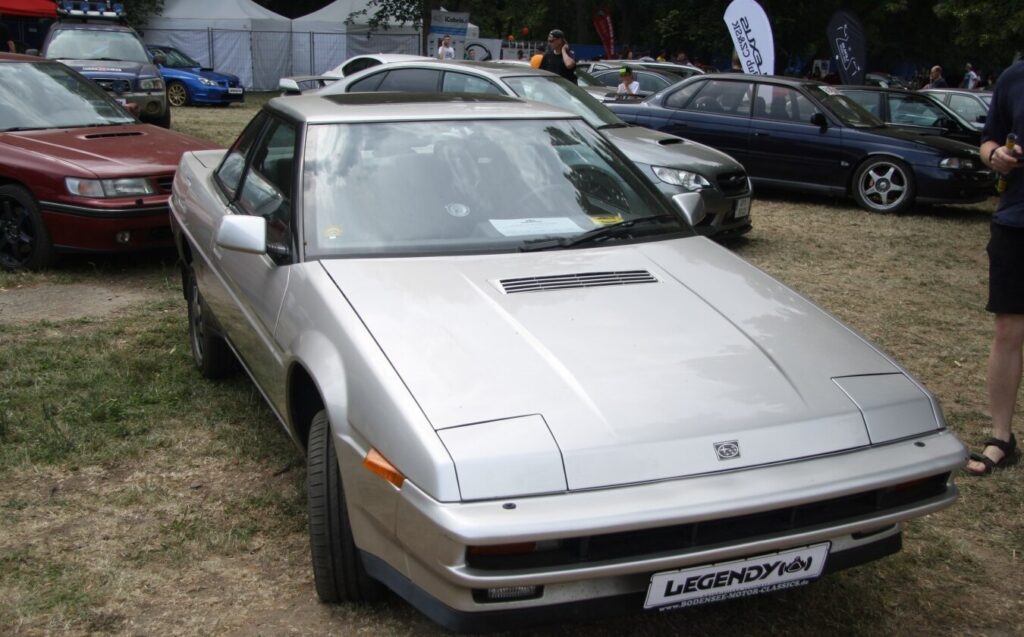
The Subaru XT Coupe, produced between 1985 and 1991, represented a bold step forward for the Japanese automaker. This distinctive coupe, internally designated as the first generation, aimed to broaden Subaru’s appeal beyond its traditional all-wheel-drive wagon and sedan offerings. The 1.8 Turbo variant, equipped with a turbocharged boxer engine and all-wheel drive, was a key model in the XT lineup, offering a blend of performance and practicality. It was built on Subaru’s new platform, designed to offer a more modern driving experience and styling compared to previous models. The XT Coupe was primarily marketed in Japan and North America, offering a unique alternative to established sports coupes.
Technical Specifications
| Brand | Subaru |
| Model | XT |
| Generation | XT Coupe |
| Type (Engine) | 1.8 Turbo (136 Hp) 4WD |
| Start of production | 1985 |
| End of production | 1991 |
| Powertrain Architecture | Internal Combustion engine |
| Body type | Coupe |
| Seats | 5 |
| Doors | 2 |
| Fuel consumption (urban) | 10.3 l/100 km (22.8 US mpg) |
| Fuel consumption (extra urban) | 6.6 l/100 km (35.6 US mpg) |
| Fuel Type | Petrol (Gasoline) |
| Acceleration 0 – 100 km/h | 9 sec |
| Acceleration 0 – 62 mph | 9 sec |
| Acceleration 0 – 60 mph | 8.6 sec |
| Maximum speed | 200 km/h (124.27 mph) |
| Weight-to-power ratio | 8.6 kg/Hp |
| Weight-to-torque ratio | 5.9 kg/Nm |
| Power | 136 Hp @ 5600 rpm |
| Power per litre | 76.3 Hp/l |
| Torque | 196 Nm @ 2800 rpm (144.56 lb.-ft. @ 2800 rpm) |
| Engine layout | Front, Longitudinal |
| Engine Model/Code | EA 82T |
| Engine displacement | 1782 cm3 (108.74 cu. in.) |
| Number of cylinders | 4 |
| Engine configuration | Boxer |
| Cylinder Bore | 92 mm (3.62 in.) |
| Piston Stroke | 67 mm (2.64 in.) |
| Compression ratio | 7.7:1 |
| Number of valves per cylinder | 2 |
| Fuel injection system | Multi-port manifold injection |
| Engine aspiration | Turbocharger |
| Valvetrain | SOHC |
| Engine oil capacity | 4 l (4.23 US qt | 3.52 UK qt) |
| Kerb Weight | 1165 kg (2568.39 lbs.) |
| Max. weight | 1620 kg (3571.49 lbs.) |
| Max load | 455 kg (1003.1 lbs.) |
| Trunk (boot) space – minimum | 315 l (11.12 cu. ft.) |
| Fuel tank capacity | 60 l (15.85 US gal | 13.2 UK gal) |
| Max. roof load | 80 kg (176.37 lbs.) |
| Permitted trailer load with brakes (8%) | 1500 kg (3306.93 lbs.) |
| Permitted trailer load with brakes (12%) | 1200 kg (2645.55 lbs.) |
| Permitted trailer load without brakes | 500 kg (1102.31 lbs.) |
| Permitted towbar download | 70 kg (154.32 lbs.) |
| Length | 4450 mm (175.2 in.) |
| Width | 1690 mm (66.54 in.) |
| Height | 1335 mm (52.56 in.) |
| Wheelbase | 2465 mm (97.05 in.) |
| Front track | 1435 mm (56.5 in.) |
| Rear (Back) track | 1425 mm (56.1 in.) |
| Ride height (ground clearance) | 170-200 mm (6.69 – 7.87 in.) |
| Minimum turning circle (turning diameter) | 9.8 m (32.15 ft.) |
| Drivetrain Architecture | All wheel drive (4×4) |
| Number of gears and type of gearbox | 5 gears, manual transmission |
| Front suspension | Independent type McPherson, Transverse stabilizer, Air suspension |
| Rear suspension | Air suspension, Transverse stabilizer, Trailing arm |
| Front brakes | Ventilated discs |
| Rear brakes | Disc |
| Assisting systems | ABS (Anti-lock braking system) |
| Steering type | Steering rack and pinion |
| Power steering | Hydraulic Steering |
| Tires size | 185/70 R13 |
| Wheel rims size | 5J x 13 |
Powertrain & Engine Architecture
The heart of the XT Coupe 1.8 Turbo was the EA82T engine, a 1.8-liter (1782cc) horizontally-opposed, four-cylinder “boxer” engine. This engine was a significant departure for Subaru, as it incorporated a turbocharger and multi-port fuel injection to boost power output to 136 horsepower and 196 Nm (144.56 lb-ft) of torque. The turbocharger, a Garrett unit, provided a noticeable increase in performance compared to naturally aspirated versions of the EA82. The engine featured a single overhead camshaft (SOHC) valvetrain, operating two valves per cylinder. The EA82 engine family was known for its relatively simple design and durability, but the addition of a turbocharger required careful attention to cooling and maintenance. The 5-speed manual transmission was standard, delivering power to all four wheels via Subaru’s symmetrical all-wheel-drive system. This system utilized a viscous coupling to transfer torque to the rear wheels when front wheel slip was detected.
Driving Characteristics
The 1.8 Turbo 4WD XT Coupe offered a surprisingly capable driving experience for its time. The turbocharger provided a noticeable boost in acceleration, making it feel quicker than its displacement might suggest. While not a true sports car, the XT Coupe offered a good balance of performance and comfort. The all-wheel-drive system provided excellent traction, particularly in inclement weather. The 5-speed manual transmission allowed for precise control over the engine’s power band. However, turbo lag was present, requiring drivers to anticipate acceleration. Compared to the base model XT, the turbo version offered a significantly more engaging driving experience. The manual transmission was the only option for this engine, offering a more direct connection to the engine than an automatic would have.
Equipment & Trim Levels
The XT Coupe 1.8 Turbo was generally positioned as the mid-range offering in the XT lineup. Standard features included power steering, air conditioning, and a decent sound system. The interior featured cloth upholstery and a relatively minimalist dashboard design. Optional extras included a sunroof, upgraded sound system, and alloy wheels. The XT Coupe aimed for a sporty yet comfortable interior, with supportive seats and a driver-focused layout. The digital instrument cluster was a distinctive feature, setting it apart from more conventional cars of the era.
Chassis & Braking
The XT Coupe featured an independent McPherson strut suspension in the front and an air suspension system with trailing arms in the rear. The air suspension was a notable feature, providing a comfortable ride and the ability to adjust ride height. The braking system consisted of ventilated discs in the front and solid discs in the rear. Anti-lock brakes (ABS) were available as an option, enhancing safety. The chassis was designed to be relatively lightweight, contributing to the car’s nimble handling. The suspension tuning was geared towards providing a balance of comfort and handling, making it suitable for both daily driving and spirited backroad excursions.
Market Reception & Comparison
The Subaru XT Coupe 1.8 Turbo was generally well-received by automotive critics, who praised its unique styling, all-wheel-drive system, and turbocharged engine. However, some critics noted the presence of turbo lag and the somewhat unconventional interior design. Compared to other coupes of the era, such as the Toyota Celica or Mazda RX-7, the XT Coupe offered a unique combination of features and performance. Its all-wheel-drive system gave it an advantage in slippery conditions, while its turbocharged engine provided competitive acceleration. Fuel economy was reasonable for a turbocharged vehicle of its time, averaging around 23 mpg in combined driving.
Legacy
The Subaru XT Coupe, particularly the 1.8 Turbo 4WD variant, has gained a cult following among Subaru enthusiasts. The EA82T engine, while not without its quirks, proved to be relatively durable with proper maintenance. Today, well-maintained XT Coupes are becoming increasingly collectible. The car’s unique styling and innovative features continue to appeal to those seeking a distinctive and capable classic coupe. Parts availability can be a challenge, but a dedicated community of owners and suppliers helps to keep these cars on the road. The XT Coupe represents a pivotal moment in Subaru’s history, demonstrating the company’s willingness to experiment with new designs and technologies.
