
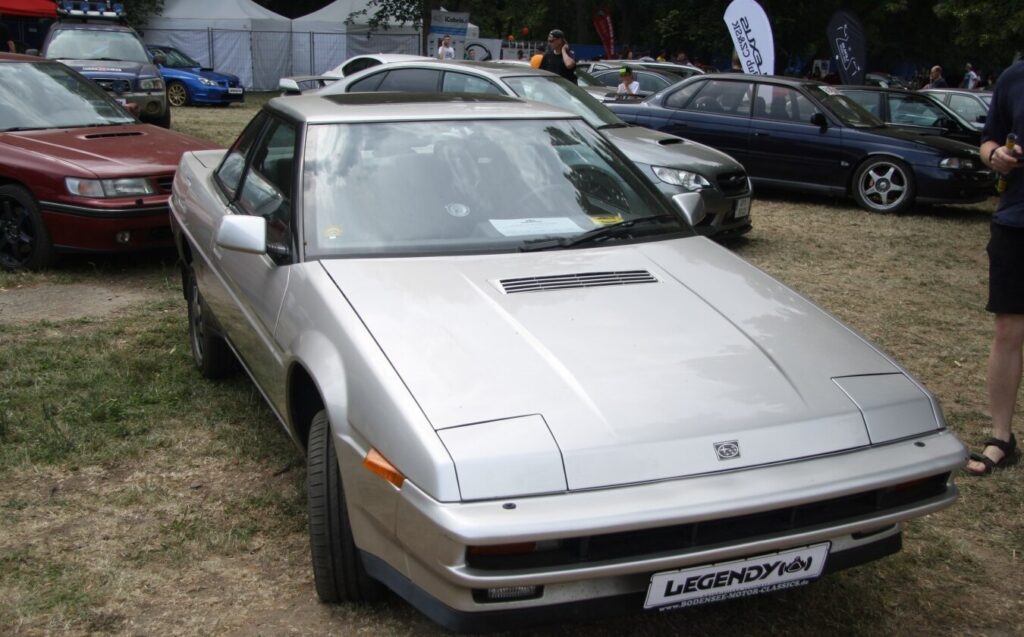
The Subaru XT Coupe, produced between 1987 and 1991, represented a bold design departure for the Japanese automaker. Positioned as a sporty, technologically advanced coupe, the XT aimed to attract a younger demographic and challenge established players in the personal luxury car segment. The 2.7-liter, 145 horsepower, four-wheel drive variant was a key offering within the XT lineup, representing a balance between performance and all-weather capability. It was built on Subaru’s new platform, showcasing their commitment to innovative engineering and distinctive styling. The XT Coupe was primarily marketed in North America and Japan, where its unique aesthetic and standard all-wheel drive proved appealing.
Technical Specifications
| Brand | Subaru |
| Model | XT |
| Generation | XT Coupe |
| Type (Engine) | 2.7 (145 Hp) 4WD |
| Start of production | 1987 |
| End of production | 1991 |
| Powertrain Architecture | Internal Combustion engine |
| Body type | Coupe |
| Seats | 5 |
| Doors | 2 |
| Fuel consumption (urban) | 13.1 l/100 km (18 US mpg, 21.6 UK mpg) |
| Fuel consumption (extra urban) | 9.4 l/100 km (25 US mpg, 30.1 UK mpg) |
| Fuel Type | Petrol (Gasoline) |
| Maximum speed | 210 km/h (130.49 mph) |
| Weight-to-power ratio | 9 kg/Hp, 110.8 Hp/tonne |
| Weight-to-torque ratio | 6.2 kg/Nm, 161.2 Nm/tonne |
| Power | 145 Hp @ 5200 rpm |
| Power per litre | 54.3 Hp/l |
| Torque | 211 Nm @ 4000 rpm (155.63 lb.-ft. @ 4000 rpm) |
| Engine layout | Front, Longitudinal |
| Engine Model/Code | ER27 |
| Engine displacement | 2672 cm3 (163.06 cu. in.) |
| Number of cylinders | 6 |
| Engine configuration | Boxer |
| Cylinder Bore | 92 mm (3.62 in.) |
| Piston Stroke | 67 mm (2.64 in.) |
| Compression ratio | 9.5:1 |
| Number of valves per cylinder | 2 |
| Fuel injection system | Multi-port manifold injection |
| Engine aspiration | Naturally aspirated engine |
| Valvetrain | SOHC |
| Kerb Weight | 1309 kg (2885.85 lbs.) |
| Trunk (boot) space (minimum) | 315 l (11.12 cu. ft.) |
| Fuel tank capacity | 60 l (15.85 US gal | 13.2 UK gal) |
| Length | 4450 mm (175.2 in.) |
| Width | 1690 mm (66.54 in.) |
| Height | 1335 mm (52.56 in.) |
| Wheelbase | 2465 mm (97.05 in.) |
| Front track | 1435 mm (56.5 in.) |
| Rear (Back) track | 1425 mm (56.1 in.) |
| Ride height (ground clearance) | 170-200 mm (6.69 – 7.87 in.) |
| Minimum turning circle | 9.8 m (32.15 ft.) |
| Drivetrain Architecture | All wheel drive (4×4) |
| Number of gears and type of gearbox | 5 gears, manual transmission |
| Front suspension | Independent type McPherson, Transverse stabilizer, Air suspension |
| Rear suspension | Air suspension, Transverse stabilizer, Trailing arm |
| Front brakes | Ventilated discs |
| Rear brakes | Disc |
| Assisting systems | ABS (Anti-lock braking system) |
| Steering type | Steering rack and pinion |
| Power steering | Electric Steering |
| Tires size | 195/60 R14 |
| Wheel rims size | 5.5J x 14 |
Powertrain & Engine Architecture
The heart of the XT Coupe 2.7 was the ER27 engine, a 2.7-liter, naturally aspirated, horizontally-opposed (boxer) six-cylinder. This engine configuration was a Subaru hallmark, known for its inherent balance and smooth operation. The ER27 featured a single overhead camshaft (SOHC) valvetrain operating two valves per cylinder. Fuel delivery was handled by a multi-port fuel injection system, contributing to improved efficiency and responsiveness compared to earlier carbureted designs. The engine produced 145 horsepower at 5200 rpm and 211 Nm (155.63 lb.-ft.) of torque at 4000 rpm. This power was delivered to all four wheels through a standard five-speed manual transmission. The all-wheel drive system employed a viscous coupling to distribute power between the front and rear axles, providing enhanced traction in various conditions.
Driving Characteristics
The 2.7-liter engine, paired with the five-speed manual transmission, offered a reasonably engaging driving experience. While not a high-performance machine, the XT Coupe provided adequate acceleration for everyday driving. The all-wheel drive system instilled confidence, particularly on slippery surfaces. Compared to the later, more powerful turbocharged XT models, the 2.7-liter version felt less urgent in its acceleration. The gear ratios were tuned for a balance of fuel economy and usability, rather than outright speed. The boxer engine’s low center of gravity contributed to stable handling, and the air suspension (available on some trims) further enhanced ride comfort.
Equipment & Trim Levels
The XT Coupe 2.7 typically came equipped with features considered fairly generous for its time. Standard amenities included power windows, power locks, and a basic audio system. Higher trim levels offered options such as leather upholstery, a sunroof, and upgraded sound systems. The interior design was distinctive, featuring a wrap-around dashboard and a driver-focused cockpit. The XT Coupe aimed for a sporty and modern aesthetic, differentiating itself from more conservative competitors. The base model offered a more utilitarian interior, while the higher trims featured more luxurious appointments.
Chassis & Braking
The XT Coupe utilized an independent McPherson strut suspension in the front, coupled with an air suspension and trailing arm setup in the rear. The air suspension, when equipped, allowed for adjustable ride height and improved ride quality. Braking duties were handled by ventilated discs in the front and solid discs in the rear. An anti-lock braking system (ABS) was available, enhancing safety by preventing wheel lockup during hard braking. The chassis was designed to provide a balance of rigidity and comfort, contributing to the car’s overall handling characteristics.
Market Reception & Comparison
The Subaru XT Coupe was generally well-received by automotive critics for its unique styling and standard all-wheel drive. However, some reviewers noted that the 2.7-liter engine lacked the punch of its turbocharged counterparts. Fuel economy was also a point of concern, with the 2.7-liter engine returning around 18 mpg in city driving and 25 mpg on the highway. Compared to other coupes of the era, such as the Toyota Celica or Mazda MX-6, the XT Coupe offered a distinct alternative with its all-wheel drive system and unconventional design. The 2.7-liter model was often seen as the entry-level XT, appealing to buyers who prioritized practicality and all-weather capability over outright performance.
Legacy
The Subaru XT Coupe, while not a massive sales success, left a lasting impression on the automotive landscape. Its bold styling and innovative features paved the way for future Subaru models. The ER27 engine, while not known for exceptional longevity, proved to be reasonably reliable with proper maintenance. Today, the XT Coupe has gained a following among enthusiasts who appreciate its unique design and technological advancements. Well-maintained examples are becoming increasingly collectible, representing a piece of Subaru’s history and a testament to its willingness to challenge conventional automotive norms. The 2.7-liter version, while less sought after than the turbocharged models, remains a viable option for those seeking a unique and affordable classic coupe.
