
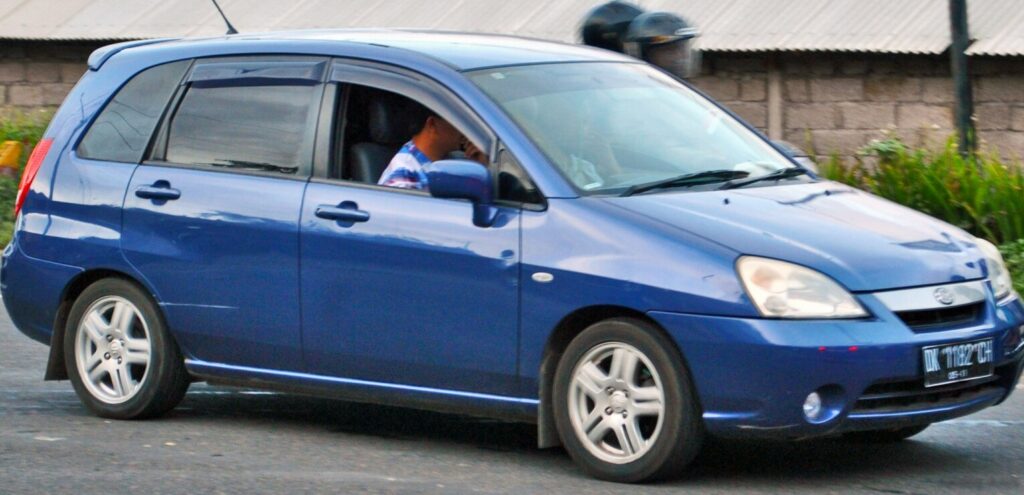
The Suzuki Aerio, produced between 2001 and 2007, was a compact wagon aimed at providing practical transportation with a focus on fuel efficiency and affordability. Positioned as a versatile option within Suzuki’s lineup, the Aerio (known as the Livina in some markets) offered a larger interior and cargo space than many of its subcompact competitors. The 1.5 i 16V variant, equipped with a 1.5-liter engine producing 110 horsepower, represented a mid-range offering, balancing performance with economy. It was a key model for Suzuki in North America and Europe, appealing to buyers seeking a small, economical vehicle with the utility of a wagon body style. This particular configuration was generally available with either a 5-speed manual or a 4-speed automatic transmission, with the automatic being a popular choice for ease of use.
Technical Specifications
| Brand | Suzuki |
| Model | Aerio |
| Generation | Aerio |
| Type (Engine) | 1.5 i 16V (110 Hp) |
| Start of production | 2001 year |
| End of production | 2007 year |
| Powertrain Architecture | Internal Combustion engine |
| Body type | Station wagon (estate) |
| Seats | 5 |
| Doors | 5 |
| Fuel Type | Petrol (Gasoline) |
| Weight-to-power ratio | 10.4 kg/Hp, 96.5 Hp/tonne |
| Weight-to-torque ratio | 8 kg/Nm, 125.4 Nm/tonne |
| Power | 110 Hp @ 6000 rpm |
| Power per litre | 73.8 Hp/l |
| Torque | 143 Nm @ 6000 rpm, 105.47 lb.-ft. @ 6000 rpm |
| Engine layout | Front, Transverse |
| Engine Model/Code | M15A |
| Engine displacement | 1490 cm3, 90.93 cu. in. |
| Number of cylinders | 4 |
| Engine configuration | Inline |
| Cylinder Bore | 78 mm, 3.07 in. |
| Piston Stroke | 78 mm, 3.07 in. |
| Compression ratio | 9.5:1 |
| Number of valves per cylinder | 4 |
| Fuel injection system | Multi-port manifold injection |
| Engine aspiration | Naturally aspirated engine |
| Engine oil capacity | 4.1 l, 4.33 US qt | 3.61 UK qt |
| Coolant | 6.5 l, 6.87 US qt | 5.72 UK qt |
| Kerb Weight | 1140 kg, 2513.27 lbs |
| Trunk (boot) space – minimum | 296 l, 10.45 cu. ft |
| Trunk (boot) space – maximum | 1062 l, 37.5 cu. ft |
| Fuel tank capacity | 50 l, 13.21 US gal | 11 UK gal |
| Length | 4230 mm, 166.54 in |
| Width | 1690 mm, 66.54 in |
| Height | 1550 mm, 61.02 in |
| Wheelbase | 2480 mm, 97.64 in |
| Front track | 1450 mm, 57.09 in |
| Rear (Back) track | 1445 mm, 56.89 in |
| Drivetrain Architecture | The Internal combustion engine (ICE) drives the front wheels of the vehicle. |
| Drive wheel | Front wheel drive |
| Number of gears and type of gearbox | 5 gears, manual transmission |
| Front suspension | Coil spring |
| Rear suspension | Torsion |
| Front brakes | Ventilated discs |
| Rear brakes | Drum |
| Assisting systems | ABS (Anti-lock braking system) |
| Power steering | Hydraulic Steering |
| Tires size | 195/55 R15 |
| Wheel rims size | 15 |
Powertrain & Engine Architecture
The heart of the Aerio 1.5 i 16V is the M15A engine, a 1.5-liter inline-four cylinder gasoline engine. This engine utilizes a single overhead camshaft (SOHC) design with four valves per cylinder, contributing to its relatively efficient operation. Fuel delivery is managed by a multi-point fuel injection system, providing precise fuel metering for optimal combustion. The engine’s 9.5:1 compression ratio strikes a balance between power output and fuel economy. The 4-speed automatic transmission, often paired with this engine, was a conventional hydraulic automatic, known for its reliability but not particularly for its fuel efficiency or responsiveness compared to more modern transmissions. The transmission’s gear ratios were tuned for everyday driving, prioritizing smooth shifts and comfortable cruising over sporty acceleration.
Driving Characteristics
The 110 horsepower and 143 Nm (105 lb-ft) of torque produced by the M15A engine in the Aerio provided adequate, though not exhilarating, performance. Acceleration was best described as leisurely, with a 0-60 mph time estimated around 11-12 seconds. The automatic transmission, while convenient, did detract from the engine’s available power, resulting in noticeable hesitation during overtaking maneuvers. Compared to the manual transmission version, the automatic felt noticeably slower. The Aerio’s suspension, consisting of coil springs in the front and a torsion beam in the rear, provided a comfortable ride, absorbing bumps and imperfections in the road reasonably well. Handling was predictable but not particularly engaging, leaning towards comfort rather than sporty dynamics.
Equipment & Trim Levels
The Aerio 1.5 i 16V typically came standard with features such as air conditioning, power windows and locks, and an AM/FM radio. Higher trim levels offered options like alloy wheels, a CD player, and upgraded interior upholstery. Safety features included dual front airbags and ABS brakes. The interior was functional and reasonably well-appointed for its price point, with durable materials and a straightforward layout. The wagon body style provided ample cargo space, making it a practical choice for families or individuals needing to transport larger items.
Chassis & Braking
The Aerio’s chassis was a typical unibody construction, providing a good balance of rigidity and weight. The front suspension utilized coil springs and MacPherson struts, while the rear employed a torsion beam setup. This configuration prioritized ride comfort and simplicity. Braking duties were handled by ventilated discs in the front and drum brakes in the rear. While adequate for normal driving conditions, the rear drum brakes were a cost-saving measure and didn’t offer the same stopping power as disc brakes. The Aerio’s hydraulic power steering provided light and easy steering effort, making it easy to maneuver in tight spaces.
Market Reception & Comparison
The Suzuki Aerio 1.5 i 16V was generally well-received by critics as a practical and affordable compact wagon. It was praised for its spacious interior, fuel efficiency, and comfortable ride. However, it was often criticized for its lack of power and somewhat unrefined driving experience. Compared to other vehicles in its class, such as the Toyota Matrix or Honda Civic Wagon, the Aerio offered a more affordable price point but lacked the same level of refinement and performance. Fuel economy was a strong point, typically achieving around 28-32 mpg in combined driving conditions.
Legacy
The Suzuki Aerio, particularly the 1.5 i 16V variant, has proven to be a relatively reliable vehicle in the used car market. The M15A engine is known for its durability, and the automatic transmission, while not the most advanced, is generally dependable. Common issues include minor oil leaks and occasional sensor failures, but these are typically inexpensive to repair. Today, the Aerio represents a budget-friendly option for those seeking a practical and economical wagon. Its simple mechanical design makes it relatively easy to maintain, and parts availability remains reasonable. While it may not offer the latest technology or performance, the Aerio continues to provide reliable transportation for many years after its production ended.
