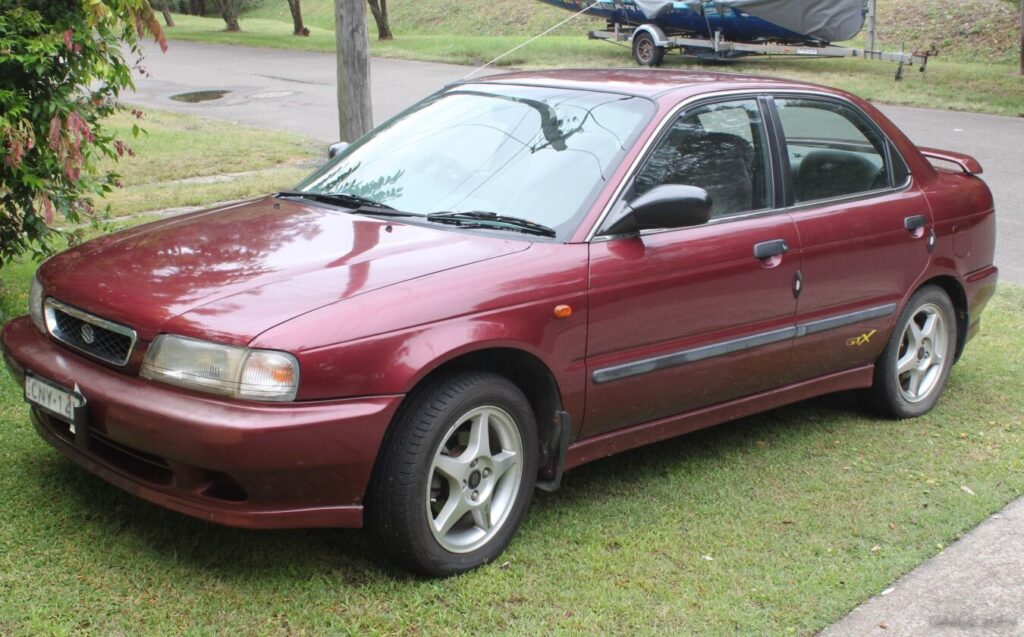
The Suzuki Baleno Combi (EG), produced between 1998 and 2002, represented Suzuki’s entry into the compact estate car market. This variant, specifically the 1.3 i 16V model producing 85 horsepower, was positioned as the more economical and practical option within the Baleno range, which also included hatchback and sedan body styles. The EG series Baleno Combi was built upon the ‘B’ platform, shared with other small Suzuki and General Motors vehicles, and aimed to provide affordable family transportation with a focus on fuel efficiency and cargo space.
The 1.3 i 16V engine, designated G13BB, is a naturally aspirated, inline-four cylinder gasoline engine with a displacement of 1298 cc (79.21 cubic inches). It features multi-port fuel injection and a single overhead camshaft (SOHC) valvetrain operating 16 valves – four per cylinder. This configuration allowed for a reasonable balance between power and fuel economy. The engine produces 85 hp at 6000 rpm and 103 Nm (75.97 lb-ft) of torque at 3000 rpm. The engine’s relatively small displacement and 9.5:1 compression ratio contributed to its fuel efficiency, but also limited its overall performance. While a five-speed manual transmission was standard, an optional four-speed automatic transmission was available, though less common. The automatic transmission was designed for smooth, comfortable operation rather than sporty performance, with gear ratios optimized for fuel economy and ease of driving.
In real-world driving conditions, the 1.3L Baleno Combi with the manual transmission offered adequate performance for everyday use. Acceleration was modest, and overtaking required careful planning. The automatic transmission further reduced acceleration capability, making it best suited for urban driving and relaxed highway cruising. Compared to other Baleno variants, such as those equipped with larger engines, this 1.3L model prioritized fuel economy over outright speed. The power delivery was linear, but the engine needed to be revved to access its peak power output. The weight-to-power ratio of 11.7 kg/hp meant it wasn’t a particularly quick vehicle, but it was manageable for most drivers.
The Baleno Combi 1.3 i 16V typically came with a fairly basic level of equipment, reflecting its position as an entry-level model. Standard features generally included power steering, central locking, and basic instrumentation. Interior upholstery was typically cloth, and the dashboard featured a functional, if somewhat plain, design. Optional extras included air conditioning, power windows, and an upgraded audio system. The Combi’s defining feature was its spacious interior and large cargo area, offering 375 liters (13.24 cubic feet) of space with the rear seats up, expanding to 1377 liters (48.63 cubic feet) with the seats folded down. This made it a practical choice for families or those needing to transport larger items.
The Baleno Combi utilized an independent McPherson strut suspension system at the front, coupled with an independent multi-link suspension at the rear, both incorporating coil springs and an anti-roll bar. This setup provided a reasonable level of ride comfort and handling. Braking was handled by disc brakes at the front and drum brakes at the rear. An Anti-lock Braking System (ABS) was available as an option, enhancing safety. The steering employed a hydraulic power steering rack and pinion system, providing light and responsive steering feel. The vehicle rode on 175/70 R13 tires mounted on 13-inch wheels.
Contemporary reviews of the Baleno Combi 1.3 i 16V generally praised its fuel efficiency, spaciousness, and practicality. However, critics often noted its lack of outright performance and somewhat basic interior. Compared to other compact estates of the time, the Baleno Combi offered a competitive price point and a good level of standard equipment for the money. Fuel economy figures were quoted at 8.3 l/100 km (28.3 US mpg) in urban conditions and 5.6 l/100 km (42 US mpg) on the open road. Reliability was generally considered good, although routine maintenance was essential to ensure longevity.
| Engine Model/Code | G13BB |
| Engine Displacement | 1298 cm3 (79.21 cu. in.) |
| Number of Cylinders | 4, Inline |
| Power | 85 Hp @ 6000 rpm |
| Torque | 103 Nm @ 3000 rpm (75.97 lb.-ft. @ 3000 rpm) |
| Fuel Type | Petrol (Gasoline) |
| Fuel Injection | Multi-port manifold injection |
| Valvetrain | SOHC |
| Compression Ratio | 9.5:1 |
| Engine Oil Capacity | 3.3 l (3.49 US qt | 2.9 UK qt) |
| Coolant Capacity | 3.6 l (3.8 US qt | 3.17 UK qt) |
| Kerb Weight | 995 kg (2193.6 lbs.) |
| Max. Weight | 1520 kg (3351.03 lbs.) |
| Trunk Space (min/max) | 375 l / 1377 l (13.24 cu. ft. / 48.63 cu. ft.) |
| Fuel Tank Capacity | 51 l (13.47 US gal | 11.22 UK gal) |
| Length | 4375 mm (172.24 in.) |
| Width | 1690 mm (66.54 in.) |
| Height | 1460 mm (57.48 in.) |
| Wheelbase | 2480 mm (97.64 in.) |
| Transmission | 5 gears, manual transmission |
Today, the Suzuki Baleno Combi 1.3 i 16V is a relatively rare sight on the roads. While not known for exceptional performance or luxury, its simplicity and practicality have made it a sought-after vehicle among those looking for an affordable and reliable estate car. The G13BB engine is generally considered durable, but regular maintenance is crucial to prevent issues. Parts availability can be a challenge in some regions, but the Baleno Combi remains a viable option for those seeking a classic, economical, and spacious vehicle.