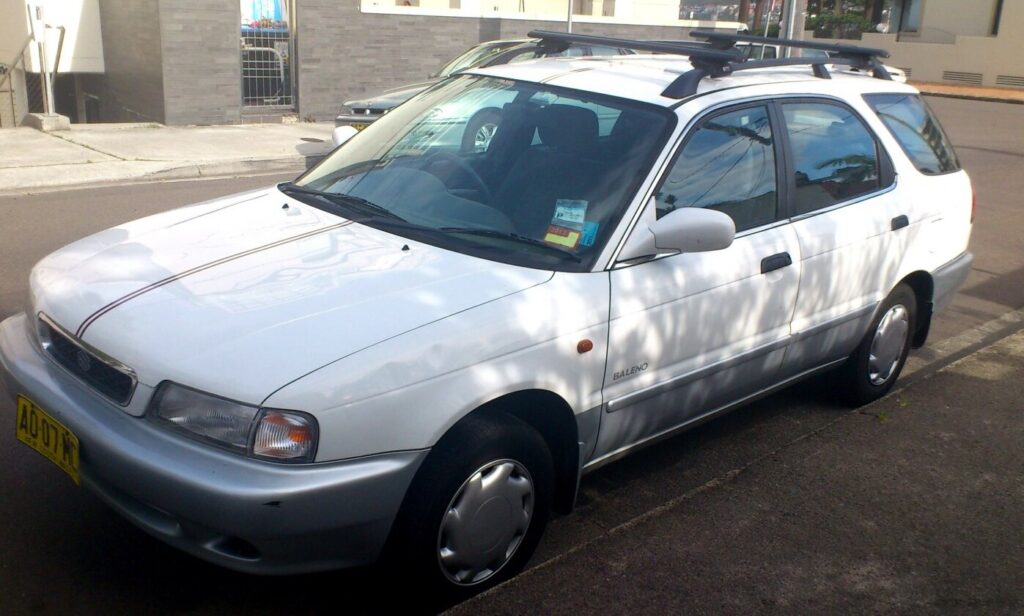
The Suzuki Baleno Combi (EG series), produced between 1996 and 2002, represented Suzuki’s entry into the European compact estate car market. This variant, specifically the 1.6 i 16V model producing 98 horsepower, occupied a mid-range position within the Baleno lineup, offering a balance between affordability, practicality, and reasonable performance. The Baleno Combi was based on the 1HX0/A3 platform, shared with other models like the Opel/Vauxhall Astra and Isuzu Gemini, reflecting a collaborative effort in vehicle development during the 1990s.
The heart of the 1.6 i 16V Baleno Combi was the G16B engine, a 1.6-liter inline-four cylinder gasoline engine. This engine featured a multi-port fuel injection system, providing precise fuel delivery for improved efficiency and responsiveness. The 16-valve configuration, with dual overhead camshafts (DOHC), enhanced the engine’s breathing capabilities, contributing to its 98 hp output at 6000 rpm and 127 Nm (93.67 lb-ft) of torque at 3200 rpm. The engine’s design prioritized reliability and ease of maintenance, typical of Suzuki’s engineering philosophy. The G16B engine had a compression ratio of 9.5:1, and required 3.3 liters of engine oil and 4.2 liters of coolant.
In driving terms, the 1.6 i 16V Baleno Combi offered adequate performance for everyday use. Acceleration from 0 to 100 km/h (0-62 mph) took approximately 12 seconds, with a top speed of 175 km/h (108.74 mph). While not a particularly sporty vehicle, the engine provided sufficient power for comfortable cruising and overtaking on highways. Compared to the base 1.3-liter engine option, the 1.6-liter offered a noticeable improvement in responsiveness, particularly when fully loaded or traveling uphill. It wasn’t as quick as larger-engined competitors, but it provided a more refined driving experience than the smaller displacement models. The five-speed manual transmission allowed drivers to effectively utilize the engine’s powerband.
The Baleno Combi 1.6 i 16V typically came equipped with a reasonable level of standard features for its time. Interior appointments included cloth upholstery, a basic audio system, and power steering. Depending on the market and optional packages, features like air conditioning, electric windows, and central locking were available. The dashboard layout was functional and straightforward, prioritizing usability over stylistic flair. The estate body style provided a generous 375 liters of trunk space (minimum), expanding to 1377 liters with the rear seats folded down, making it a practical choice for families or those needing to transport larger items.
The chassis of the Baleno Combi featured a front independent suspension with wishbone configuration, and a rear independent suspension, also utilizing a wishbone setup. This suspension design aimed to provide a comfortable ride while maintaining reasonable handling characteristics. Braking duties were handled by ventilated discs on the front wheels and drum brakes on the rear. Anti-lock Braking System (ABS) was included as a standard safety feature. The steering system employed a hydraulic power steering rack and pinion, offering a balance between assistance and road feel. The vehicle rode on 175/70 R13 tires mounted on 13-inch wheels.
Contemporary reviews of the Baleno Combi 1.6 i 16V generally praised its practicality, spacious interior, and competitive pricing. Critics noted that the engine, while adequate, wasn’t particularly exciting, and the overall driving experience was more focused on comfort than performance. Fuel economy was considered reasonable, with combined cycle consumption around 8.9 l/100 km (26.4 US mpg). Compared to other trims, the 1.6-liter offered a better balance of performance and fuel efficiency than the smaller 1.3-liter, while remaining more affordable than potential higher-performance variants that were not offered in the Combi body style. Reliability was generally considered good, consistent with Suzuki’s reputation.
| Engine Model/Code | G16B |
| Engine Displacement | 1590 cm3 (97.03 cu. in.) |
| Number of Cylinders | 4, Inline |
| Cylinder Bore | 75 mm (2.95 in.) |
| Piston Stroke | 90 mm (3.54 in.) |
| Compression Ratio | 9.5:1 |
| Power | 98 Hp @ 6000 rpm |
| Torque | 127 Nm @ 3200 rpm (93.67 lb.-ft. @ 3200 rpm) |
| Fuel Injection System | Multi-port manifold injection |
| Fuel Consumption (Urban) | 8.9 l/100 km (26.4 US mpg) |
| Fuel Consumption (Extra Urban) | 6 l/100 km (39.2 US mpg) |
| Acceleration 0-100 km/h | 12 sec |
| Maximum Speed | 175 km/h (108.74 mph) |
| Kerb Weight | 1090 kg (2403.04 lbs.) |
| Max. Weight | 1560 kg (3439.21 lbs.) |
| Trunk Space (Min/Max) | 375 l / 1377 l (13.24 cu. ft. / 48.63 cu. ft.) |
| Fuel Tank Capacity | 51 l (13.47 US gal) |
| Length | 4345 mm (171.06 in.) |
| Width | 1690 mm (66.54 in.) |
| Height | 1460 mm (57.48 in.) |
Today, the Suzuki Baleno Combi 1.6 i 16V is a relatively uncommon sight on the roads. The G16B engine is known for its durability and relatively straightforward maintenance, making well-maintained examples a viable option for budget-conscious buyers seeking a practical and reliable estate car. Parts availability can be a challenge in some regions, but the engine’s simplicity often allows for easier repairs. While not a collector’s item, the Baleno Combi 1.6 i 16V represents a solid and dependable vehicle from a bygone era of automotive engineering.