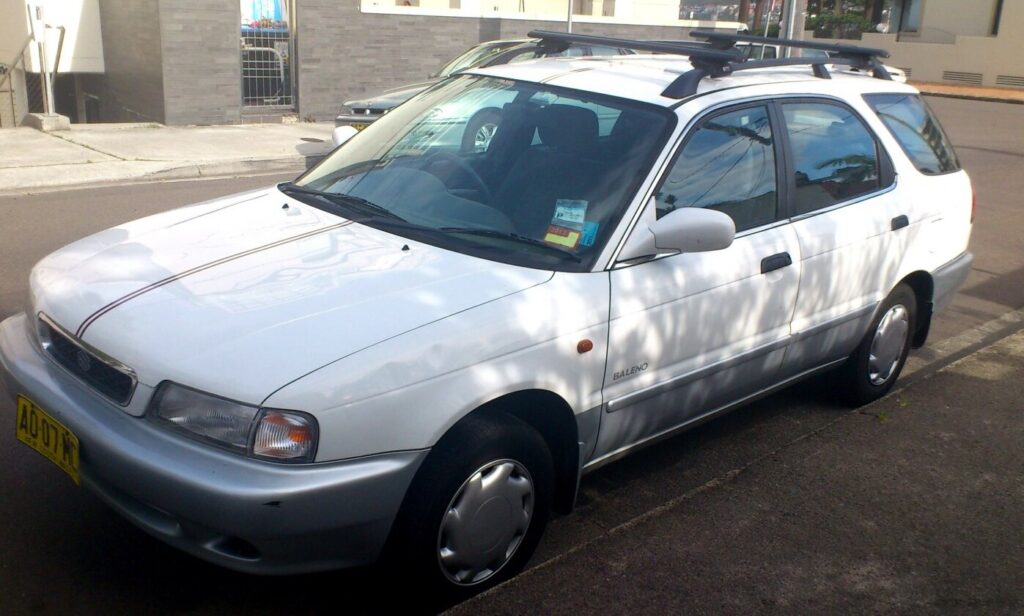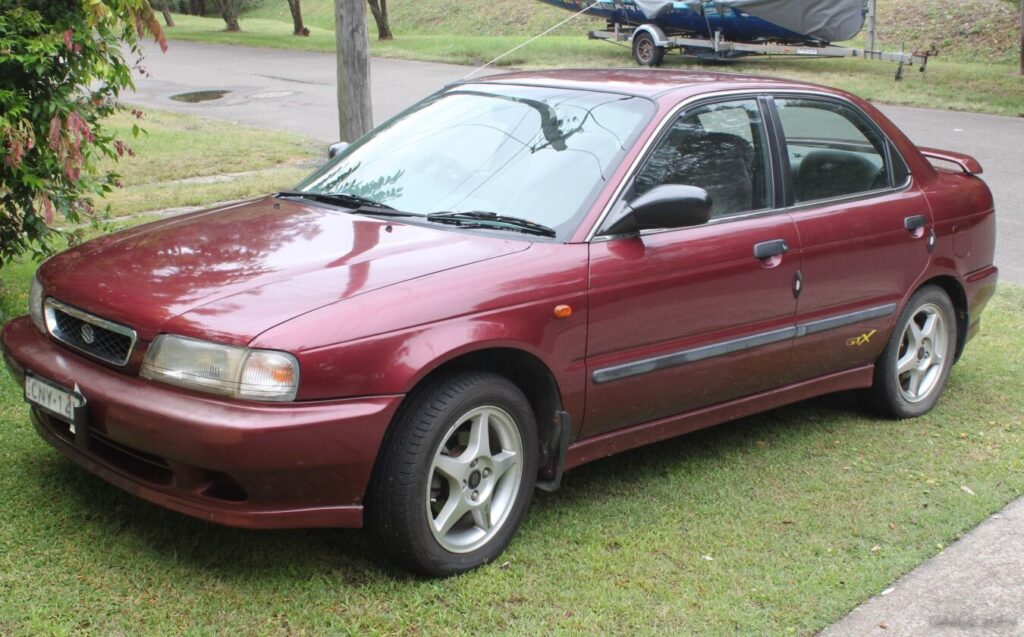
The Suzuki Baleno (EG series), launched in 1995, represented a significant step forward for Suzuki in the compact sedan market. This generation Baleno, built until 2002, was a collaborative effort with General Motors, sharing platforms and components with several Opel/Vauxhall and Holden models. The 1.3 i 16V (85 hp) Automatic variant occupied the entry-level position within the Baleno lineup, offering a balance of affordability, fuel efficiency, and ease of use. It was aimed at buyers prioritizing practicality and comfortable commuting over outright performance. This model was a key part of Suzuki’s strategy to establish a stronger presence in the global automotive market.
The 1.3L 16V Automatic Baleno: Positioning and Overview
The 1.3L 16V Automatic Baleno was designed to be the most accessible version of the EG Baleno. It served as the gateway to the model range, appealing to a broad customer base, particularly first-time car buyers, families needing a reliable second vehicle, and individuals seeking a fuel-efficient daily driver. Compared to the higher-spec 1.6L variants, the 1.3L offered a more economical purchase price and lower running costs, albeit with reduced power and acceleration. It differed significantly from potential competitors offering manual transmissions, providing a more relaxed driving experience, especially in urban environments.
Powertrain & Engine Architecture
At the heart of the 1.3L Baleno Automatic lies the G13BB engine, a 1298cc (79.21 cubic inches) inline-four cylinder gasoline engine. This engine featured a 16-valve dual overhead camshaft (DOHC) valvetrain, contributing to its relatively efficient operation. The G13BB utilized multi-port fuel injection, a common technology in the mid-1990s, for precise fuel delivery. The compression ratio was set at 9.5:1. The engine produced 85 horsepower at 6000 rpm and 103 Nm (75.97 lb-ft) of torque at 3000 rpm. Power per liter was a respectable 65.5 hp/l for the time.
The engine was mated to a 3-speed automatic transmission. While not known for its sophistication, this transmission provided smooth and convenient gear changes, making it ideal for city driving. The automatic transmission’s gear ratios were optimized for fuel economy and drivability rather than outright performance. Specific ratios were not widely published, but the focus was on providing adequate acceleration from a standstill and maintaining comfortable cruising speeds. The drivetrain is front-wheel drive.
Driving Characteristics
The 1.3L Automatic Baleno offered a comfortable, if not particularly exciting, driving experience. Acceleration from 0-100 km/h (0-62 mph) took approximately 13 seconds, and 0-60 mph was achieved in around 12.4 seconds. The top speed was rated at 160 km/h (99.42 mph). The automatic transmission contributed to a smooth, linear power delivery, but the limited horsepower meant that overtaking maneuvers required careful planning. Compared to the manual transmission versions of the 1.3L, the automatic offered less direct control, but greater convenience. The 1.6L models provided a noticeable performance advantage, with quicker acceleration and higher top speeds, but at the cost of increased fuel consumption.
The car’s weight-to-power ratio of 10.8 kg/hp and weight-to-torque ratio of 8.9 kg/Nm reflected its modest performance capabilities. The suspension, tuned for comfort, absorbed bumps and imperfections in the road reasonably well, providing a stable ride. However, it wasn’t designed for aggressive cornering.
Equipment & Trim Levels
The 1.3L Automatic Baleno typically came equipped with a basic but functional set of features. Standard equipment generally included power steering, central locking, and an AM/FM radio. Interior upholstery was typically cloth, with a simple dashboard layout. Air conditioning was often an optional extra, as were power windows and alloy wheels. The trim level was generally considered the base model, with limited cosmetic enhancements compared to the higher-spec variants. Safety features were relatively basic for the era, typically including seatbelts and an anti-lock braking system (ABS) as optional equipment.
Chassis & Braking
The Baleno EG series utilized a front independent suspension with wishbone configuration, providing a reasonable level of ride comfort and handling. The rear suspension also employed a wishbone setup. The braking system consisted of ventilated discs on the front wheels and drum brakes on the rear. This configuration was typical for vehicles in this price range during the 1990s. The inclusion of ABS, when specified, enhanced braking performance and stability, particularly on slippery surfaces. The steering system was a rack and pinion type, offering precise and responsive steering feel.
Market Reception & Comparison
The 1.3L Automatic Baleno received generally positive reviews for its affordability, fuel efficiency, and ease of use. Critics praised its comfortable ride and practical interior. However, the engine’s lack of power was a common criticism, particularly when compared to competitors offering more powerful engines. Fuel economy was a strong point, with combined fuel consumption figures of around 8.3 l/100 km (28.3 US mpg, 34 UK mpg). In terms of reliability, the G13BB engine proved to be generally robust, although regular maintenance was essential. Compared to the 1.6L Baleno, the 1.3L offered a lower purchase price and better fuel economy, but sacrificed performance. Compared to other vehicles in its class, such as the Toyota Corolla and Honda Civic, the Baleno offered a competitive package, particularly in terms of value for money.
Technical Specifications
| Engine Model/Code | G13BB |
| Engine Displacement | 1298 cm3 (79.21 cu. in.) |
| Number of Cylinders | 4, Inline |
| Cylinder Bore | 74 mm (2.91 in.) |
| Piston Stroke | 75.5 mm (2.97 in.) |
| Compression Ratio | 9.5:1 |
| Number of Valves per Cylinder | 4 |
| Fuel Injection System | Multi-port manifold injection |
| Engine Aspiration | Naturally aspirated |
| Engine Oil Capacity | 3.3 l (3.49 US qt | 2.9 UK qt) |
| Coolant Capacity | 3.6 l (3.8 US qt | 3.17 UK qt) |
| Maximum Power | 85 Hp @ 6000 rpm |
| Maximum Torque | 103 Nm @ 3000 rpm (75.97 lb.-ft. @ 3000 rpm) |
| Fuel Consumption (Urban) | 8.6 l/100 km (27.4 US mpg, 32.8 UK mpg, 11.6 km/l) |
| Fuel Consumption (Extra Urban) | 6.4 l/100 km (36.8 US mpg, 44.1 UK mpg, 15.6 km/l) |
| Fuel Consumption (Combined) | 8.3 l/100 km (28.3 US mpg, 34 UK mpg, 12 km/l) |
| Acceleration 0-100 km/h | 13 sec |
| Acceleration 0-62 mph | 13 sec |
| Acceleration 0-60 mph | 12.4 sec |
| Maximum Speed | 160 km/h (99.42 mph) |
| Kerb Weight | 915 kg (2017.23 lbs.) |
| Max. Weight | 1345 kg (2965.22 lbs.) |
| Trunk (Boot) Space (Minimum) | 210 l (7.42 cu. ft.) |
| Trunk (Boot) Space (Maximum) | 495 l (17.48 cu. ft.) |
| Fuel Tank Capacity | 51 l (13.47 US gal | 11.22 UK gal) |
| Tire Size | 175/70 R13 H |
| Gearbox | 3 gears, automatic transmission |
Legacy
The 1.3L Automatic Baleno, while not a performance icon, proved to be a reliable and economical vehicle. The G13BB engine, when properly maintained, is known for its longevity. Today, these Balenos are relatively rare sights on the road, but those that remain are often well-maintained by enthusiasts who appreciate their simplicity and affordability. In the used car market, they represent a budget-friendly option for those seeking a basic, dependable sedan. The automatic transmission, while not the most advanced, has proven to be reasonably durable over time. The Baleno’s legacy lies in its role as a practical and accessible vehicle that provided affordable transportation for a wide range of drivers.